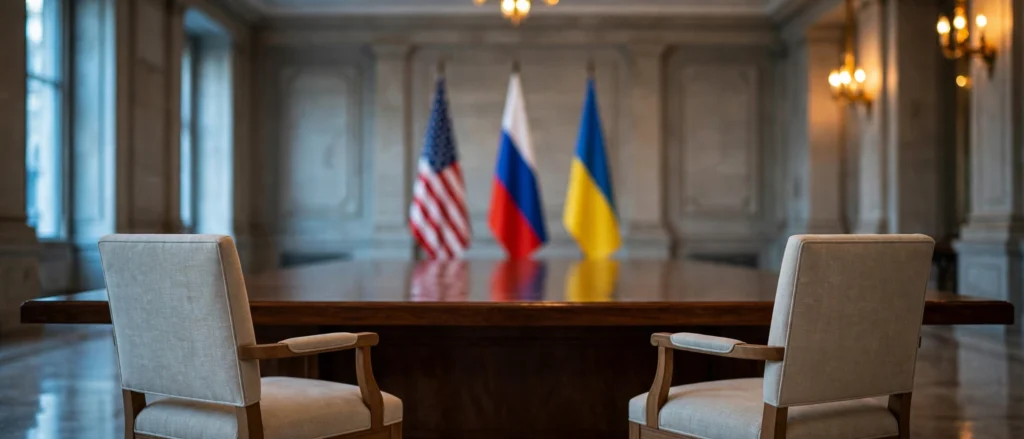
Ukraine War News: Trump Says Putin-Zelenskyy Meeting Soon
President Donald Trump said on Wednesday that a meeting between Russian President Vladimir Putin and Ukrainian President Volodymyr Zelenskyy would be set up very soon, the latest ukraine war news from a White House trying to restart peace talks that have been stalled for months. Speaking to reporters on the tarmac at Joint Base Andrews as he returned from a campaign trip to Texas, Trump said progress toward ending the war was gathering pace, and he raised the prospect of the two wartime leaders sitting down together for the first time since the fighting began. “There’ll be a meeting set up very soon and I think a lot of progress could be made,” Trump told reporters. Asked who the meeting would involve, he answered directly: “With President Putin and President Zelenskyy.”
The remarks, delivered in the final days before the November 3 midterm elections in the United States, landed as the most concrete signal in months that the administration believes a leaders’ meeting is within reach. But Trump named no date and no venue, and neither Kyiv nor Moscow has publicly confirmed that the two leaders have agreed to meet. The war, now in its fifth year, has already outlasted the timetable Trump set for himself when he took office.
Ukraine War News: What Trump Said at Andrews
The announcement came in the most informal of settings, a few shouted questions on an airport tarmac. Trump was returning to Washington from Texas, where he had been campaigning, when reporters asked him about the state of the diplomacy around Ukraine. He did not read from a prepared statement, and he offered no written plan. What he offered instead was a short burst of optimism, delivered in the plain language he has used throughout his second term to describe the war. “We’re making a lot of progress with Russia-Ukraine,” he said, a line he repeated in slightly different words as the questions continued. “I think we are making great progress with Russia and Ukraine. A meeting will be arranged soon.”
Trump went further than a negotiators’ meeting. Asked at what level the meeting would be held, he expressed the hope that it would take place at the level of heads of state, with Putin and Zelenskyy in the room together. That is the part of the announcement that matters most, because a face-to-face meeting between the two presidents is precisely what has not happened at any point since the invasion began. What Trump did not say is just as important: he gave no date and no venue, and neither Kyiv nor Moscow has publicly confirmed that the two leaders have agreed to meet at all.
White House News: The November Trilateral Plan
The leaders’ meeting Trump described sits at the end of a longer sequence, and the earlier steps in that sequence are further along. Zelenskyy said on Sunday that a trilateral meeting between Kyiv, Washington and Moscow would take place in November, aimed at restarting peace talks that have been stalled. The Kremlin had previously said that a meeting between the three countries was planned to take place in the United Arab Emirates in November. Last week, both Russia and Ukraine confirmed that they would resume trilateral talks with the United States, the first time in a long while that both sides have agreed on the same next step at the same time.
Zelenskyy has said the trilateral talks are planned for the first half of November, and that he hopes a meeting between him and Putin will follow them. That order of events matters. The negotiators meet first, to test whether there is anything to talk about, and the leaders meet after, if the negotiators find enough common ground to justify it. It is a slower path than the one Trump sketched on the tarmac, but it is also the path that both Kyiv and Moscow have actually signed up to, at least in public.
Trump Administration: A Year of Stalled Talks
The announcement has to be measured against the record that came before it, and that record is not encouraging. Trump came to power in January 2025 promising to end the war in 24 hours. More than a year of American-led talks has failed to produce a breakthrough, and tens of thousands of people have been killed in the meantime. The war that began when Putin ordered the February 2022 invasion of Ukraine has now run through nearly five calendar years, and the diplomacy around it has cycled through the same pattern again and again: a burst of optimism from Washington, a round of talks that produces little, and a return to the battlefield.
Part of the problem is that the two sides have never agreed on what a meeting would even be for. Putin has consistently rejected face-to-face talks with Zelenskyy, and he has insisted that Moscow intends to seize the rest of eastern Ukraine. That is not a negotiating position that leaves much room for a handshake photograph. It is a statement of war aims, and it has not changed in any meaningful way since the invasion began. A meeting between the two presidents would therefore have to bridge a gap that has not narrowed in four years, and neither side has given any public sign that it is ready to narrow it now.
NATO News: The Obstacles to a Leaders’ Meeting
The conditions Putin has attached to any settlement are the clearest sign of how far apart the parties remain. Putin has said Russia is ready to resume American-mediated talks next month, but he has called for security guarantees for both countries and an overall security framework for Europe. That language sounds cooperative, and it may be intended to sound that way. But a security framework for Europe is a very large demand, and it is the kind of demand that takes years to negotiate even when both sides want an agreement. It is not the kind of demand that gets settled in a single meeting of presidents, and it is not clear that Washington and Kyiv read it the same way Moscow does.
Midterm Elections 2026: The Timing of the Announcement
The timing of the announcement is impossible to ignore. The remarks come just six days before the November 3 midterm elections in the United States, which will determine control of Congress. Trump made them on his way back from a campaign trip to Texas, in the middle of a final week of rallies and appearances aimed at turning out his supporters. A promise of progress on a war he vowed to end in a day is, among other things, a campaign message, and it arrives at the moment when campaign messages matter most.
That does not mean the announcement is only a campaign message. Presidents can say true things in election weeks, and the trilateral talks planned for November are real, confirmed by both sides, and scheduled to begin within days. But the calendar does mean the claim should be read with the election in mind. Trump promised to end this war in 24 hours, and more than a year later it is still going.
What Happens Next: November Will Tell
The next few weeks will show whether Trump’s announcement was the start of something or another false dawn. The first test is the trilateral meeting itself, planned for the first half of November, with the Kremlin pointing to the United Arab Emirates as the venue. If the negotiators meet, and if they agree to meet again, that will be the first real evidence that the process Trump described is actually moving. If they do not meet, or if they meet and part without agreement, the announcement will join the long list of promises that the war has already swallowed.
The second test is whether Putin drops his refusal to meet Zelenskyy face to face. Nothing in the Russian statements so far suggests that he has, and the Kremlin’s own language about the talks has been careful and limited. A leaders’ meeting needs the consent of both leaders, and so far only one of them has said anything about it in public. Zelenskyy has said he hopes a meeting with Putin will follow the trilateral talks, which is an expression of hope, not a confirmation. Putin has said nothing about meeting Zelenskyy at all. Until he does, the meeting Trump described exists only in the president’s own words.
What is certain is that the war will not wait for the diplomacy to catch up. Tens of thousands have already been killed, and the fighting continues while the talking is arranged. A meeting set up very soon would be the most significant diplomatic development of the war in years, if it happens. But the words that matter now are not the ones spoken on a tarmac at Joint Base Andrews. They are the ones that will be spoken in a negotiating room in November, by people who have spent years failing to agree, and who will have to find a way to agree now. November will tell whether they can.
Source: Bloomberg