Trump Netanyahu News: Trump Claims Credit for Bibi Gains
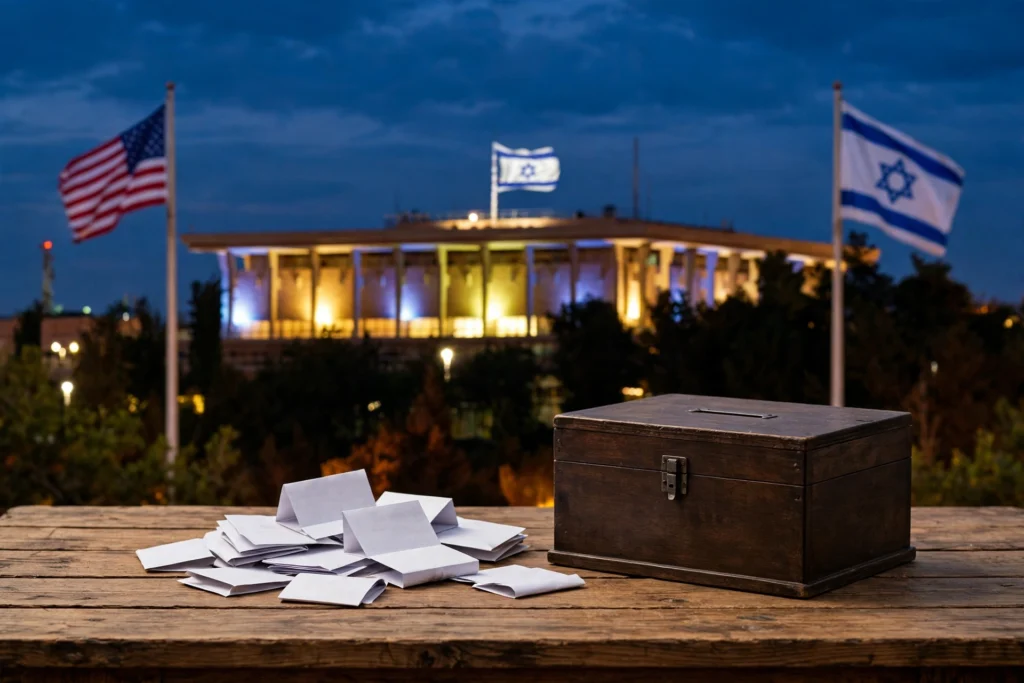
President Donald Trump has claimed credit for Prime Minister Benjamin Netanyahu’s stronger-than-expected showing in Israel’s parliamentary election, saying his endorsement turned the tide for the Israeli leader in Tuesday’s vote. The latest trump netanyahu news came in a social media post and in remarks to reporters after a campaign rally in Texas, as partial results showed Netanyahu’s right-wing bloc running ahead of the pre-election polls and the race for a governing majority still too close to call. With just over half of the ballots counted, the pro-Netanyahu bloc held 55 seats and the opposition 50, with the Arab parties on 15, and neither side within reach of the 61 seats needed to form a government in the 120-seat Knesset.
Trump’s claim landed in the middle of a count that is still moving, with votes cast in double envelopes, including those of soldiers, counted later. Early polls ahead of the vote had indicated that Netanyahu’s governing coalition was heading toward potential defeat against a unified opposition alliance led by former military chief Gadi Eisenkot. Instead, Netanyahu’s Likud party and its allied religious factions pulled ahead overnight, putting the prime minister in a far stronger position than the preliminary projections had suggested.
Trump Netanyahu News: The Truth Social Post
Trump made his claim first on Truth Social, in a post that quoted political commentator Irving C. Schwartz. “When President Trump endorsed Bibi Netanyahu, the whole tide turned, and now, rather than a decisive defeat for a great prime minister, it looks like a big come-from-behind stalemate, or even a WIN for Netanyahu,” the post read. “It all took place AFTER the endorsement by President Trump, who only wants what is good for the Middle East, Israel, and the United States of America!”
The post itself is a curious document, and the Times of Israel noted the oddity in its own report. The entire post is written as a quote, and it is unclear whether Trump is quoting an analyst he heard on cable television or speaking about himself in the third person. The distinction matters, because the claim reads very differently depending on who is making it. If Schwartz said it, then Trump is passing on someone else’s praise. If Trump wrote it about himself, then it is the president of the United States claiming, in his own voice, that his endorsement decided an election in another country. Either way, the message Trump chose to amplify is the same: the endorsement went out, the tide turned, and the credit belongs to him.
Election Results: The Count So Far
The numbers behind Trump’s claim are still taking shape, and they deserve to be read carefully. With 53.7 percent of ballot boxes counted as of 7:27 in the morning, partial results published by the Central Elections Committee gave the pro-Netanyahu bloc 55 seats and the anti-Netanyahu bloc 50. A later update, with 55.4 percent of the vote counted, showed the same shape: the Netanyahu-led bloc on 55 seats, the opposition bloc led by Eisenkot’s Yashar party on 49, and the two Arab coalitions on 12 and 4 seats. The results are partial and will change as counting continues, and the final numbers could look different from the ones published so far. But the pattern is consistent across every update: Netanyahu’s bloc is ahead of where the polls said it would be, and the opposition is behind.
Trump’s own account of the results, given to reporters as he returned from Texas, was characteristically confident. “I hear he did very well. It’s pretty close, very good,” he said. “When the endorsement came out, it helped him a lot.” He added that Netanyahu was probably winning or tied, and that he had heard the Israeli leader was doing pretty well. “It’s still a little early. But I hear in Israel, I mean, top people are saying, ‘Wow, he did much better.’ Something like a tie, maybe even a win. We’ll see what happens.” The caution in the last sentence is worth noting. Trump is claiming credit for a result that has not yet been decided, and he knows it. The count is not finished, the majority is not secured, and the word “win” is still doing a lot of work in his account of the night.
White House News: What Trump Said in Texas
Trump spoke about the Israeli election twice on Wednesday, once on social media and once to reporters, and the two versions of the story are slightly different in tone. The social media post is triumphant, describing a decisive defeat turned into a comeback and a win. The remarks to reporters are more measured, full of qualifiers and second-hand reports. “From exit polls, I’m hearing [Netanyahu] was doing very well. I think when the endorsement went out, it had helped him a lot,” Trump said after attending a rally in Texas. He was, by his own account, reporting what he had heard, not what he knew. Asked if he had spoken to Netanyahu since the results started coming in, Trump said that he had not.
Election Polls: From Predicted Defeat to a Dead Heat
To understand why Netanyahu’s showing counts as a surprise, it helps to remember what the polls were saying before the vote. The final surveys put Eisenkot’s Yashar narrowly ahead of Likud, with the last polls before a polling blackout that took effect on Friday projecting Eisenkot’s party winning between 22 and 24 seats and Likud on between 21 and 23. The latest Channel 12 poll put Eisenkot first with 23 seats against 21 for Likud, though on the pro-Netanyahu Channel 14, Likud was projected to take 30 seats and Yashar about 20. In head-to-head matchups asking voters who is better suited to be prime minister, Eisenkot had led Netanyahu by a steady margin in recent polling.
The bloc arithmetic was even more discouraging for the prime minister. Most polls put Netanyahu’s bloc, made up of Likud, the two far-right parties and the two ultra-Orthodox parties, at between 49 and 55 seats, short of a majority. The opposition, led by Eisenkot but deeply fragmented, was not in a much better position, and neither Bennett nor Liberman had endorsed Eisenkot for the premiership. Even a clear win for Yashar as the largest party would not by itself have delivered the premiership, because the question that matters in Israeli politics is not who wins the most seats but who can put together 61.
Midterm Elections 2026: The Endorsement as Campaign Argument
The endorsement that Trump is now claiming credit for was, from the start, a campaign argument as much as a diplomatic gesture. Netanyahu spent the final days of the campaign leaning on his alliance with the American president, telling voters that his relationship with Trump was the guarantee of Israel’s security and the best defense against the regional threats from Iran. It was a message aimed at voters who see the American alliance as the foundation of Israeli security, and who trust Trump more than they trust any Israeli politician. For those voters, an endorsement from Trump was not foreign interference. It was a recommendation from a friend.
Trump’s own politics are part of the same story. The remarks about Israel came on the same trip, and in the same breath, as his comments on Ukraine and Brazil, and they were delivered six days before the November 3 midterm elections in the United States. A president who is campaigning at home is also campaigning abroad, in the sense that every foreign success he can claim is a domestic argument as well. An endorsement that turned an election in Israel is, for American voters, evidence that their president matters in the world. Whether the endorsement actually turned the election is a question for Israeli analysts. Whether it helps Trump at home is a question for American voters, and they will answer it on November 3.
What Happens Next: The 61-Seat Problem
The hardest part of the Israeli election is still to come, and it has nothing to do with Trump. Neither bloc has 61 seats, and neither is likely to get there without a long and difficult negotiation. Netanyahu has already begun to frame the outcome in his own terms, saying the right-wing bloc had a significant, decisive majority among Jewish voters and those who support a Jewish state, and calling for unity to form a strong national right-wing government. That is the language of a man who believes he has won, even if the arithmetic says otherwise. But the arithmetic is stubborn, and the gap between 55 seats and 61 is the space in which Israeli governments are made and unmade.
Trump’s claim will be part of that bargaining, whether the negotiators want it or not. A prime minister who owes his survival, in his own telling or in Trump’s, to an American endorsement is a prime minister whose freedom of action is constrained by that debt. And a president who has claimed credit for an election in another country has set a precedent that will be remembered the next time an election is held, in Israel or anywhere else.
Source: The Jerusalem Post