Trump Administration Grants Florida Isaias Disaster Aid
The Trump administration has granted a major disaster declaration for Florida, unlocking federal money to help communities across the Panhandle recover from Hurricane Isaias. The declaration approves public assistance for 15 counties, allowing local governments to seek reimbursement for emergency work and for the repair or replacement of public facilities damaged by the storm, and it opens the door for certain nonprofit organizations to apply for federal help as well. The decision, reported by the Pensacola News Journal on Tuesday, is the biggest step yet in the federal response to a storm that killed six people in Florida and generated more than 55,000 insurance claims.
The counties designated for public assistance include Escambia and Santa Rosa, which suffered the most severe damage from the storm, along with Bay, Calhoun, Franklin, Gadsden, Gulf, Holmes, Jackson, Jefferson, Liberty, Okaloosa, Wakulla, Walton and Washington counties. The declaration can also allow nonprofits such as hospitals, shelters, food banks, schools and churches to apply for federal assistance.
The announcement came with an important caveat. The News Journal reported that it was unable to independently verify the approval or locate the declaration on the Federal Emergency Management Agency’s website on Tuesday evening, and it described the story as developing. The declaration was first publicized through social media posts from state and local officials, who shared a fact sheet summarizing its terms. Pensacola Mayor D.C. Reeves posted a link to the fact sheet, thanking the president and Florida’s congressional delegation and Governor Ron DeSantis, and Congressman Jimmy Patronis and state Representative Michelle Salzman also posted links to it.
Trump Administration: What the Declaration Unlocks
The core of the declaration is public assistance, and the distinction matters. Under the federal disaster system, there are two kinds of help a presidential declaration can unlock, and they serve different people. Public assistance reimburses governments and certain nonprofits for the cost of emergency work and for repairing or replacing facilities damaged by a disaster. Individual assistance, by contrast, provides aid directly to residents and households. The declaration approved on Tuesday covers public assistance. Individual assistance is still under review, and so is hazard mitigation, the program that funds work to prevent or reduce long-term risk from future hazards.
For each of the 15 counties, the declaration means that the money already spent on emergency protective measures, debris removal, and repairs to roads, bridges, and public buildings can be submitted for federal reimbursement, with the federal government typically covering the large majority of eligible costs. The declaration also matters for the nonprofits that hold Panhandle communities together. Hospitals, shelters, food banks, schools and churches can apply for federal assistance under the public assistance program, and in a region where many of those institutions are small and operate on thin margins, that eligibility can be the difference between reopening and closing.
The path to the declaration ran through the governor’s office. Governor DeSantis announced late last week that the state’s Division of Emergency Management had submitted a request to the president for a major disaster declaration, seeking roughly 237 million dollars in federal resources to support affected communities across northwest Florida. The request sought public assistance for 15 counties and individual assistance for eligible residents in eight designated counties, and the approval of the public assistance portion is the first half of that request to be granted. The wait was longer than the five days it took after Hurricane Sally in 2020.
Hurricane Tracker: The Damage Across 15 Counties
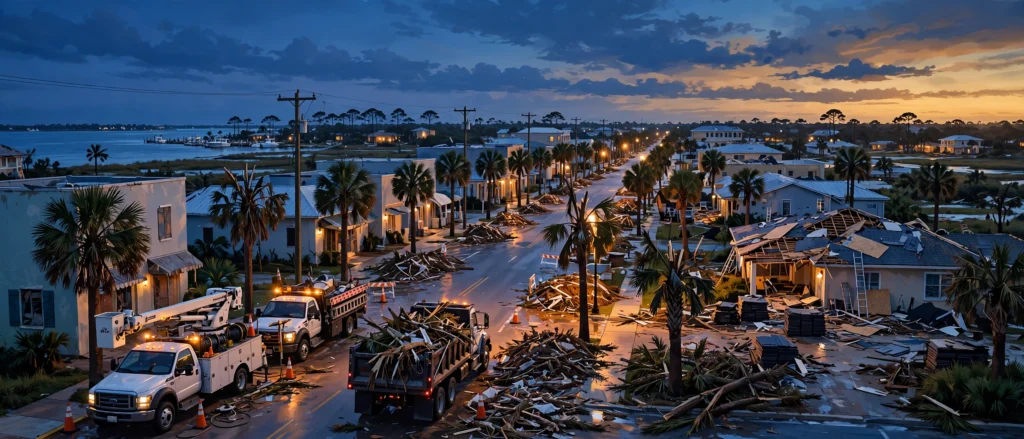
The damage the declaration is meant to address is extensive, and the numbers coming out of the Panhandle explain why counties pressed so hard for federal help. Escambia County released a preliminary estimate of about 64 million dollars in public damage and recovery costs on Tuesday, and debris removal accounts for the overwhelming majority of it. The county’s breakdown puts debris removal at 54.87 million dollars, public buildings and equipment at 5.2 million, parks at 1.5 million, emergency protective measures at 1.5 million, and roads and bridges at 1 million.
Santa Rosa County, which suffered alongside Escambia, estimates it has about 1.7 million cubic yards of vegetative debris to clear, and WEAR-TV reported that Escambia County expects its cleanup to take up to four months, with multiple rounds of collection. Okaloosa and Santa Rosa counties are still compiling their numbers, and county officials are asking residents to report property damage to their county property appraiser’s office, since those figures feed the state’s case for federal aid.
The human cost of the storm is measured in lives and livelihoods as well as dollars. Six deaths in Florida have been linked to the hurricane, and more than 55,000 insurance claims have been filed across the state, with the heaviest concentration in Santa Rosa and Escambia counties. The weather news today from the Panhandle is no longer about the storm itself, which has passed, but about the long work of clearing, repairing, and rebuilding that follows it. The state’s own response began while the storm was still a threat. On October 9, the president approved emergency declarations for Florida, Alabama and Georgia, covering emergency protective measures in 27 Florida counties at a 75 percent federal cost share. The emergency declaration was a first step. The major disaster declaration is the second, and it is the one that pays for the recovery rather than the response.
Donald Trump Latest News: What Is Still Under Review
The most important thing the declaration does not do is provide individual assistance, and that gap is the focus of the next phase of the federal response. Individual assistance provides aid directly to residents and households, and it is the help that families waiting on roof repairs and temporary housing need most. The fact sheet notes that individual assistance is still under review, and the governor has said the state is still assembling the data it needs to make its case. The president’s emergency declaration in October was not a major disaster declaration and does not automatically provide money to individual households, and the same is true of the public assistance portion approved this week.
The governor addressed the question directly on Tuesday, saying that Florida will most likely qualify for individual assistance and that the state is waiting on some of the counties to give it the data it needs to submit its case. A joint preliminary damage assessment team from the Federal Emergency Management Agency is in the region, supported by Florida State Guard drone and cut-and-toss crews, and its findings will feed the decision on whether individual assistance is approved and for which counties. The state has asked for individual assistance for residents in eight designated counties, and the outcome of that request will determine how much direct help reaches households.
The same careful process applies to hazard mitigation, the third component of the federal response, which also remains under review. Hazard mitigation funds work that prevents or reduces long-term risk to life and property from natural hazards, and it is the part of the system that looks beyond the current storm to the next one. The News Journal reported that it could not locate the declaration on the agency’s website on Tuesday evening, and the story was published as a developing one. The formal paperwork has not yet appeared in the places where disaster declarations are usually published, and the details will become clearer as the federal government posts them.
How Isaias Compares to Milton, Helene and Michael
The scale of Hurricane Isaias becomes clearer when it is set against the other storms that have struck Florida in recent years. The claims from Isaias have topped 580 million dollars, according to estimates, with most of the losses attributed to wind damage, and just over 3,500 claims have been closed with some payment while nearly 8,500 have been closed without any payment. The numbers are still preliminary, with insurers continuing to receive claims and evaluate the financial impact.
Hurricane Milton, which made landfall near Siesta Key in Sarasota County in October 2024, generated approximately 5.6 billion dollars in insured losses and 385,146 claims, according to state insurance data. Hurricane Helene, which struck Florida’s Big Bend region in September 2024, produced approximately 2.58 billion dollars in insured losses from 155,182 claims. Hurricane Michael, which made landfall near Mexico Beach in the Florida Panhandle on October 10, 2018, as a Category 5 storm with maximum sustained winds of 160 miles per hour, generated approximately 9.1 billion dollars in insured losses in Florida, with nearly 159,000 claims filed.
What Happens Next: Individual Assistance and the Recovery Timeline
The next steps in the recovery will unfold over the coming days and weeks, and the first one is the decision on individual assistance. The governor has said the state will most likely qualify, and the federal assessment team now working in the region will determine which counties are included and what kinds of help residents can apply for. Residents in the affected counties should watch for announcements from the state Division of Emergency Management and the Federal Emergency Management Agency, and they should check the disaster assistance website for updates on aid for individual households.
The cleanup will take months regardless of what the federal government decides. Escambia County has said its debris removal alone will take up to four months, with multiple rounds of collection, and Santa Rosa County is still working through 1.7 million cubic yards of vegetative debris. County property appraisers are still collecting damage reports from residents, and those reports will shape both the state’s case for individual assistance and the final tally of the storm’s cost.
The declaration is a milestone, not an ending. It unlocks the money that local governments need to pay for the work they have already done and the work still to come, and it signals that the federal government has accepted the scale of the disaster. But the help that reaches individual households is still pending, the cleanup will stretch into next year, and the full cost of the storm is still being counted. For the 15 counties named in the declaration, the recovery has begun.
Source: Pensacola News Journal