
What Are Stablecoins and Why Do They Matter in Crypto?
Author: Malik Mohsin Saleem Khan
Introduction: Understanding Stablecoins in the Crypto Economy
Cryptocurrency is often associated with dramatic price movements.
Bitcoin can experience substantial changes in value over relatively short periods. Other digital assets can be even more volatile. While this volatility attracts traders and investors, it can make cryptocurrencies difficult to use as a day-to-day medium of exchange or stable unit of account.
This is where stablecoins enter the picture.
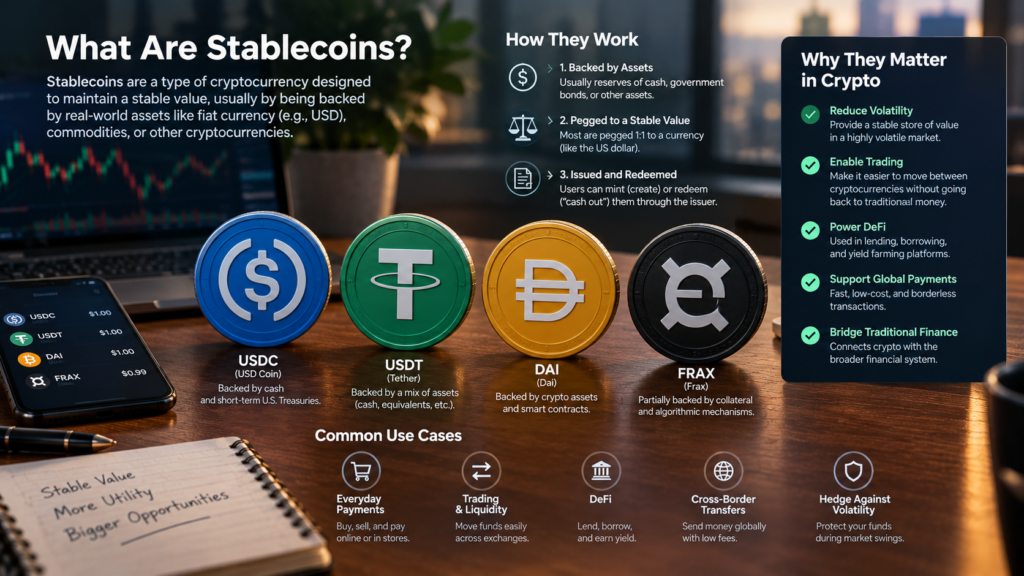
Stablecoins are cryptocurrencies designed to maintain a relatively stable value, often by referencing an asset such as the U.S. dollar.
Instead of trying to make every cryptocurrency behave like traditional money, stablecoins provide a bridge between the volatility of crypto markets and the relative price stability of traditional currencies or other reference assets.
A stablecoin might be designed to maintain a value close to:
1 token ≈ 1 U.S. dollar
This doesn’t mean the token is magically guaranteed to remain at exactly $1 at all times. Different stablecoins use different mechanisms, reserves, collateral structures, and governance systems to pursue price stability.
Stablecoins have become important throughout the cryptocurrency ecosystem because they can be used for:
Trading
Payments
Transfers
DeFi
Liquidity
Settlement
Hedging
Moving value between platforms
Blockchain-based financial applications
In this guide, we’ll explore what stablecoins are, how stablecoins work, the different types of stablecoins, why they matter, their advantages and risks, and how they fit into the future of digital finance.
What Is a Stablecoin?
A stablecoin is a cryptocurrency designed to maintain a relatively stable value relative to a reference asset or value.
The most common reference is the U.S. dollar.
For example, a stablecoin may be designed around a target value of:
1 token ≈ $1
Unlike Bitcoin, whose market price is determined primarily by supply, demand, and market conditions, stablecoins use additional mechanisms intended to reduce price volatility.
These mechanisms vary significantly.
Some stablecoins are backed by reserves of traditional assets.
Others are backed by cryptocurrency collateral.
Some have used algorithmic mechanisms intended to manage supply and demand.
Therefore, the word stablecoin describes a broad category rather than one single technological design.
Why Were Stablecoins Created?
The original vision of cryptocurrency emphasized decentralized digital money.
However, cryptocurrencies such as Bitcoin have historically experienced significant price volatility.
Imagine a merchant selling a product for:
$100 worth of Bitcoin
If Bitcoin’s price changes substantially between the moment of sale and the moment the merchant converts the payment, the value received can differ significantly.
Stablecoins attempt to address part of this problem.
If a stablecoin is designed to track the U.S. dollar, a merchant may instead price an item at:
100 stablecoin units
with the expectation that the value will remain close to $100.
Stablecoins therefore provide a form of price-stable digital representation that can move across blockchain networks.
How Do Stablecoins Work?
There isn’t one universal method.
Stablecoins generally fall into several broad categories:
Fiat-backed stablecoins
Crypto-backed stablecoins
Commodity-backed stablecoins
Algorithmic or uncollateralized stablecoins
Hybrid models
The key question is:
What mechanism is supposed to support the stablecoin’s value?
Understanding that mechanism is essential because two stablecoins with similar names or prices can have dramatically different risk profiles.
Fiat-Backed Stablecoins
Fiat-backed stablecoins are generally designed to maintain their value through reserves involving traditional assets.
A common model is a stablecoin designed to track the U.S. dollar.
The issuer may hold assets intended to support outstanding tokens.
The concept can be simplified as:
Traditional assets → reserves → stablecoin tokens
When new tokens are issued, the issuer may increase its reserve assets.
When tokens are redeemed, tokens may be removed from circulation according to the issuer’s redemption process.
The exact reserve composition depends on the specific stablecoin.
Examples of Fiat-Backed Stablecoins
Some of the best-known dollar-referenced stablecoins include:
Tether’s USDT
Circle’s USDC
Other dollar-denominated stablecoins
The structures and reserve disclosures of these projects can differ significantly.
Therefore, users should not assume that all dollar stablecoins operate identically.
When evaluating one, it is useful to research:
Reserve composition
Redemption mechanisms
Issuer structure
Transparency
Attestation or audit information
Supported blockchains
Regulatory framework
Counterparty risks
What Is USDT?
USDT, commonly known as Tether, is one of the most widely used stablecoins in the cryptocurrency market.
It is designed to track the value of the U.S. dollar.
USDT exists across multiple blockchain networks, meaning the same broad stablecoin brand can be represented through different blockchain implementations.
This is important because users need to verify the network when transferring USDT.
For example, an address and transaction format associated with one network may not be identical to another.
What Is USDC?
USDC is another widely used dollar-referenced stablecoin.
It is issued by Circle and has been used extensively across cryptocurrency trading and decentralized finance.
Like other stablecoins, its design involves mechanisms intended to maintain its value relative to the U.S. dollar.
USDC is available across multiple blockchain networks.
Again, users should verify the exact network before sending or receiving tokens.
Crypto-Backed Stablecoins
A crypto-backed stablecoin uses cryptocurrency as collateral.
This creates an interesting challenge.
Cryptocurrencies themselves can be volatile.
If a stablecoin is backed by volatile crypto assets, the system may need to hold more collateral than the value of the stablecoins it issues.
This is called overcollateralization.
For example, a hypothetical protocol might require:
$150 of crypto collateral → $100 of stablecoin
The additional collateral provides a buffer against price declines.
If the collateral falls substantially, the protocol may liquidate some collateral according to its rules.
Why Overcollateralization Matters
Suppose a stablecoin issues:
$1 million worth of tokens
and holds exactly:
$1 million worth of volatile cryptocurrency
A relatively small decline in the collateral could create a shortfall.
Instead, a protocol could hold:
$1.5 million of collateral
against:
$1 million of stablecoins
Now there is a larger buffer.
The exact collateral ratio depends on the protocol.
Overcollateralization can improve resilience, but it also creates capital inefficiency because more assets must be locked than the value of the stablecoins issued.
Commodity-Backed Stablecoins
Some digital tokens are designed to track commodities rather than fiat currencies.
Gold is a common example.
A token might attempt to represent a specific quantity or value of gold.
The concept can be summarized as:
Physical commodity → custody/reserves → digital token
This can provide blockchain-based exposure to an asset that traditionally exists outside the blockchain.
However, users need to understand the custody arrangements and redemption rights behind the token.
Algorithmic Stablecoins
Algorithmic stablecoins attempt to maintain price stability primarily through software-controlled supply mechanisms rather than straightforward reserve backing.
The protocol may increase or decrease token supply according to predefined rules.
The theoretical objective is:
Price rises above target → increase supply
Price falls below target → reduce supply or create incentives for demand
However, maintaining a stable value without sufficient collateral can be extremely difficult.
Historical failures of algorithmic stablecoin designs have demonstrated that market confidence can disappear faster than an algorithm can restore it.
Therefore, users should carefully examine the mechanisms supporting any stablecoin rather than assuming that the word “stable” means guaranteed stability.
How Stablecoins Maintain Their Peg
The term peg refers to the target relationship between the stablecoin and its reference asset.
For a dollar stablecoin:
Target = $1
A stablecoin may trade slightly above or below that level.
For example:
$0.998
or
$1.002
Small fluctuations can occur because of market demand, liquidity, transaction costs, and redemption conditions.
The mechanism used to bring the price back toward the target depends on the stablecoin.
What Happens When a Stablecoin Trades Above $1?
Suppose a dollar stablecoin is trading at:
$1.02
If the system allows efficient issuance and redemption, market participants may have an incentive to create or obtain tokens and sell them at the higher market price.
This additional supply can push the market price toward the target.
This is a simplified example.
Real-world stablecoin markets involve:
Liquidity
Arbitrage
Redemption rules
Market makers
Exchange infrastructure
Transaction costs
What Happens When a Stablecoin Trades Below $1?
Now imagine the stablecoin trades at:
$0.98
If holders can redeem tokens for approximately $1 under the issuer’s rules, an arbitrage opportunity may theoretically exist.
A market participant could acquire the discounted token and redeem it at the target value.
That can reduce available supply and potentially move the market price back toward $1.
However, this mechanism only works effectively when market participants trust the redemption process and the underlying system is functioning as expected.
Why Stablecoins Can Depeg
A depeg occurs when a stablecoin moves significantly away from its intended reference value.
Possible causes include:
Loss of market confidence
Reserve concerns
Liquidity shortages
Banking problems
Smart-contract failures
Collateral price crashes
Market panic
Redemption restrictions
Technical problems
For example, a dollar stablecoin might temporarily trade below $1 during a period of intense selling.
The severity and duration of a depeg can vary considerably.
Why Stablecoins Matter in Cryptocurrency Trading
Stablecoins are deeply integrated into crypto markets.
One major use is as a trading quote asset.
Instead of trading:
BTC → USD
many crypto exchanges offer:
BTC → USDT
or:
BTC → USDC
This allows traders to move between volatile crypto assets and a dollar-referenced digital asset without necessarily leaving the blockchain-based ecosystem.
Stablecoins can therefore function as a kind of digital cash layer for crypto markets.
Stablecoins and Crypto Liquidity
Liquidity is essential to financial markets.
A market with strong liquidity generally allows participants to buy and sell assets more efficiently.
Stablecoins contribute to liquidity because they can serve as the other side of trading pairs.
For example:
BTC/USDT
ETH/USDC
SOL/USDT
This makes it easier for users to move between volatile digital assets and dollar-referenced assets.
Stablecoins in Decentralized Finance
Stablecoins are also central to DeFi, or decentralized finance.
DeFi applications can use stablecoins for:
Lending
Borrowing
Trading
Liquidity pools
Payments
Collateral
Yield-generating strategies
Consider a decentralized lending protocol.
A user may deposit a stablecoin into the protocol.
Another user may borrow that stablecoin by providing sufficient collateral.
The transactions can be governed by smart contracts rather than a traditional bank.
Stablecoins make these applications more practical because many users prefer financial products denominated in a relatively stable unit.
Stablecoins as Digital Dollars
One of the most significant roles of dollar stablecoins is their ability to represent dollar-denominated value on blockchain networks.
Traditional dollars exist primarily inside banking and financial infrastructure.
Stablecoins can move through blockchain networks.
This means users can potentially transfer dollar-referenced digital assets:
Across borders
Between exchanges
Between wallets
Into DeFi protocols
Between applications
This can create a bridge between traditional currency concepts and blockchain infrastructure.
Stablecoins for International Transfers
Cross-border payments can involve:
Banks
Correspondent banking relationships
Currency conversion
Settlement delays
Transaction fees
Compliance requirements
Stablecoins can provide an alternative blockchain-based settlement mechanism.
For example, a user could send a dollar-referenced stablecoin to another blockchain address without using a traditional international bank transfer.
However, the real-world usability depends on:
Local regulations
Exchange availability
Wallet access
Liquidity
On/off-ramp infrastructure
Network fees
Stablecoins don’t automatically eliminate every problem associated with international payments.
Stablecoins and Remittances
Remittances are payments sent by people to recipients in another country.
Stablecoins can potentially provide another method for transferring value internationally.
A simplified model could look like:
Sender → stablecoin → blockchain → recipient → local currency
The recipient may eventually convert the stablecoin into their local currency.
This creates an important distinction:
Stablecoins can simplify the digital transfer of value, but converting them into local fiat currency may still require an exchange, payment provider, or other intermediary.
Stablecoins and Merchant Payments
Businesses may potentially accept stablecoins as payment.
The appeal is relatively straightforward.
A merchant may prefer receiving a digital asset designed to maintain a relatively stable value rather than an asset with large price swings.
Potential benefits include:
Blockchain settlement
Global accessibility
Programmable payments
Potentially fast transfers
Integration with digital applications
But merchants also need to consider:
Regulatory requirements
Accounting
Taxes
Conversion costs
Network fees
Customer demand
Stablecoin counterparty risk
Stablecoins and Savings
Stablecoins are sometimes marketed or used as a way to hold dollar-denominated value within crypto ecosystems.
However, users should distinguish between:
Holding a stablecoin
and
Earning a return on a stablecoin
Simply holding a stablecoin does not necessarily generate interest.
If a platform promises yield, that return may come from lending, liquidity provision, trading strategies, or other mechanisms.
Those activities introduce additional risks.
A high advertised yield should never automatically be interpreted as a guaranteed return.
Stablecoins and Lending
Stablecoins are widely used in crypto lending markets.
A user may:
Deposit collateral.
Borrow stablecoins.
Use the stablecoins elsewhere.
Repay the loan.
Withdraw collateral.
The collateral may be cryptocurrency.
Because crypto prices can change rapidly, lending protocols often require borrowers to maintain sufficient collateral.
If collateral falls below required levels, liquidation mechanisms may activate.
Stablecoins and Liquidity Pools
Decentralized exchanges frequently use liquidity pools.
A pool might contain:
ETH + USDC
Liquidity providers deposit both assets according to the pool’s rules.
Traders then exchange assets against the pool.
Liquidity providers may receive fees or other incentives.
However, providing liquidity carries risks such as:
Impermanent loss
Smart-contract risk
Token price changes
Stablecoin depegging
Protocol exploits
Stablecoins can reduce one side of the price volatility equation, but they don’t eliminate all liquidity-provider risks.
What Are the Advantages of Stablecoins?
Stablecoins offer several potential benefits.
1. Lower Volatility
They are designed to maintain a relatively stable value.
2. Blockchain-Based Transfers
They can move through blockchain networks.
3. Crypto Market Liquidity
They provide commonly used quote assets for trading.
4. DeFi Compatibility
They can be integrated into decentralized applications.
5. Global Accessibility
Depending on local laws and infrastructure, users can potentially access blockchain-based dollar representations from many locations.
6. Programmability
Stablecoins can interact with smart contracts.
This allows developers to build automated financial applications around them.
What Are the Risks of Stablecoins?
The word stablecoin should never be interpreted as “risk-free.”
Stablecoins can have several types of risk.
Depeg risk
The token may move away from its intended price.
Reserve risk
Users may have concerns about the quality, liquidity, or availability of assets backing a stablecoin.
Issuer risk
A centralized stablecoin can involve dependence on its issuing organization.
Regulatory risk
Governments and regulators may impose rules affecting issuance, use, or redemption.
Smart-contract risk
Blockchain-based stablecoins can depend on smart contracts that may contain vulnerabilities.
Liquidity risk
A stablecoin may become harder to sell at its target price during stressed market conditions.
Counterparty risk
Users may depend on banks, custodians, issuers, or other external organizations.
Centralized vs. Decentralized Stablecoins
Stablecoins can also be categorized according to how centralized their control and infrastructure are.
Centralized stablecoins
These are generally issued and managed by an identifiable organization.
Advantages can include:
Clear issuer
Established redemption process
Reserve management
Institutional infrastructure
Potential concerns include:
Centralized control
Regulatory restrictions
Counterparty risk
Dependence on issuer operations
Decentralized stablecoins
These may use smart contracts and decentralized collateral systems.
Potential benefits include:
Greater on-chain transparency
Reduced dependence on a single issuer
Programmable collateral systems
Potential risks include:
Smart-contract vulnerabilities
Governance risk
Complex liquidation systems
Collateral volatility
Stablecoins vs. Bitcoin
Stablecoins and Bitcoin serve different purposes.
| Feature | Stablecoins | Bitcoin |
|---|---|---|
| Main objective | Relative price stability | Decentralized digital monetary asset |
| Price volatility | Designed to be lower | Can be substantial |
| Supply model | Depends on stablecoin | Protocol-defined issuance |
| Typical use | Trading, payments, DeFi | Payments, savings, investment, settlement |
| Centralization | Varies | Network is decentralized |
| Blockchain | Depends on stablecoin | Bitcoin blockchain |
This doesn’t mean one is universally better than the other.
They perform different roles.
Stablecoins vs. Traditional Dollars
Stablecoins and dollars are also not identical.
A traditional dollar is a sovereign fiat currency.
A dollar stablecoin is a digital token designed to reference the dollar.
The stablecoin may depend on:
Issuer infrastructure
Reserve assets
Blockchain technology
Custodians
Redemption mechanisms
Therefore:
1 stablecoin ≈ $1
does not necessarily mean:
1 stablecoin = the same thing as $1 held directly in a bank account.
The legal and economic relationship depends on the specific stablecoin.
Stablecoins on Multiple Blockchains
Many major stablecoins are available on multiple blockchain networks.
This allows users to choose different networks based on:
Transaction fees
Speed
Wallet support
Exchange support
Application compatibility
However, this creates a major operational risk.
A user must make sure the sender and recipient support the same network.
For example, if you send a token using one network to an address or service expecting another network, the funds may not arrive as intended.
Always verify:
Token + network + destination address
before sending funds.
Stablecoin Transaction Fees
Stablecoin transfers don’t necessarily have a single universal fee.
The cost depends partly on the blockchain being used.
For example, the same stablecoin concept may exist on networks with very different transaction costs.
Fees can also change based on:
Network congestion
Blockchain design
Gas prices
Exchange policies
This is one reason stablecoins should not be evaluated separately from the networks on which they operate.
Stablecoin Regulation
Stablecoins have attracted increasing attention from regulators and policymakers around the world.
Governments may focus on issues including:
Consumer protection
Reserve requirements
Redemption rights
Financial stability
Anti-money-laundering controls
Payment regulation
Issuer licensing
The regulatory treatment of stablecoins can vary significantly between jurisdictions and can change over time.
Users should therefore check the rules applicable to their own location and the specific stablecoin they intend to use.
Why Transparency Matters
If a stablecoin claims to be backed by reserves, users naturally want to know:
What exactly backs the tokens?
Transparency can involve information about:
Reserve composition
Supply
Issuer
Custody arrangements
Attestations
Redemption mechanisms
The quality and frequency of disclosures can vary.
Users should examine primary documentation and independent reports rather than relying solely on marketing statements.
What Happens if Everyone Wants to Redeem at Once?
This is one of the most important questions surrounding stablecoins.
Imagine a stablecoin has:
$10 billion of tokens outstanding
and a large percentage of holders suddenly want to redeem them.
The system needs sufficient liquid assets and operational capacity to process those redemptions according to its terms.
If reserves are highly liquid and properly managed, redemptions may be easier to process.
If reserves are difficult to liquidate or the issuer faces operational problems, stress can develop.
This is why reserve quality and liquidity are critical considerations.
Why Stablecoins Are Important to Web3
Web3 applications often need a way to represent value.
Users don’t always want to interact with highly volatile assets.
Imagine a decentralized marketplace selling a service for:
$50
Using a stablecoin can make pricing more intuitive than pricing the service in a volatile cryptocurrency.
Stablecoins therefore provide a familiar unit of account for blockchain applications.
They can serve as a financial layer connecting:
Wallets → dApps → DeFi → Exchanges → Payments
The Role of Stablecoins in Tokenized Finance
Stablecoins can also play an important role in the tokenization of traditional assets.
Imagine a blockchain-based platform where users trade tokenized assets.
The platform needs some form of settlement asset.
A stablecoin could potentially serve as the digital payment leg of the transaction.
For example:
Tokenized asset → exchanged for → stablecoin
This illustrates why stablecoins can be important beyond cryptocurrency trading.
They can potentially become part of broader blockchain-based financial infrastructure.
Common Stablecoin Misconceptions
“Stablecoins can never lose value.”
False.
Stablecoins can depeg.
“All stablecoins are backed by cash.”
False.
Different stablecoins use different mechanisms.
“Stablecoins are the same as dollars.”
Not necessarily.
A stablecoin is a token designed to reference an asset such as the dollar.
“Stablecoin yield is guaranteed.”
No.
Yield-generating products can involve significant risks.
“All stablecoins are equally safe.”
No.
Their reserve models, collateral, governance, liquidity, and technology can differ considerably.
How to Research a Stablecoin
Before using a stablecoin, consider researching:
1. What backs it?
Understand the collateral or reserve mechanism.
2. Who issues it?
Determine whether there is a centralized issuer.
3. Can it be redeemed?
Understand the official redemption process and eligibility requirements.
4. Where are reserves held?
Look at available disclosures.
5. Which blockchains does it support?
Confirm network compatibility.
6. What risks exist?
Look for:
Depeg risk
Smart-contract risk
Counterparty risk
Regulatory risk
Liquidity risk
7. How transparent is the project?
Review documentation and independent reporting where available.
The Future of Stablecoins
Stablecoins could become an increasingly important part of digital finance.
Potential developments include:
Faster digital payments
Global settlement
Programmable money
Tokenized financial assets
DeFi applications
Institutional settlement
Cross-border transfers
Integration with traditional financial systems
Financial institutions may also explore blockchain-based settlement using tokenized deposits or stablecoin-like structures.
At the same time, regulation is likely to remain a major factor in determining how stablecoins develop.
The future stablecoin market may therefore contain a mixture of:
Private issuers
Bank-issued digital assets
Decentralized protocols
Regulated payment tokens
Blockchain-native financial infrastructure
Frequently Asked Questions About Stablecoins
What is a stablecoin?
A stablecoin is a cryptocurrency designed to maintain a relatively stable value relative to a reference asset, often the U.S. dollar.
How do stablecoins maintain their value?
Different stablecoins use different mechanisms, including fiat reserves, cryptocurrency collateral, commodities, algorithms, or combinations of these approaches.
Is USDT a stablecoin?
Yes. USDT is a dollar-referenced stablecoin issued by Tether.
Is USDC a stablecoin?
Yes. USDC is a dollar-referenced stablecoin issued by Circle.
Can stablecoins lose their peg?
Yes. Stablecoins can trade above or below their intended reference value.
Are stablecoins cryptocurrencies?
Yes. Stablecoins are generally blockchain-based digital assets and are commonly considered a category of cryptocurrency.
Are stablecoins safe?
Their risk varies. Users should examine the stablecoin’s reserves, issuer, collateral, technology, liquidity, regulatory environment, and redemption mechanisms.
Can I use stablecoins for payments?
Stablecoins can be used for blockchain-based payments where supported, although practical usability depends on merchants, networks, exchanges, regulations, and local infrastructure.
Do stablecoins earn interest?
Simply holding a stablecoin does not necessarily generate interest. Returns typically come from separate products or strategies that introduce additional risks.
Why are stablecoins important to DeFi?
They provide relatively stable units of value that can be used for lending, borrowing, trading, liquidity pools, and other decentralized financial applications.
Final Thoughts: Why Stablecoins Matter
Stablecoins occupy a unique position within the cryptocurrency ecosystem.
They combine the transferability and programmability of blockchain-based assets with a design goal of maintaining relatively stable value.
This makes them useful for trading, payments, DeFi, liquidity, settlement, and digital financial applications.
But the term “stablecoin” should never be interpreted as a guarantee.
Different stablecoins rely on different mechanisms, and those mechanisms introduce different risks.
Some rely heavily on centralized issuers and reserve assets. Others use cryptocurrency collateral and smart contracts. Some have experimented with algorithmic approaches.
Understanding the mechanism behind a stablecoin is therefore more important than simply looking at its price.
Before using one, consider:
What supports its value?
Who controls the system?
What are the redemption rules?
How transparent are its reserves?
What blockchain does it use?
What happens during extreme market stress?
What regulatory and counterparty risks exist?
Stablecoins have already become a major building block of crypto markets and decentralized applications. Their future role could extend beyond trading into payments, tokenized assets, global settlement, and broader financial infrastructure.
As blockchain technology continues to mature, stablecoins may remain one of the most important bridges between traditional money and the digital asset economy
Leave a Reply