Ukraine War News: Merz Warns Trump on Putin Talks
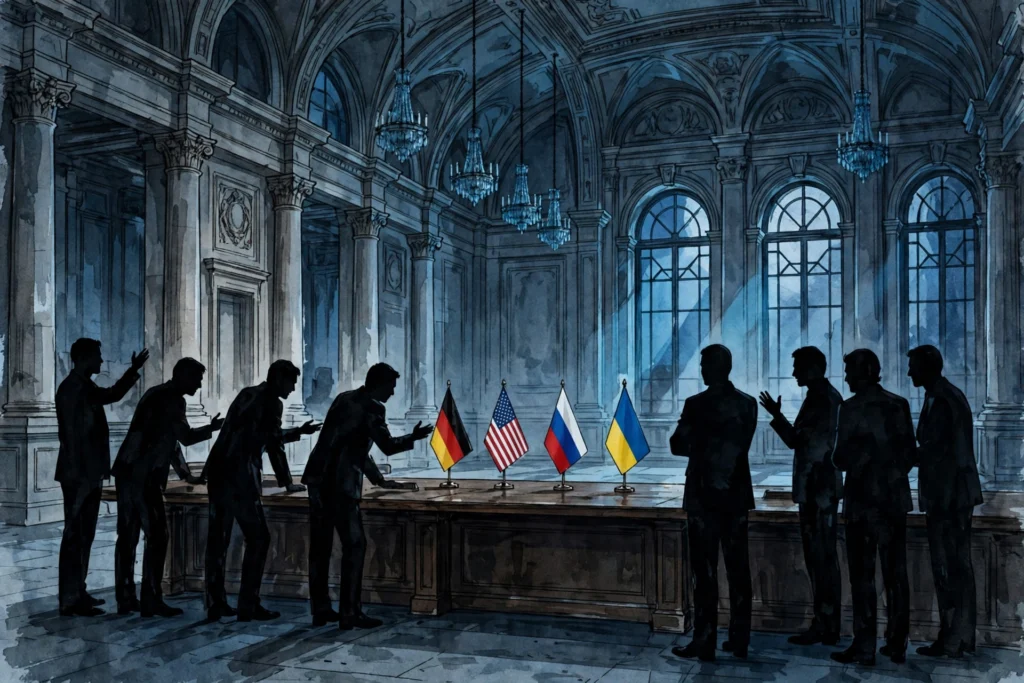
**SEO Title:** Ukraine War News: Merz Warns Trump on Putin Talks **Meta Description:** German Chancellor Friedrich Merz urged Trump to avoid surprises in talks with Putin on Ukraine, warning Europe fears a second Anchorage moment. Full story. **Category:** Politics **Focus Keyword:** ukraine war news **Tags:** ukraine war news, trump news, white house news, nato news, trump administration, marco rubio news, Friedrich Merz, Vladimir Putin, Volodymyr Zelenskyy **Image Prompt:** Editorial illustration of a tense diplomatic summit scene: flags of Germany, the United States, Russia and Ukraine on a long conference table in a grand European hall, silhouetted diplomats in discussion, dramatic cool-toned lighting, no real people, no text **Source:** Reuters
German Chancellor Friedrich Merz delivered a blunt public message to President Donald Trump on Friday, urging the American leader to produce no surprises when he sits down with Russian President Vladimir Putin next week to discuss the war in Ukraine. Speaking on the sidelines of a meeting of European leaders in Dublin, Merz warned that many in Europe fear the coming talks could repeat the pattern of the Alaska summit last year, when Trump met Putin face to face while Ukraine and its European allies watched from the outside.
Merz did not hide the worry behind diplomatic language. "Some here in Dublin fear this could turn into a 'second Anchorage moment'," he said, referring to the meeting between Trump and Putin in Anchorage, Alaska, in August 2025. He then addressed Washington directly. "I therefore want to state our message to the United States very clearly: please, no surprises. Continue to play as part of 'Team Europe' and 'Team Ukraine'." The choice of words was deliberate. By invoking a team, the German chancellor reminded the White House that Europe and Ukraine see themselves as partners in any negotiation about the continent's future, not as spectators waiting to be told the outcome.
Trump News: Why Merz Fears a Second Anchorage Moment
To understand why Merz reached for the Anchorage comparison, it helps to recall what happened at that summit. In August 2025, Trump welcomed Putin to Alaska for talks billed as a step toward ending the war, a meeting that gave the Russian leader a red-carpet reception on American soil and produced warm words but no ceasefire. For many in Europe, the episode became shorthand for a style of diplomacy in which the continent's security is negotiated bilaterally between Washington and Moscow. Merz's warning was, in effect, a plea that the coming meeting in China should not become Anchorage all over again.
The German chancellor's concern is rooted in more than symbolism. Germany is Ukraine's largest European backer and the anchor of the continent's economy, and Merz has positioned himself as one of the most outspoken European voices on the war since taking office. He has argued repeatedly that no settlement can hold unless Ukraine and Europe are at the table, and that any deal which rewards territorial conquest would invite further aggression.
White House Push: Envoys, Prisoner Swap and a Wider Deal
The diplomatic sprint that set the stage for Merz's warning began earlier in the week in Abu Dhabi, where Russian and Ukrainian officials met on November 10 and 11 for two days of American-mediated talks, the first direct discussions between the two sides in nine months. The sessions were brokered by Kushner, Trump's son-in-law, and Witkoff. Russia's delegation was again headed by Kremlin aide Vladimir Medinsky, joined for the first time by Deputy Foreign Minister Sergei Ryabkov and a senior military officer.
The Abu Dhabi talks delivered only one concrete result, but it was a significant one. Russia and Ukraine agreed to what has been described as the largest prisoner exchange so far in the war, with the exact number still to be agreed. On the central questions, ceasefire terms, territory, and security guarantees, the two sides remained far apart, and Kushner acknowledged the gap afterward. "The reality is there's no trust right now between the sides, and that's to be expected after a conflict like this," he said.
On Thursday, November 12, Kushner and Witkoff arrived at the Kremlin for talks with Putin, as Washington sought to generate new momentum in the peace effort. One of their stated goals was to win the Russian leader's blessing for European representatives to join the next round of discussions, which are, after all, about European security. The meeting in Moscow was described by Kushner as very detailed and productive, though the envoys left with little new information beyond confirmation of the prisoner exchange and a new Russian proposal for a humanitarian operation in Kostiantynivka, the Ukrainian city at the heart of the fighting in the Donetsk region.
The American push is not limited to Ukraine. According to reporting by Axios, the Trump administration wants to negotiate the Russia-Ukraine peace agreement and a broader Europe-Russia security framework at the same time, although any new security arrangement would only be implemented after a deal to end the war had been reached. It followed Trump's November 5 meeting at the White House with Putin's special envoy, Kirill Dmitriev, after which the president said he believed a "big, beautiful agreement" could be close and suggested it might involve not only Ukraine but all of Europe. Trump has frequently said an agreement to end the war was close without a deal emerging, and last week he repeated that hope, prompting concern in European capitals that the United States was planning to withdraw troops from the continent.
NATO News: Europe Demands a Seat at the Table
The response from European leaders in Dublin was coordinated and firm. After Kushner and Witkoff flew from Moscow to the Irish capital on Thursday night to meet Zelenskyy, the Ukrainian president announced a new development: Europeans would indeed be invited to the next meeting of the negotiations to end the war. "We cannot conclude this deal between Moscow and Kyiv without the Europeans being at the table," Kushner said, and Zelenskyy added that all sides had accepted that Europe would get a seat at the table. Moscow, however, has not confirmed the agreement, and the Russian delegation in Abu Dhabi had refused to meet European and NATO representatives at all.
European leaders used the Dublin gathering to restate the principles they say must underpin any settlement. In a political statement released at the meeting, they insisted on respect for territorial integrity, the inviolability of borders, non-interference in internal affairs, and the right of states to freely determine their relations with other states. "These are principles that have never been so badly undermined," one European diplomat said. Macron reminded the gathering that at a time when many would like to see Europe excluded from discussions about its own security, the declaration also recognized the need for a wake-up call. Polish Prime Minister Donald Tusk added that under no circumstances would Europe allow anyone to establish new security rules over the heads of Poland and Europe.
The question of who would speak for Europe remains unresolved. Europeans remain divided over the appointment of a potential envoy, and Macron said Europe needed to decide on a clear and united vision of what it wants for Ukraine and itself before choosing one. Merz said there were well-established formats for discussion within the European Union and insisted that leaders would agree on representatives in due course, adding that it was first necessary to get Putin to the negotiating table before deciding who would speak for Europe. "It's not about individuals; what matters is that Putin is prepared to hold talks," he said in Dublin.
Zelenskyy also warned his European counterparts in Dublin about what he described as a trap set by Russia. For more than 30 years, he said, Putin has sought to push NATO allied forces as far from Russia's borders as possible while neutralizing Ukraine and restoring Russian influence there.
Putin's own statements in Moscow underlined how far apart the two sides remain. Addressing Kushner and Witkoff at the start of the Kremlin talks, he asked them to work with Europe so that Europeans could decide what they wanted, peace or war. He warned that foreign peacekeepers deployed to Ukraine would be targeted by Russian forces, and he insisted that any deployment of European troops to Ukraine to guarantee security after a peace agreement would mean the continuation of the war, calling it an absolutely unacceptable proposal. He reiterated that he already considers the Ukrainian regions of Donetsk, Luhansk, Zaporizhzhia and Kherson, whose annexation Moscow announced in autumn 2022, to be Russian, even though the Russian army does not exercise total control over those regions. Publicly, there has been no sign that Putin is willing to drop his insistence that Ukraine surrender the entire eastern region of Donbas before a peace deal can be struck, and Zelenskyy has staunchly refused to hand over land that his forces have died defending.
What Happens Next: China Talks, the G20 and the Road Ahead
The immediate focus now turns to next week, when Trump is expected to hold talks with Putin in China, the meeting that prompted Merz's warning. No detailed agenda has been published, and it is not clear whether the talks will be a formal bilateral session or a meeting on the margins of a wider gathering. What is clear is that European leaders will be watching every signal from it, measuring whether the president honors the "Team Europe" and "Team Ukraine" pledge that Merz invoked, or whether the meeting produces the kind of surprise announcement that has defined earlier rounds of this diplomacy.
Beyond next week, attention is already turning to December, when the United States hosts the Group of 20 summit in Miami. Trump has said he wants Putin there, and Secretary of State Marco Rubio has confirmed that an invitation was extended, though the Russian leader has not yet confirmed whether he will attend. Merz said earlier this month that he would not shy away from a conversation with Putin if the Russian president came to Miami, and that such a meeting was not ruled out.
For now, the one tangible achievement of the week is the prisoner exchange agreed in Abu Dhabi, and even that has yet to be carried out. The talks wrapped up on Wednesday, November 11, with no visible breakthrough in ending the nearly five years of large-scale hostilities, which began on February 24, 2022. Merz's message to Trump, delivered on the same stage, is likely to echo through the discussion: no surprises, no side deals, and no settlement for Europe made without Europe. Whether the president heeds it will become clear when he sits down with Putin next week, in a meeting the whole continent will be watching.
Source: Reuters