Trump News: Asia Reset Ends in Xi-Putin Nuclear Summit
President Donald Trump is preparing to leave Washington on Monday for a four-day swing through Asia that his aides describe as a reset, and that ends with something no American president has ever attempted: a three-way meeting with the leaders of China and Russia to talk about nuclear weapons. The trip takes him first to Manila, where he will meet Southeast Asian leaders and sit down with the leaders of India, Japan and Australia, and then to Shenzhen, the Chinese technology hub hosting this year's Asia-Pacific Economic Cooperation summit. In the latest trump news, the journey is being framed inside the White House as a chance to change the subject after a bruising month at home, and to put the president at the centre of the world's most consequential diplomacy. It is also, by the administration's own admission, a gamble: the meeting at the end of the trip has no precedent, no agreed agenda beyond nuclear stockpiles, and, according to one American official, low expectations of a breakthrough.
The stakes are plain enough. The last nuclear arms treaty between the United States and Russia expired in February, leaving the two largest nuclear powers without a binding limit on their arsenals for the first time in decades. Each side is estimated to hold around 5,000 warheads, while China has been building rapidly to more than 600 and has shown little interest in joining any pact. Trump has spoken for months about bringing all three powers into a single arms conversation, and on Thursday he will get the first version of it. What he does with that opening will shape how the trip is judged.
Trump News: The Manila Stop and the Deals on the Table
The first stop is the Philippines, where Trump arrives on Tuesday for the Association of Southeast Asian Nations summit in Manila. He will meet Southeast Asian leaders who look to Washington for help in countering Beijing's pressure in the region, and he is expected to hold talks with Philippine President Ferdinand Marcos Jr. The White House has said he plans to sign a trade deal with Thailand while he is in Manila, and he will attend the ASEAN-US Special Summit on Monday, November 17. It is his first ASEAN gathering in the Philippines since 2017, and his first major overseas trip since the midterm elections of November 3, when his party lost control of both houses of Congress.
The most closely watched meeting in Manila, however, is not the ASEAN session itself. On Tuesday evening, Trump is set to sit down with the leaders of India, Japan and Australia for the first Quad leaders' summit in more than two years. The Quadrilateral Security Dialogue, the four-nation grouping of the United States, India, Japan and Australia, last met in September 2024, and this will be the first Quad summit ever held in a country that is not a member. The four leaders expected around the table are Trump, Indian Prime Minister Narendra Modi, Japanese Prime Minister Sanae Takaichi and Australian Prime Minister Anthony Albanese. Sources in New Delhi confirmed the plan over the weekend, and American officials have confirmed that Trump will take part.
The agenda, according to officials briefed on the preparations, is dominated by two practical questions: securing the supply chains for the critical minerals that power modern industry, and keeping the commercial shipping lanes that carry the region's energy supplies safe from attack. Both issues cut directly to the contest with China, which dominates the processing of many of the minerals used in batteries, electronics and defence systems, and whose coast guard and maritime militia have pressed claims across the South China Sea. The ASEAN summit opened in Manila on Sunday with tariff tensions dominating the first day, and a Quad meeting focused on minerals and shipping lanes gives the administration something to build rather than something to argue about.
There is a technology dimension as well. Trump is expected to press Southeast Asian nations to join Pax Silica, the American-led initiative for a trusted supply chain in artificial intelligence and semiconductors, and the Quad summit is expected to announce more than 85 million dollars in support for reliable AI infrastructure across the Indo-Pacific. Indonesia is expected to announce its participation in Pax Silica during the visit. China is expanding its own AI cooperation with ASEAN countries, and Premier Li Qiang used his appearance in Manila to press Beijing's case. The contest over the region's technology future now runs alongside the contest over trade and security.
The Shenzhen Summit: A First-Ever Three-Way Nuclear Meeting
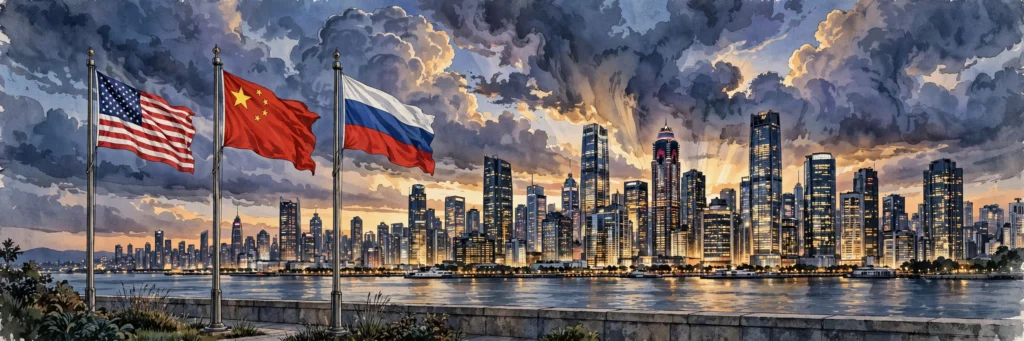
From Manila, Trump travels to Shenzhen for the APEC summit, where the centrepiece of the whole trip awaits. He is scheduled to meet Xi Jinping for a bilateral meeting and working lunch on Thursday, November 19, his fourth meeting with the Chinese leader in just over a year. Then comes the meeting without precedent: the first-ever three-way talks with Xi and Putin, focused on nuclear stockpiles. Putin originally proposed the three-party summit as a venue to discuss the war in Ukraine, where questions of borders and sovereignty hang over peace talks now in their fifth year. Trump's aides insist Thursday's meeting is nothing of the sort, and say Ukraine will not even be on the agenda. Instead, Trump hopes to open discussions on nuclear weapons with two leaders he has worked hard to cultivate.
The numbers explain why the administration thinks the conversation is overdue. With the last American-Russian arms treaty expired since February, there is no binding framework governing the two arsenals of roughly 5,000 warheads each. China has been adding warheads at a pace that has alarmed American planners, passing 600 and still climbing, while showing little appetite for joining a pact that would freeze it far below the other two powers. A United States official, speaking on condition of anonymity, said expectations for a major breakthrough were low, describing the talks instead as a starting point. That caution is echoed in Beijing, where analysts say a trilateral arms agreement is a non-starter for China, which holds far fewer warheads than the other two.
The meeting has already drawn comparisons, particularly in Russia, with the 1945 Yalta Conference, when the leaders of the United States, Britain and the Soviet Union settled the shape of the postwar world. Xi had initially appeared sceptical of hosting it, officials said, concerned it could overshadow the APEC summit. The White House is careful to describe Thursday as an opening rather than a negotiation, but the symbolism is the point: three leaders whose countries hold nearly all of the world's nuclear weapons, sitting together for the first time.
Trump's interest in the meeting goes beyond arms control. He has talked about legacy-building endeavours such as denuclearisation agreements with Beijing and Moscow, and he may also seek to enlist Putin and Xi in setting up a future meeting with North Korea's leader, Kim Jong Un, who has close ties to both men. With a fragile trade-war truce between the United States and China extended into early next year, and more Trump-Xi talks already scheduled for December at the G20 in Miami, some analysts had initially billed the Shenzhen meeting as a low-stakes summit. The addition of the three-way nuclear session has changed that calculation, and raised the stakes for a trip that was already carrying unusual weight.
White House News: The Spy Scandal Hanging Over the Trip
No account of this trip is complete without the scandal that will follow the president to Shenzhen. The visit comes as the administration faces questions over allegations that Nvidia chief executive Jensen Huang, who has close ties to Trump, had an affair with a suspected Chinese spy, a story that has raised the stakes for the president's latest face-to-face meeting with Xi. Trump does not intend to raise the spying matter with the Chinese leader, American officials have previously said, and his aides insist the episode would not dominate the journey. A senior administration official said the Nvidia situation should not really have any bearing on the trip. But the allegations have already changed the atmosphere around it, and they will be in the room even if no one mentions them.
The scandal is not the only unfinished business. The fragile truce in the trade war has been extended into early next year, and the terms of a longer settlement remain unresolved. At the top of Beijing's wish list is ensuring that Trump does not approve a 14 billion dollar arms package for Taiwan, which China claims as its own. Trump has said he is holding the decision, and whether the package moves forward will be read in Beijing as a measure of how far the improved personal relationship between the two leaders extends into policy. For an administration that has spent the past year cultivating deeper ties with Xi, the Shenzhen meeting is a test of whether that investment produces anything concrete, or whether the relationship remains a matter of ceremony.
Midterm Elections 2026: A Trip Shaped by Defeat at Home
That domestic context is impossible to separate from the diplomacy. Trump will attempt this week to follow a pattern set by other presidents who have used foreign travel to recover political ground after setbacks at home, and the Asia trip has been designed with that purpose in view. The sequence matters: the Quad session comes first, giving Trump a meeting with three close partners before he faces the two leaders with whom Washington's relationships are most strained. The ASEAN summit opened with tariff tensions dominating the first day, and a president arriving with trade deals to announce and allies to reassure has a better story to tell than one arriving empty-handed.
The midterm elections 2026 result is the backdrop to every stop. The Republicans' defeat on November 3 ended the party's control of Congress and handed Democrats the gavels in both chambers from January, and the new majority has already begun preparing investigations of the administration. The trip does not change that arithmetic, but it can give the president a week of images and announcements that push the domestic story to the background, and a nuclear summit that no predecessor has ever held. The three-way meeting is the most visible expression of Trump's belief that personal ties between leaders can unlock problems that institutions have failed to solve. Whether that belief survives contact with the realities of nuclear arithmetic, Chinese reluctance and Russian interests is the open question of the week.
What Happens Next
The schedule is now set. Trump arrives in Manila on Tuesday, attends the ASEAN-US Special Summit, and joins the Quad leaders on Tuesday evening. He then travels to Shenzhen for the APEC summit, where he meets Xi for a bilateral meeting and working lunch on Thursday, November 19, before the three-way session with Xi and Putin later that day. The first things to watch are the concrete announcements: the Thailand trade deal in Manila, the Quad's package of support for AI infrastructure and supply chains, and any sign of movement on the Taiwan arms package that Beijing is watching so closely. The second is the language that comes out of Thursday's meeting, and whether the three leaders agree to keep talking about nuclear weapons, which would itself be a result. The third is what happens in December, when Trump and Xi are due to meet again at the G20 in Miami, and whether the Shenzhen conversation has a sequel or fades into a photograph. For now, the trip is a test of whether a president weakened at home can still command the world's attention abroad, and the answer will arrive one summit at a time.
Source: Associated Press