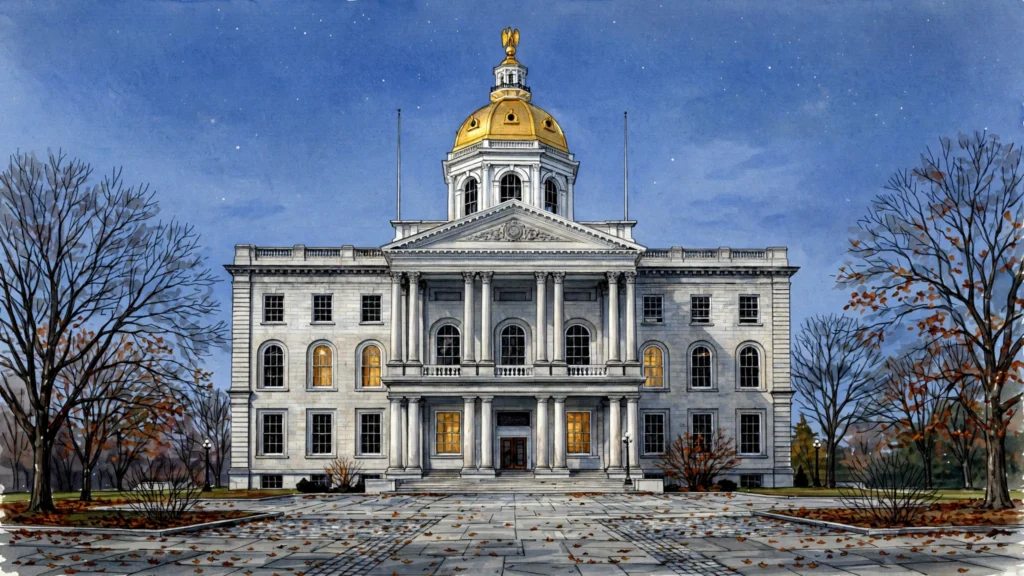
Trump Approval Rating Hits Record Low in New Hampshire
The trump approval rating in New Hampshire has fallen to its lowest point in either of Donald Trump's two terms as president, according to the latest survey from the University of New Hampshire Survey Center. The poll, released on November 19, found that just 29 percent of Granite Staters approve of the president's overall job performance, while more than 70 percent disapprove. With approval minus disapproval, his net rating in the state now sits at roughly minus 42 points, a depth of unpopularity no earlier survey in the series has recorded. The poll surveyed 1,475 New Hampshire residents online between November 13 and 17, and it carries a margin of error of plus or minus 2.6 percentage points.
The numbers arrive a little more than two weeks after the November 3 midterm elections, in which Democrats flipped more than 40 seats in the House of Representatives and nine seats in the Senate to take control of both chambers of Congress. The New Hampshire survey suggests voters in the state connect those losses directly to the president: a large majority said Trump bears at least some of the blame for the Republican defeat, and even his own party is no longer united behind him.
What makes the new figures striking is not only the overall number but where the losses have come from. Support has fallen fastest among the voters who once formed the core of Trump's coalition in the state. Among New Hampshire Republicans, 65 percent now approve of the president's performance, down from 93 percent in November of last year, a collapse of 28 points in twelve months. The survey found that approval has fallen across the board, and the president's rating is now at its lowest in every measure the poll tracks, a verdict that cuts across party lines in a state that has long been one of the closest-watched barometers in American politics.
Election Polls: Voters Blame Trump for Midterm Losses
The clearest message in the survey is about responsibility for the midterm results. Most Granite Staters, 91 percent, think Trump bears a lot or some responsibility for the Republicans' loss of control of Congress, according to the poll. That view is shared by a majority of Democrats and a majority of independents, and by a plurality of Republicans as well, a rare point of agreement in a state where partisans usually disagree about almost everything. The finding turns the midterm outcome into a personal referendum on the president, rather than a verdict on the party as a whole or on individual candidates.
The scale of the Democratic victory helps explain why voters are drawing that connection. Democrats flipped more than 40 House seats and nine Senate seats, enough to take both chambers in Washington, a result that ended unified Republican control of the federal government and set up two years of divided government. In New Hampshire, where the presidential race has been decided by narrow margins for years, the result was part of a national pattern in which voters punished the party in power. The poll suggests that pattern was no accident: voters in the state say they knew whom they were voting against.
The survey also found the Republican Party in New Hampshire divided over what to do next. While 43 percent of respondents think Republican leaders should continue to follow Trump, 39 percent think they should go in a different direction, a near-even split that leaves the party without a clear consensus about its future. That division matters because New Hampshire holds the first presidential primary in the nation, and the question of whether the party stays loyal to Trump or moves past him will shape the 2028 race from its earliest days. For now, the poll shows a party caught between loyalty and doubt, with neither side holding a commanding lead.
The timing of the survey adds weight to the findings. The interviews were conducted from November 13 to 17, after the midterm results were known and after the first days of the lame-duck session, when voters had time to absorb the outcome. The sample of 1,475 residents was surveyed online, and the margin of error of plus or minus 2.6 points means the 29 percent approval figure is unlikely to be far off the true level of support in the state. Even at the upper edge of that range, the result would still be the lowest approval rating the poll has ever recorded for Trump in New Hampshire.
Presidential Approval Rating: A Steady Slide Since Spring
The new low is the latest step in a decline that the University of New Hampshire has tracked all year. In April, the same survey found that 39 percent of New Hampshire residents approved of Trump's job performance, with 60 percent disapproving. By late June, approval had slipped to 38 percent and disapproval had risen to 62 percent, giving the president a net rating of minus 24, then the lowest since October 2017. In July, approval fell further to 37 percent against 62 percent disapproval, a net rating of minus 25. In September, the poll recorded 32 percent approval and 67 percent disapproval, another record low, with approval of his handling of the economy and foreign affairs falling to record lows of 31 percent and 29 percent respectively. The November reading of 29 percent continues that line almost without interruption.
The slide has been driven by the issues that dominated the midterm campaign. In the September survey, voters gave the president his worst marks on the economy and on foreign affairs. On the economy, 69 percent of Granite Staters disapproved of his handling, including one out of every three Republicans and 84 percent of independents. Two-thirds said the decision to attack Iran was wrong, and three-quarters said the conflict was going poorly. The November poll did not repeat every one of those questions, but the overall rating suggests the underlying judgments have not improved.
National surveys tell a similar story. A Reuters/Ipsos poll released on November 9 found Trump's approval rating at 32 percent nationally, just one point above his career low of 31 percent, recorded in mid-October. Only 21 percent of Americans approved of his management of the cost of living, and 25 percent gave him good marks on the economy. Nate Silver's Silver Bulletin average, updated on November 20, put the president at 37 percent approval against 60 percent disapproval, and the RealClearPolitics average showed approval near 39 percent with disapproval close to 59 percent.
New Hampshire has long been a useful place to read the national mood, because its voters are famously independent and its politics are closely balanced. The state backed the Democratic candidate in the last several presidential elections while repeatedly electing Republican governors, and its first-in-the-nation primary gives it an outsized role in choosing nominees. When the UNH Survey Center's numbers move this far, this fast, and in the same direction as the national polls, the signal is hard to dismiss as a local quirk.
Midterm Elections 2026: What Voters Want the New Congress to Do
The poll did not only ask voters to judge the past. It also asked what Democrats should do with the majorities they won, and the answers point to an ambitious agenda of hearings and investigations when the new Congress is sworn in early in January. Three-quarters of respondents said Democrats should hold hearings on artificial intelligence, the most popular item on the list. The next most popular was holding hearings on the government's handling of the Jeffrey Epstein case, backed by 71 percent of those surveyed.
More than half of Granite Staters said Democrats should try to impeach Secretary of War Pete Hegseth, at 56 percent, and hold hearings on Trump and his family's finances, at 55 percent. Voters were split on the most far-reaching step of all: 45 percent supported pursuing the impeachment of Trump himself, while 48 percent opposed it. The poll's authors also noted that most voters said they disliked the political advertisements they saw before the election, that the advertisements did not affect their vote, and that most found it very easy to vote.
The agenda voters sketched out will shape the opening weeks of the new Congress. Hearings on artificial intelligence would put Democrats in charge of examining a technology central to the economy and national security, and hearings on the Epstein case would revisit a subject that has dogged the administration for months. The split over impeachment suggests Democratic leaders will have to balance the demands of their base against the views of the broader public, including independents whose support helped deliver the midterm victory.
For Trump, the poll's message is that the political ground has shifted under him in a state he once competed hard to win. The 29 percent approval rating is not only a record low for him in New Hampshire, it leaves him with little room to recover support among the voters he would need to win the state again. The collapse among Republicans, from 93 percent approval a year ago to 65 percent now, is the most consequential part of the survey, because it suggests the erosion is happening inside his own coalition rather than only among his opponents.
Who Is Leading in the Polls Right Now and What Happens Next
The question now is whether the November reading is a floor or another step down. The national polling averages show Trump at roughly 37 to 39 percent approval, with disapproval near 60 percent, and the trend in both the national surveys and the New Hampshire series has pointed in one direction for months. The next UNH survey will show whether the post-midterm numbers stabilize or fall further.
The immediate consequence plays out in Washington. The lame-duck session continues with Republicans still holding both chambers until the new members are sworn in, but the incoming Democratic majorities have already signaled their priorities, and the New Hampshire poll suggests the public is broadly behind hearings on artificial intelligence and the Epstein case, even if it is divided on impeachment. The administration will spend its final weeks of unified government trying to move its remaining agenda, including confirmations, while the new Congress prepares to take over in January.
For New Hampshire itself, the poll sets the terms of the next political debate. The Republican split over whether to keep following Trump will shape the party's choices in the state and in the first primary, and the voters who delivered the Democratic victory have told pollsters what they expect to happen next. Whether the new majority follows that agenda, and whether Trump's standing recovers or falls further, will be the story of the months ahead. Stay with TrendSignal for fresh US news every day.
Source: Seacoastonline.com