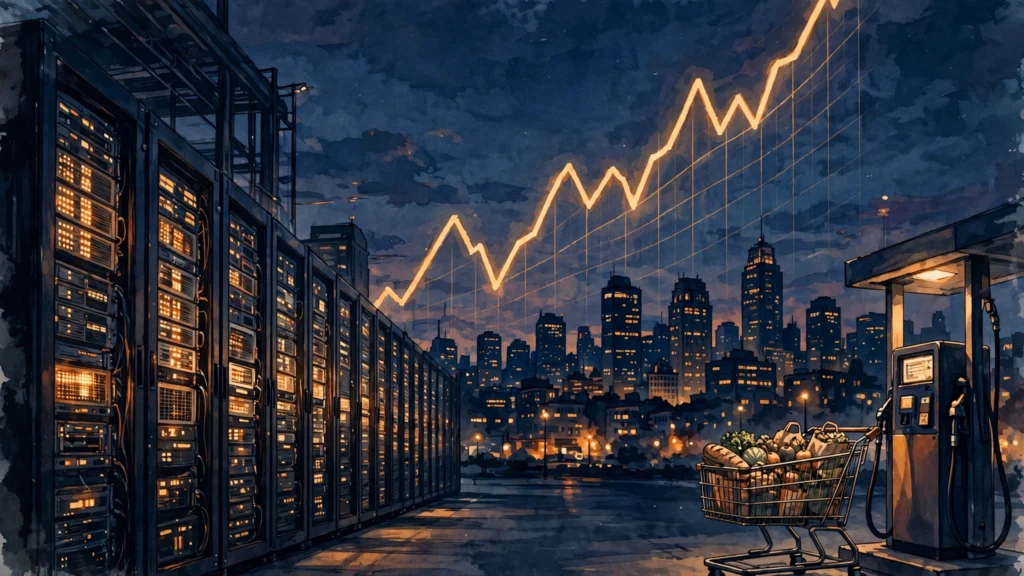
Inflation Report: AI and Tariffs Push Prices Higher
The latest inflation report has delivered an uncomfortable message for the White House and for Wall Street at the same time. America's three leading stock indexes have been setting records since early August, powered by the artificial intelligence build-out and by corporate earnings that keep beating expectations. Yet the newest price data shows inflation moving in the wrong direction again, and the forces pushing prices higher are no longer limited to one policy or one shock. Tariffs, an energy disruption tied to the Iran war, and the AI boom itself are all adding to the cost of living, and the Federal Reserve now faces a choice it would rather not make.
The numbers behind the warning come from the government's own price gauges and from the Federal Reserve's forecasting tools. The Personal Consumption Expenditures price index, the measure the Fed watches most closely, rose to 3.6 percent in the twelve months to September, up from 3.4 percent in August. Core PCE, which strips out food and energy, climbed to 3.1 percent from 3.0 percent, rising 0.3 percent in September alone. Those readings already sit well above the central bank's 2 percent goal. What worries economists more is where the figures are heading. The Federal Reserve Bank of Cleveland's Inflation Nowcasting tool expects headline PCE to reach 3.77 percent in October and 3.82 percent in November, with core PCE at 3.2 percent and 3.31 percent.
The consumer price index tells a similar story. Consumer prices rose 0.4 percent in October, with core prices up 0.3 percent for a third month in a row. The CPI had already touched a three-year high of 4.2 percent in May. Riccardo Trezzi, a former economist at the Federal Reserve Board, estimates annualized inflation for October reached about 4 percent. The Bureau of Labor Statistics could not publish a full year-on-year CPI comparison for October because it collected almost no prices in October 2025, during a government funding lapse. Even so, the monthly readings are clear: prices are rising faster than the Fed wants, and the pace has not slowed.
That contrasts sharply with the mood on Wall Street. During President Donald Trump's first term, from January 2017 to January 2021, the Dow Jones Industrial Average gained 57 percent, the S&P 500 rose 70 percent and the Nasdaq Composite soared 142 percent. His second term has added to those gains. Through October 13, the Dow was up 19 percent, the S&P 500 up 30 percent and the Nasdaq up 39 percent since the start of the second term, and all three indexes have pushed to new highs since early August. The AI infrastructure build-out has powered that run, lifting technology earnings, while record share buybacks by S&P 500 companies have added further support. The Tax Cuts and Jobs Act, signed in December 2017, cut the top corporate tax rate from 35 percent to 21 percent, and the resulting surge in buybacks has been a steady tailwind for share prices ever since.
Yet the same forces that have lifted the market are now squeezing households. Analysts who follow the inflation data describe the problem as twofold. The first part is the inflation linked directly to the president's own policies, sometimes called Trumpflation. The second part is newer, and in some ways more surprising: the AI boom, the market's favorite growth story, has itself become a source of rising prices. Together they have left the Federal Reserve caught between two bad options, and the next few weeks will show how it chooses.
CPI Inflation Data: Prices Are Climbing Again
In a healthy economy, prices rise a little each year, and the Fed aims for inflation of about 2 percent. The trouble begins when price growth stays well above that pace for months on end: it eats into pay packets, forces the central bank to keep borrowing costs high, and threatens the spending that keeps the economy moving.
The United States has now spent much of 2026 above that comfort zone. The CPI's 4.2 percent reading in May was the highest in three years, more than double the Fed's target, and September's PCE figures confirmed the pressure had not faded over the summer. Headline PCE at 3.6 percent and core PCE at 3.1 percent both moved up from August, and the Cleveland Fed's nowcast points to further increases in October and November rather than a retreat.
The October CPI report added to the concern. A monthly rise of 0.4 percent in headline prices and 0.3 percent in core prices may sound small, but repeated month after month it compounds into a serious annual rate. Core prices have now risen 0.3 percent in three consecutive months, a pace that works out to roughly 3.7 percent a year if it continues — the kind of steady, grinding inflation central bankers find hardest to bring down, because it is spread across services and goods rather than one volatile category such as fuel.
The New York Fed's October consumer survey found that households expect inflation of 3.9 percent over the next year, 3.3 percent over three years and 3.0 percent over five years. Expectations matter because they shape behavior: when people believe prices will keep rising, workers press for bigger pay rises and businesses feel freer to lift their own prices, which can turn a temporary burst of inflation into a lasting one. Fed staff noted that the risks to the inflation outlook were tilted upward, in part because expectations could drift away from the 2 percent target after five years of elevated price growth. Unemployment, meanwhile, stood at 4.2 percent in September and 4.1 percent in October, so the economy is still creating jobs even as prices climb.
Tariffs Impact on Prices: The New York Fed's Findings
The first and most documented driver of today's inflation is the president's tariff policy. Since the start of the second term, the administration has imposed sweeping global duties of 10 percent to 12.5 percent on more than 80 countries. The effect on consumer prices has now been measured in detail by three economists at the Federal Reserve Bank of New York, writing for the bank's Liberty Street Economics blog in a study titled "How Fast Do Tariffs Pass Through into Consumer Prices?"
Their finding is striking. By February 2026, the 2025 tariffs had added an estimated 2.9 percentage points to goods price inflation. Without the tariffs, the authors concluded, goods prices would have fallen slightly. About a quarter of every point in higher tariff rates shows up in consumer prices within a year, and a 10 percent across-the-board tariff lifts consumer goods prices by about 2.6 percent after twelve months.
Roughly two-thirds of the increase comes directly from pricier imports, which reach shoppers quickly. The remaining third comes from American-made goods: duties on unfinished products such as steel raise domestic manufacturing costs, and where imports have become much more expensive, domestic producers have room to raise their own prices. That second channel takes six to twelve months to work through, so tariff-driven inflation arrives in waves. This is why economists describe the tariff effect as entrenched rather than fleeting: a tariff stays in place, lifting the price level each time a new round of duties takes effect.
The Iran War and the Energy Shock
The second driver of Trumpflation is the war with Iran and its effect on world energy markets. The closure of the Strait of Hormuz, the narrow waterway through which a large share of the world's seaborne oil travels, has created what analysts describe as the largest energy supply disruption in modern history. Fuel prices have surged as a result, and diesel reached an all-time high in September.
The pump price is only the most visible part of the story. Businesses caught by the closure have been forced to change shipping routes, find new suppliers and pay more for transport, as well as more for petroleum-based products such as plastics and synthetic polymers. Some companies have absorbed those extra costs; others have passed them straight on to customers. That spread from energy into the wider economy is what makes the current episode different from a normal oil shock. Energy disruptions are usually short-lived, but when higher fuel and transport costs filter into manufactured goods, food distribution and everyday services, the inflation becomes broader and harder to reverse. The October data suggests that process is now well under way.
Stock Market Today: The AI Build-Out's Hidden Cost
The most surprising element of the new inflation picture is the role of the stock market's own favorite story. The AI infrastructure build-out has been the single biggest driver of share prices and corporate earnings in recent years, and market researchers at IDC value the AI opportunity at 22.5 trillion dollars through 2031. But that spending spree is now pushing up prices across the technology supply chain, and the cost is landing on consumers as well as on businesses.
For more than two decades, technology was one of the great deflationary forces in the American economy. Between 2006 and 2019, import prices for computer and electronic products fell 30 percent, as better manufacturing and faster chips made devices cheaper year after year. That long decline has now gone into reverse. Import prices for computer and electronic products surged 7.4 percent in the first six months of 2026 alone, reaching 77.1 points, the highest level since January 2016. The year-on-year jump of 8.0 percent was the largest annual increase on record. According to data from the Bureau of Labor Statistics and the St. Louis Federal Reserve, the Import Price Index for Computer and Electronic Products climbed to its highest level since December 2013 as of September 2026.
The cause is booming demand meeting limited supply. Companies are racing to build AI data centers regardless of cost, and the appetite for graphics processing units and memory has far outrun what manufacturers can produce. Shortages have given AI hardware makers extraordinary pricing power, and the higher costs ripple through the supply chain. Shoppers buying laptops, smartphones or any device with a processor, storage or memory are almost certainly paying more than a year ago, and businesses face the same squeeze on servers and networking gear.
That creates a genuine dilemma for the market. The same build-out that has driven the Dow, the S&P 500 and the Nasdaq to record highs is also feeding the inflation the Fed is trying to tame. If the central bank does nothing, the data-center boom is likely to push consumer prices higher still. But if it moves aggressively against inflation, it risks damaging the very market rally and the economic growth engine that the AI investment wave represents. It is a bind with no painless exit, and it explains why the latest inflation report has unsettled investors who had grown used to good news.
Federal Reserve News: Warsh and the FOMC Face a Bind
The Federal Reserve's response so far has been to tighten. The central bank raised interest rates in September for the first time since 2023, beginning only the fourth rate-hiking cycle of the 21st century. At its October 27 to 28 meeting, the Federal Open Market Committee held its benchmark rate at 3.75 percent to 4.00 percent, but the vote was 10 to 2, with Governor Lisa Cook and Cleveland Fed President Beth Hammack dissenting in favor of an immediate quarter-point increase.
The minutes of that meeting, published on November 18, show how close the committee came to moving. Almost all participants judged that further increases in the federal funds rate would likely be appropriate under their baseline outlooks. A few of those who backed the hold described the decision as a close call. Christopher Waller, a Fed governor, said on November 10 that he was leaning toward a quarter-point rise in December, and that a half-point step should be considered if the October consumer price data resembled the previous two monthly readings. It did.
Fed Chair Kevin Warsh has been adamant that the central bank will return annualized PCE inflation to its 2 percent target, but the September Summary of Economic Projections shows how far away that goal remains. The median projection put headline PCE at 3.7 percent for 2026 and 2.3 percent for 2027, with core PCE at 3.4 percent and 2.5 percent, and the median federal funds rate at 4.1 percent at the end of 2026 and 2027, against 3.9 percent in 2028 and 3.6 percent in 2029. Fed staff still expect inflation to fall sharply in 2027 and reach about 2 percent in 2028, as energy, tariff and AI-related pressures fade, but they judged the risks as skewed upward.
Traders have taken the hint. After the minutes were published, CME Group's FedWatch tool put the chance of a quarter-point rise in December at 94.7 percent, with about 5.3 percent assigned to a half-point move. A December increase would be the second step in the new hiking cycle, arriving with the economy still growing and the stock market near its highs. The Trump administration has argued that elevated inflation is temporary and should be ignored by the central bank, a view the Fed's own minutes do not share. But a market that has climbed so far, so fast, on the back of one theme is vulnerable if the cost of borrowing keeps rising: if higher rates slow the AI build-out even slightly, it may be enough to tip the Dow, the S&P 500 and the Nasdaq from their peaks.
Economy News: What Happens Next
The calendar now gives investors and policymakers a rapid sequence of tests. The Bureau of Economic Analysis releases October PCE data on November 25, which will show whether the Cleveland Fed's nowcast of 3.77 percent was on the mark. The November employment report follows on December 4, and the Federal Open Market Committee meets on December 8 and 9, deciding with the October PCE figures in hand but without the November CPI report, which is not due until December 10, the day after the meeting ends. The November CPI reading will therefore be the first verdict on the December decision, not an input to it.
Several questions will decide how this plays out. The first is whether the tariff pass-through keeps building: the New York Fed's study shows that about a quarter of a tariff increase reaches consumers within a year, with the domestic-goods channel taking six to twelve months, so duties imposed in 2025 are still working through the pipeline. The second question is energy: if the Strait of Hormuz remains closed and diesel prices stay near their records, transport and manufacturing costs will keep feeding into consumer prices. The third question is the AI boom itself. Demand for chips, memory and data-center capacity shows no sign of slowing, and whether technology's flip from cheaper goods to dearer ones lasts depends on whether supply can catch up with demand. For now, both the spending and the shortages continue.
The final question is the Fed's nerve. Chair Warsh has pledged to bring inflation back to 2 percent, and the October minutes show a committee nearly united behind further rate rises. But each increase raises borrowing costs for households and businesses and risks knocking a pricey stock market off its highs. Doing too little risks letting inflation expectations drift higher, which would make the eventual fix more painful. Doing too much risks turning a market correction into something worse.
For households, the meaning of the latest inflation report is straightforward: the cost of living is still rising faster than the Fed wants, and the reasons are broader than a single policy or shock. Tariffs are lifting the price of goods, the Iran war is lifting the price of energy and transport, and the AI build-out is lifting the price of the devices modern life depends on. None of those forces is fading quickly, which is why the economy can look strong on the stock market while feeling squeezed at the checkout.
Stay with TrendSignal for fresh US news every day.
Source: The Motley Fool