Pete Hegseth News: Trump Arch a Defense Asset, Filing Says
Defense Secretary Pete Hegseth has told a federal judge that President Donald Trump’s planned triumphal arch in Washington is a generational national defense opportunity, putting the Pentagon’s weight behind a project that began as a monument to the nation’s 250th birthday and has since been recast as a military asset. In a written declaration submitted on Wednesday, Hegseth argued that the 250-foot structure would help defend the capital against drones and other evolving threats, a claim the Trump administration is now advancing in court as opponents try to stop construction before it can begin.
The filing is the administration’s latest attempt to defend a project that has become a personal legacy effort for the president and a flashpoint in the closing days of the midterm elections 2026 campaign. Hegseth’s declaration, made under penalty of perjury, describes the arch as a dual-purpose structure: a major national monument that would also carry military utility in support of homeland defense. That framing is new. When Trump first proposed the arch, he presented it as a celebration of the country’s 250th anniversary. No national security justification appeared in the plans submitted for federal review, and critics have seized on the shift as evidence that the defense rationale was added to rescue a project in legal trouble.
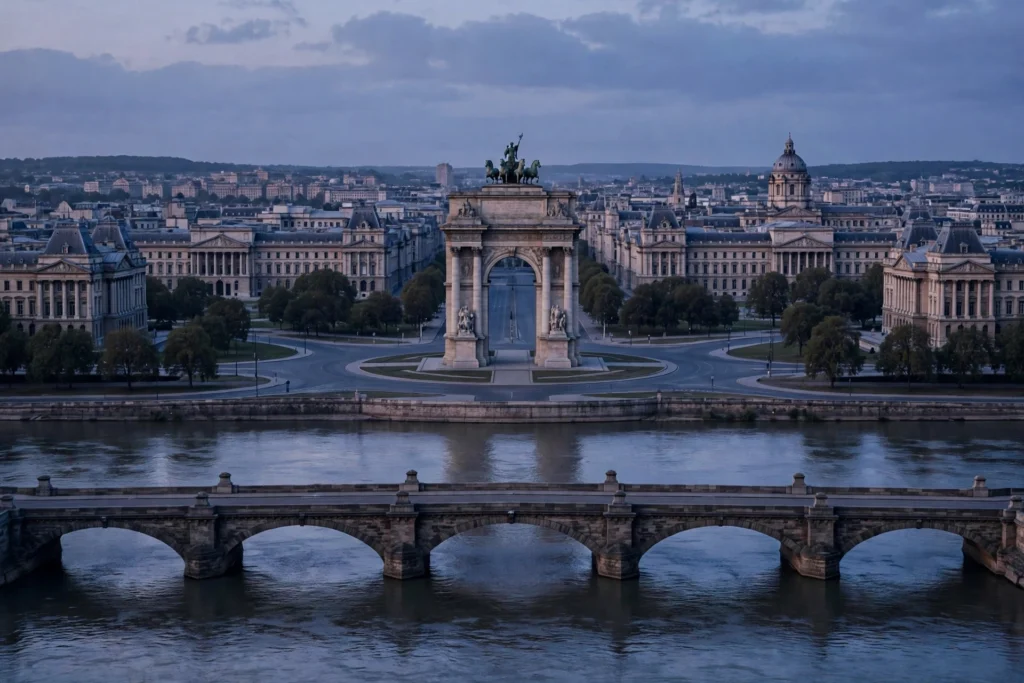
Hegseth’s argument rests on geography. The arch is planned for Memorial Circle, a busy traffic circle at the western end of the Arlington Memorial Bridge, between the Lincoln Memorial and Arlington National Cemetery. The site overlooks major national landmarks and roads used by federal officials, and Hegseth wrote that its height would create an elevation advantage and line-of-sight connectivity that lower buildings cannot offer. From that perch, he argued, sensors and communications equipment could see farther, officials could identify and assess threats more quickly, and protective teams could coordinate more effectively across the capital region.
Pete Hegseth News: The Defense Case for the Arch
In his declaration, Hegseth spelled out several security functions the arch could support. He listed military command, drone sensor integration, counter-drone strike systems, communication connectivity, observation and overwatch among the purposes the structure could serve. He wrote that the capital’s landscape and its dense concentration of government agencies leave it exposed to the well-established threat of drones being used by bad actors, and he called the arch a generational national defense opportunity to mitigate those evolving threats.
“The Arch is a generational national defense opportunity to mitigate these evolving threats,” Hegseth wrote, according to reports of the filing. “It will be utilized as a dual-purpose structure: a major national monument that also incorporates military utility to support Homeland defense,” he added. “The elevated position can also support authorized protective-overwatch and counter-sniper personnel by improving observational, situational awareness and coordination with other security elements.”
Hegseth also addressed a practical question that opponents have raised: whether turning a monument into a military installation would require redesigning it. He said it would not. The implementation of the capabilities discussed in his declaration would not require any structural modifications or alterations to the existing plans for the arch, he wrote. In other words, the same 250-foot structure that was drawn up as a monument could, in the administration’s telling, function as a defense platform without being rebuilt.
Homeland Security Secretary Markwayne Mullin filed a supporting declaration making a similar case. Mullin wrote that the arch was intended to incorporate features that would support national security, and that its location provides opportunities for increased capability for information-sharing and logistical coordination. Together, the two cabinet declarations form the administration’s core courtroom argument: that Washington faces continuously evolving threats, and that a tall structure at a central, elevated site would give the government a better vantage point from which to meet them.
The declarations were submitted ahead of a hearing on Friday, when U.S. District Judge Tanya Chutkan will hear arguments about whether to block construction. The Justice Department told the court that Hegseth would be unavailable to testify at that hearing, a point the project’s opponents have noted: the official making the most sweeping defense claims will not, according to the government, be available to answer questions about them in person.
Trump Administration: From Birthday Monument to Military Complex
The arch’s history explains why the defense argument has drawn so much scrutiny. Trump first proposed the structure as a monument marking the United States’ 250th birthday, an anniversary project in the mold of grand national memorials. Last month, as legal challenges mounted, he debuted a new justification, saying the arch would double as a tourist attraction and a military complex where drones and ammunition could be stored and military snipers could be posted. The shift in framing was striking, and it came as the project faced a wave of criticism and two lawsuits aimed at stopping its construction.
The pattern is familiar to observers of the Trump administration. The White House ballroom project, another signature Trump construction effort, was originally described as a space needed to host VIP guests before the administration later insisted that building was also vital to national security. Critics argue that the arch is following the same playbook: a personal presidential project, justified after the fact with security language when its original rationale proved insufficient to carry it through the approval process. Supporters answer that a structure’s uses can evolve, and that a monument in the heart of the capital would be foolish not to serve the nation’s defense as well.
The administration’s legal filings also set out a timeline that has sharpened the urgency of the court fight. Construction crews could break ground as soon as November 5, the day after the deadline the project’s opponents have asked the judge to meet, but aboveground construction would not begin until May 2027 at the earliest, and the full build could stretch into 2030. The administration is also hoping for final approval from the National Capital Planning Commission, which is led by Trump appointees, with a vote expected around November 5. That sequence — a commission vote, then immediate groundbreaking — is why opponents have pressed for an injunction now, before the project becomes, in their phrase, a fait accompli like the ballroom.
For the Pentagon, the arch case is also a test of how far the military’s voice reaches into domestic construction disputes. Defense secretaries do not routinely file declarations in lawsuits about monuments. Hegseth’s decision to do so, in such sweeping terms, signals that the administration views the arch not as a parks project but as part of its broader argument about homeland defense, drone threats, and the protection of the capital. Whether a judge accepts that framing may matter well beyond this one structure, because it could establish how much weight a cabinet secretary’s security claims carry when they arrive late in a project’s history.
White House News: The Lawsuits Trying to Stop the Arch
Two lawsuits stand between the arch and construction. The first was filed in February by three Vietnam War veterans and a historic preservationist, who argue that the arch will impinge on the nearby Arlington National Cemetery and who are seeking a preliminary injunction to bar construction by November 4. Their case is the one Judge Chutkan will hear on Friday afternoon. The veterans’ argument is partly about the sanctity of the cemetery’s surroundings: a 250-foot triumphal arch at the entrance to Arlington, they contend, would dominate and diminish a landscape meant for remembrance.
The second lawsuit was filed by Arlington County, which argues that the administration failed to complete a legally required environmental review before pressing ahead with the development. That claim goes to process rather than symbolism: federal projects of this scale are normally subject to detailed environmental assessment, and the county says the administration barrelled ahead without it. The administration disputes that account, and the court fight now turns in part on which side’s version of the approval record the judge credits.
Both cases arrive at a moment when the project’s critics have found an unlikely ally in the paper trail. As Hegseth’s own critics have pointed out, no plans submitted to any review board used national security as a justification for the arch before the recent reframing. That absence does not by itself defeat the administration’s case — governments are allowed to identify new uses for structures — but it gives opponents a simple, memorable argument: if the arch was always a defense asset, why did nobody say so until the lawsuits arrived?
The administration’s answer, implicit in the Hegseth and Mullin declarations, is that threats evolve and that a structure’s value should be judged by what it can do, not only by what it was first called. The arch’s height and central location, the declarations argue, are facts about the structure itself, whatever the original press release said. A sensor placed 250 feet in the air sees farther than one placed at street level, and a command post at the center of the capital’s monumental core can coordinate faster than one on the periphery. Those are physical claims, and the judge will have to weigh them against the argument that they are post-hoc rationalizations for a monument the president simply wants to build.
Pentagon News: Drones, the Capital, and the Security Debate
The drone threat at the center of Hegseth’s argument is real and widely acknowledged. Small unmanned aircraft have become a central concern for security agencies around the world, used for surveillance, smuggling, and, in war zones, as weapons. Washington, with its concentration of government buildings, military installations, and high-profile events, is an obvious focus of that concern. Federal agencies already operate counter-drone systems around the capital, and the question in the arch case is not whether drone defense matters, but whether a monument is a sensible or necessary part of it.
Skeptics note that the capital already has rooftops, towers, and dedicated facilities that could host sensors and overwatch teams without building a new 250-foot arch. They also note that the arch’s own filings describe capabilities — command, sensor integration, counter-drone systems, communications — that are normally housed in purpose-built, secure facilities rather than public monuments. Supporters counter that the arch’s unique combination of height, centrality, and sightlines is precisely what makes it valuable, and that dismissing it because other sites exist misses the point of layered defense.
The debate also touches on a broader question about how the United States protects its capital in an era of cheap, capable drones. Traditional air defense was built for aircraft and missiles; the drone era demands distributed sensors, rapid identification, and the ability to distinguish hostile craft from the growing number of legitimate commercial and recreational drones in city skies. In that context, any tall structure in central Washington has potential security value, but turning a monument into a node in a defense network also raises questions about public access, symbolism, and the militarization of civic space that go beyond engineering.
Those questions will not be settled on Friday. The hearing before Judge Chutkan concerns a preliminary injunction — whether construction should be paused while the lawsuits proceed — not a final ruling on the arch itself. But the injunction decision will effectively determine the project’s momentum. If construction begins on November 5, opponents fear, the political and practical cost of stopping it later will rise sharply, even if they ultimately win in court. If the judge blocks construction, the administration will face months of additional litigation with its flagship monument stalled.
Midterm Elections 2026: What Happens Next
The immediate calendar is now clear. On Friday, Judge Chutkan hears arguments on the veterans’ request for a preliminary injunction, with the plaintiffs asking for a ruling by November 4. Around November 5, the National Capital Planning Commission is expected to vote on final approval, and the administration has said groundbreaking could follow immediately. Aboveground construction, however, would not begin until May 2027 at the earliest, giving opponents time to continue their legal challenge even if the injunction is denied.
Politically, the arch fight lands in the final week before the November 3 midterm elections, when the Trump administration’s construction projects have become a proxy for a larger argument about presidential power and legacy. The president’s supporters see a leader building monuments to American greatness; his critics see a leader using the machinery of government to advance personal projects and dressing them in security language when challenged. The arch, like the ballroom before it, will be read through that lens whatever the court decides.
For now, the most consequential sentence in the case may be the one Hegseth put in writing: that the arch is a generational national defense opportunity. If the judge credits it, the administration will have a powerful new argument for its project. If she does not, the arch will return to being what it was first announced as — a birthday monument, facing lawsuits, an environmental challenge, and a skeptical public, with its future decided in courtrooms rather than on construction sites.
Source: The Washington Post