Iran War News: US Warns Allies of Post-Election Strikes
U.S. officials have told several Middle East countries and regional allies to be prepared for potential renewed military action against Iran after next week’s midterm elections, as well as for the possibility that Iran will attempt to retaliate against them, according to two diplomats briefed on the matter. The warning, reported by the Associated Press on October 28, puts the region on alert for a return to major operations in a war that began in late February, and it arrives less than a week before Americans vote on November 3.
Both diplomats spoke on the condition of anonymity because they were not authorized to comment about the sensitive warnings conveyed by U.S. diplomats and defense officials. They stressed that President Donald Trump has not made a final decision on whether to carry out new strikes against Iran. The president, however, has repeatedly said he is weighing ordering new military action once the critical November 3 elections are over, and the fresh urgings for allies to prepare for potential retaliation are a sign that a return to large-scale operations is now firmly on the horizon.
The White House and U.S. officials declined to comment on the report. That silence is itself part of the pattern of this conflict: warnings delivered through diplomatic and military channels, official reticence in public, and a region left to read the signals and prepare for the worst. For the governments receiving the message — Gulf Arab states, regional partners, and countries hosting U.S. forces — the practical question is not whether Washington is bluffing, but how much time they have, what Iran might hit in response, and whether diplomacy can still head off a new round of fighting.
Iran War News: What the Allies Were Told
According to the diplomats cited by the Associated Press, the United States told regional allies that a new round of military action could last for several days. Regional officials, in turn, are bracing for Iran and its proxy groups to retaliate, a response that could lead to a fight lasting even longer than the initial operation. The warnings put the risk of escalation at the forefront of regional calculations, with potential spillover to energy facilities and critical infrastructure that the global economy depends on.
The Associated Press reported that it could not establish how soon the military might be ready to strike again after the election, and that the United States has not struck Iran since early September. That gap matters. A pause of nearly two months, combined with a buildup reported by other outlets, suggests that if a decision is made, it would follow a period of preparation rather than a sudden, improvised response. It also means the region has had time to watch the signals accumulate: the warnings to allies, the movement of air defenses, and the president’s own public statements about what might follow the vote.
On October 8, Trump said in a post on Truth Social that the United States would not attack Iran before the midterms. Asked on October 28 about strikes afterward, he replied, “Anything’s possible,” according to Reuters. The two statements, taken together, sketch the administration’s public position with unusual clarity: no action before the election, and no ruling out of action after it. For allies, that is less a reassurance than a timetable, and the private warnings reported by the Associated Press appear to be the diplomatic version of the same message.
The Wall Street Journal, cited by other outlets, reported that Washington had conveyed its message to several Arab Gulf states through both diplomatic and military channels, describing a possible short, intense military operation following the November 3 vote. The Journal’s account, as relayed in those reports, described the notification as one of several signs that the United States and Israel are preparing a new large-scale military operation against Iran. The White House, in a statement carried by those reports, would not discuss sensitive military plans that may or may not exist, saying only that President Trump keeps all options on the table to ensure that Iran can never have a nuclear weapon.
Trump Administration: The Military Buildup Behind the Warning
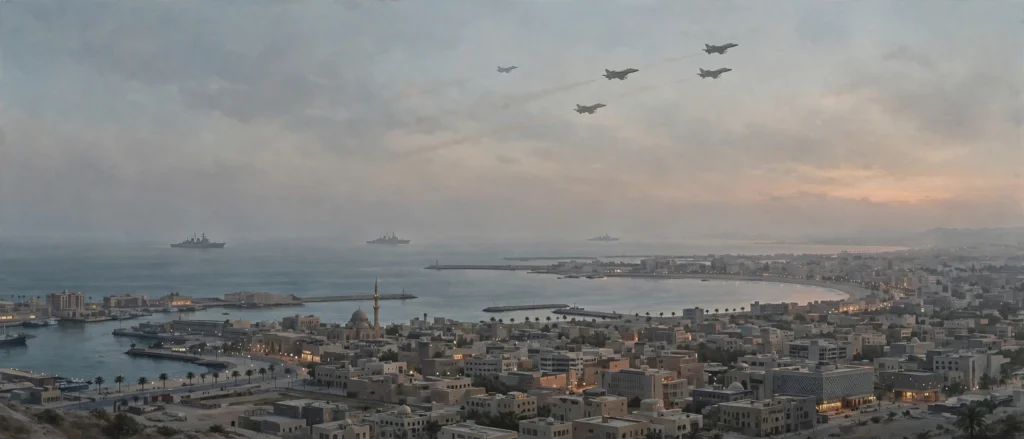
The warnings to allies have not arrived alone. Reports in recent days have described a U.S. military buildup in the Middle East, including additional air defense systems and troops, and growing speculation that Trump is weighing a large-scale strike on Iran’s nuclear facilities and key infrastructure. Among the moves reported: the Pentagon is relocating a Patriot air-defense battery from Texas to the region, troops stationed at bases considered vulnerable to attack have been moved to other positions, forces in the region have restocked ammunition, and bombers and fighter jets are being prepared for airstrikes.
An additional aircraft-carrier strike group and a Marine expeditionary unit are expected in the region next month, according to those reports, reinforcing roughly 20 U.S. warships already in the Middle East — although some of the arriving vessels could replace ships already deployed rather than add to their number. Israel, too, has prepared prospective targets, according to the same accounts. None of these movements, on its own, proves that a strike has been ordered. Military buildups can serve as deterrence, as preparation, or as leverage in negotiations, and governments routinely move assets to protect their forces when tensions rise. Taken together, however, they form the backdrop against which allies are reading the warnings: a region being readied, visibly, for the possibility of renewed fighting.
A separate report added an important piece of context about timing. CNN reported on October 25, citing two U.S. officials, that forces could launch a major operation within 96 hours of a presidential order. The officials described a proposed operation extending beyond radars and launchers, which they said could be rebuilt quickly, and CNN reported that planning covered Iranian energy assets, military locations, and nuclear sites. That reported window begins with an order, not with Election Day, which means the calendar after November 3 depends on a decision that, according to the diplomats, has not yet been made.
The distinction between preparation and decision is the most important one in this story. Everything reported so far — the warnings, the Patriot battery, the repositioned troops, the restocked ammunition — is consistent with a military that is ready to act. None of it, by itself, shows that Trump has decided to act. The diplomats who spoke to the Associated Press were explicit on that point, and the administration’s public statements have preserved the same ambiguity. For allies, that ambiguity is the problem: they must prepare as if a strike is coming, while hoping that preparation itself, or diplomacy, makes it unnecessary.
Pentagon News: Diplomacy Still Running in Parallel
Even as the warnings went out, diplomacy was also underway. Axios reported on October 28 that regional mediators, with Qatar in the lead, were working to restart U.S.-Iran negotiations. Trump told Axios that mediators were carrying the discussions, though he was unsure they would succeed. The parallel tracks — military preparation on one side, mediation on the other — are a familiar feature of this conflict, and they often move in opposite directions at the same time.
Iranian Foreign Minister Abbas Araghchi said on Wednesday in a post on X that Tehran continues to give diplomacy a chance to succeed and is working with mediators to review ideas that Tehran included in a proposal floated last month, a proposal that was summarily rejected by Trump but that the Iranians still want to see used as the basis to return to a ceasefire. Araghchi’s message was aimed at two audiences at once: at Washington and the mediators, to signal that Tehran is still talking; and at the region, to argue that Iran is not the party closing the door to a deal.
The United Arab Emirates foreign ministry issued a statement urging the sides to exercise wisdom and pursue political solutions to help contain tensions and prevent a return to full-scale operations in the war that began in late February. The UAE’s statement captures the position of many Gulf states, which host U.S. forces, sit near the Strait of Hormuz, and would bear the immediate consequences of both American strikes and Iranian retaliation. Their interest is not abstract: energy infrastructure, shipping lanes, and the daily functioning of their economies are all exposed in a wider war.
The diplomacy faces a steep climb. The proposal Tehran wants to revive was already rejected once by Trump, and the administration’s public posture — keeping all options on the table, warning allies to prepare, moving air defenses into the region — suggests that Washington’s patience for a negotiated outcome is wearing thin. Mediators, led by Qatar, are working in the narrow space between a rejected proposal and a military operation, trying to find language both sides can accept before the election calendar gives way to a decision calendar.
White House News: Why the Election Date Matters
The timing of the warnings is inseparable from the American political calendar. Trump has said publicly that he is weighing new military action once the November 3 midterm elections are over, and he pledged on October 8 that the United States would not attack before the midterms. That pledge has shaped the region’s expectations: allies, adversaries, and markets have all treated the election as a dividing line, with restraint before it and uncertainty after it.
There are several reasons a president might tie military timing to an election, and none of them is stated explicitly by the administration. A major operation launched before a vote would dominate the campaign’s final days and could be read, fairly or not, as an attempt to influence the outcome. Waiting until after the vote avoids that charge and gives the administration a freer hand, whatever the result. It also gives the military time to complete the preparations now being reported. And it gives diplomacy a final window — the days before November 3 — in which mediators can argue that a deal is still possible.
The election connection also explains why the warnings have landed with such force this week. With less than a week until Election Day, the region is shifting from a period in which action was publicly ruled out to a period in which it is publicly possible. That shift, more than any single troop movement, is what allies are responding to. Governments do not issue retaliation warnings casually, and the fact that Washington has now done so through both diplomatic and military channels suggests that the post-election period is being treated, inside the administration, as a genuine decision point rather than a distant contingency.
The domestic politics cut both ways. A successful operation could rally support behind the president; a prolonged war, with retaliation against allies and disruption to energy markets, could become a liability in the months after the vote. The administration’s calculation will weigh those risks against its stated objective — ensuring that Iran can never have a nuclear weapon — and against the judgment, expressed in the warnings themselves, that Iran’s capabilities and its network of proxies remain a threat that cannot be left unaddressed indefinitely.
Midterm Elections 2026: What Happens Next
What happens next depends on three clocks running at once. The first is the election clock: Americans vote on Tuesday, November 3, and the pledge not to strike before the midterms expires with the vote. The second is the diplomatic clock: mediators led by Qatar are working to restart negotiations around a proposal Tehran still supports and Washington has already rejected, and their window is the days before a post-election decision hardens. The third is the military clock: forces that could act within 96 hours of an order, according to CNN’s reporting, are being positioned, supplied, and protected, so that a decision, if it comes, can be executed quickly.
If diplomacy produces a breakthrough, the warnings to allies may be remembered as pressure that helped force a deal. If it does not, the region could face a short, intense campaign lasting several days, followed by Iranian retaliation that regional officials fear could grow into a much wider and longer war. Energy facilities and critical infrastructure would be at the center of that retaliation risk, and the Strait of Hormuz — the narrow waterway through which a large share of the world’s seaborne oil passes — would become a focal point of tension, as it has in every previous round of this conflict.
For now, the only certainty is the warning itself. Allies have been told to prepare. The president has not made a final decision. Diplomats are still talking, and soldiers are still moving. The days after November 3 will show which of those tracks — negotiation or military action — the administration ultimately chooses, and the region, having been warned, will be watching the election results not only as an American political event, but as the starting gun for whatever comes next.
Source: The Associated Press