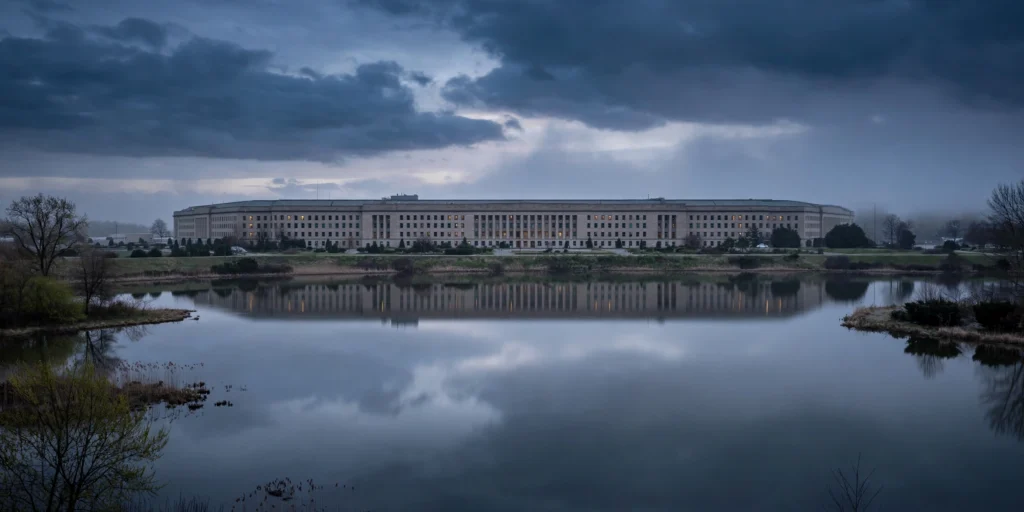
Pentagon News: Trump Weighs Blame in Long Iran War
Meta description: Trump is weighing who to blame for the long Iran war and questioning his top defence advisers, as the Pentagon lays out new strike options.
The pentagon news emerging from Washington on Sunday, November 1, 2026, was not about a decision to go to war. It was about a president asking, in private, why a war he was told would be short is still going on, and who should answer for that. According to a report in The Atlantic, published on Sunday and relayed by Israeli and international outlets, President Donald Trump has begun asking allies about two of his most senior defence advisers, Defence Secretary Pete Hegseth and General Dan Caine, the chairman of the Joint Chiefs of Staff, as he searches for someone to blame for a conflict with Iran that has now lasted more than eight months. The report, based partly on conversations with two outside advisers close to Trump and with administration officials, portrays a president frustrated by a war that was promised to him as swift and decisive, and now convinced that the conflict is at least partly responsible for his party’s political difficulties days before the midterm elections.
That frustration has a political context that cannot be separated from the military one. Americans vote on Tuesday, November 3, and Republicans face the possibility of losing control of the House of Representatives, and perhaps the Senate as well. Trump, according to the report, has come to believe that the prolonged war with Iran has contributed to that predicament, after his advisers assured him at the outset that the fighting would be over well before the elections. He has also, in public, threatened Iran with further military action, telling supporters at a campaign rally in Iowa on Sunday night that he had held back from further attacks because he wanted to avoid additional casualties, but that at some point the United States would have to give Tehran what he called the hammer. The private questioning of his advisers and the public threat to Iran are two sides of the same moment: a president who has previously declared victory in the war now trying to understand why the promises of a quick outcome did not materialise, and keeping open the option of a new round of strikes immediately after the elections.
Iran War News: A War That Was Meant to Be Short
The war that Trump is now reassessing began in late February 2026, when the United States and Israel launched joint attacks on Tehran and other Iranian cities. In its most intense phase, Tehran retaliated with missile and drone attacks across the region, and the conflict has since restricted shipping through the Strait of Hormuz, the narrow waterway through which a large share of the world’s traded oil normally passes. Since that initial campaign, American strikes have continued in a more limited form, but they have not, according to the Atlantic report, secured the concessions Washington sought from Tehran. Instead, the report says, they have hardened the Iranian government’s position and prompted retaliatory attacks against American assets and allies in the region. A renewed campaign, the magazine warns, would also further deplete American munitions stockpiles, a practical constraint that has shadowed the war from its early months.
Much of the criticism described in the report has focused on Hegseth. People close to the president are said to accuse the defence secretary of presenting an excessively optimistic assessment of the war in order to maintain Trump’s approval. One outside adviser was quoted as saying that Hegseth was good at telling the president what he wanted to hear, and sources close to Trump suggested that the secretary had failed to convey fully the difficulties facing American forces. Those are serious charges against a defence secretary in wartime, and they were rejected forcefully by the Pentagon. A Pentagon spokesperson, Sean Parnell, said Hegseth consistently provided the president and senior White House officials with a complete picture of military operations, and dismissed suggestions to the contrary as false. The White House also defended both men, with spokesperson Anna Kelly saying Trump and his team retained full confidence in Hegseth and Caine, and that both were working to carry out the president’s objectives. Readers should weigh those two accounts together: the report rests on unnamed advisers and officials, while the official denials are on the record, and neither side’s version can be verified independently from the outside.
What is not disputed is that the question of blame has become entangled with the question of what happens next. Trump has not, as of the report’s publication, ordered the resumption of strikes against Iran. People close to him say that even if he decides to launch another offensive, he may keep that decision secret until the last possible moment. That secrecy, if true, would be consistent with his handling of the war so far, in which public threats and private deliberations have run in parallel, and in which the loudest statements have not always signalled an imminent decision. It also means that the most important development in the coming days may be one that is not announced at all, until American forces are already moving.
Pentagon News: The Options on the Table
Against that backdrop, Hegseth and Caine visited the White House last week to present Trump and Vice President JD Vance with a range of military options intended to create the conditions for the president to declare victory. Admiral Brad Cooper, commander of United States Central Command, which oversees American military operations in the Middle East, also visited the White House last week. According to current and former defence officials who spoke to The Atlantic, the options included a limited strike lasting several hours, a military operation lasting several days, or a broader campaign extending over several weeks. Trump could also maintain the American naval blockade in the Strait of Hormuz while continuing to threaten renewed strikes, or he could decide against any further escalation at all. The breadth of that menu is itself revealing: it suggests that the administration has not settled on a single theory of what a new round of fighting would achieve, and that the choice ranges from a symbolic demonstration of force to a sustained campaign.
Supporters of renewed military action believe the economic pressure on Tehran is beginning to work, and that additional strikes could force the Iranian government back to the negotiating table. One proposal described in the report involves an extended campaign against Iranian air defences and infrastructure, similar to the initial phase of the war before American attacks shifted toward Iranian forces operating around the Strait of Hormuz. Under that proposal, Washington would be expected to argue that infrastructure targeted in such an operation serves both military and civilian purposes. Such attacks, however, could endanger civilians and potentially raise questions under international humanitarian law, a risk the report notes explicitly. Another proposal calls for a campaign lasting several days against Iran’s nuclear programme. Neither proposal, the report argues, offers a clear answer to the threats posed by Iran’s regional allies and proxy groups, particularly the Houthis in Yemen, who have recently attacked targets in Saudi Arabia. Eliminating the threat from Iranian-backed groups was among the objectives Trump outlined at the beginning of the war, and it remains unmet.
The economic consequences of a new campaign are another source of concern inside the administration. Renewed American strikes could drive oil prices higher and place additional pressure on the American economy and on Washington’s allies, at a moment when energy markets are already sensitive to any disruption in the Gulf. One administration official told The Atlantic that Trump’s recent shift in his approach toward Ukraine was partly motivated by a desire to allow more Russian energy supplies to reach international markets, potentially limiting the impact of renewed fighting in the Middle East on global energy prices. Whether that reasoning holds up is a matter for energy analysts, but its presence in the report shows that the Iran decision is not being weighed in isolation. It is being weighed against the price of petrol, the state of the economy, and the electoral calendar, all at once.
The plans have also drawn criticism in Congress. Democratic Senator Chris Murphy, who was briefed on some of the military options, described them last week as insane, warning that the proposals could trigger devastating escalation and seriously undermine the United States’ commitment to the rule of law. Murphy’s language was unusually strong for a senator briefed on classified options, and it signals that any new campaign would face immediate political opposition at home, not only military resistance abroad. It also underlines a recurring tension in this war: the military options presented to the president are judged not only by whether they can be carried out, but by whether they can be defended, legally and politically, once they are.
Trump Netanyahu News: An Ally’s Uncertain Future
The trump netanyahu news running alongside the Pentagon deliberations adds a further layer of uncertainty. Officials within the Trump administration expect Israeli Prime Minister Benjamin Netanyahu to support renewed attacks, given his backing for the war and his belief that continued confrontation with Iran could help him retain political power. The Atlantic noted, however, that Netanyahu’s political future remains uncertain following Israel’s elections last week, in which no clear governing majority emerged. That uncertainty matters, because an Israeli leader fighting for his political survival may have different incentives from an American president facing a midterm election, and the two men’s timetables may not align even when their objectives overlap.
It is important, at this point, to separate two different reported clashes that have sometimes been blurred together in fast-moving coverage. The Atlantic report describes Trump questioning his own American defence advisers, Hegseth and Caine. A separate set of Israeli media reports, relayed in The Times of Israel’s live coverage, describes a clash inside Israel’s own leadership: between Netanyahu and the chief of staff of the Israel Defense Forces, Lieutenant General Eyal Zamir, over an instruction from the prime minister for unspecified military action that defence officials believed could lead to a swift confrontation with Iran shortly before the election. Netanyahu denied that account, and Defence Minister Israel Katz insisted that Israel had no plans to strike Iran before the election, and that reports of disagreements between the political leadership and the military were baseless. The two stories share a subject, Iran, and a moment, the days around an election, but they describe different arguments in different capitals, and they should not be merged into a single claim that Trump and Netanyahu clashed with each other over a renewed attack. No such direct clash between the two leaders is established in the reporting cited here.
What can be said with confidence is that Washington and Jerusalem are talking, that they have not announced a joint decision, and that the question of timing remains open between them as much as it remains open within each capital. Trump has said he had a good conversation with Netanyahu about Iran, and American media have reported that the two men spoke on Saturday about whether and when to intensify combat operations. At the same time, other reporting has described a split over timing and scope, with Washington urging patience while diplomacy continues. Those reports rest on unnamed sources and should be treated with the caution that applies to any account of a private conversation between leaders. The public record, by contrast, is clear on one point: as of Sunday, no new joint attack had been announced, and the American position as stated by Secretary of State Marco Rubio on Saturday was that Trump had not made a decision about fresh strikes.
Trump Administration: Leaks, Dismissals, and the Sylvia Case
The tensions inside the Pentagon have a second, more personal dimension, described at length in the Atlantic report. As Trump considers his next steps against Iran, unease within the defence establishment has intensified following a series of dismissals of senior military officers ordered by Hegseth. Last week, the defence secretary unexpectedly fired Army Lieutenant General Brett Sylvia, one of the most senior officers on the Joint Staff and its director of planning. According to officials working with Hegseth, Sylvia failed polygraph examinations conducted as part of an investigation into leaks to the media, after reports disclosed details of White House discussions and ammunition shortages resulting from the war in Iran. Hegseth had ordered him to undergo at least three such tests, the report says. Sylvia has not publicly responded to the allegations, and The Atlantic said it was unable to reach him for comment.
Hegseth believes the Joint Staff, which reports to Caine, has a serious problem with unauthorised disclosures. According to the report, Caine did not strongly challenge that assessment, although he appeared to have been unaware of some of the circumstances surrounding Sylvia’s dismissal. Initially, Caine’s office issued a statement thanking Sylvia for thirty-two years of military service. After receiving further information from the defence secretary’s team, the office released a revised statement acknowledging that the original announcement had not accurately reflected the full circumstances of his departure. The revision, small in itself, has been read by Pentagon observers as a sign of the awkward position Caine now occupies: caught between a defence secretary determined to root out leaks and a Joint Staff whose officers are watching, nervously, to see who might be next.
According to The Atlantic, Hegseth has sought to strengthen his standing with Trump by portraying himself as someone determined to protect the president against damaging leaks. Some Pentagon officials suspect Sylvia’s dismissal was intended to weaken the influence of the Joint Staff at precisely the moment Trump is reassessing the performance of his advisers and the outcome of the war. Hegseth has already dismissed or forced the departure of more than two dozen generals and admirals, the report says, and the latest removal has fuelled unease within the Pentagon, where senior officers are questioning who might be next and what message the defence secretary is attempting to send. That unease matters for the Iran decision, because a military establishment riven by suspicion and dismissals is not an ideal instrument for carrying out a complex new campaign, and because the president’s confidence in his advisers is, on the report’s account, already shaken.
Alongside the military preparations, diplomatic efforts to bring Iran back to negotiations are continuing, and they form the other half of the story. According to The Atlantic, Vance sent a letter last Sunday to Mohsen Rezaei, a senior Iranian security official, proposing the resumption of direct talks between Washington and Tehran. The vice president emphasised that Iran’s nuclear programme would have to be addressed from the beginning of any negotiations, but did not specify what concessions or incentives the United States might offer in return. International mediators who delivered the letter sought to arrange a meeting later this week, around the time Trump is expected to decide whether to resume military operations. The prospect of renewed negotiations has also generated scepticism within the administration, after previous attempts to use military pressure to secure an agreement failed to produce the desired results. The result is a familiar pattern in this war: threats and talks advancing at the same time, each shaping the other, and neither, on its own, telling the full story.
White House News: The Official Defence, and a Historical Warning
The White House news response to the Atlantic report was, on its face, a full-throated defence. The Pentagon rejected the suggestion that Hegseth had misled the president, and the White House said both Hegseth and Caine retained the president’s full confidence. That is the standard response to an anonymous-source report that questions senior officials, and it may well reflect the administration’s genuine position. It does not, however, resolve the underlying tension described in the report, which is not really about whether two men keep their jobs. It is about whether the strategy they helped design has worked, and whether a new strategy, offered by the same advisers, can deliver a different outcome. A researcher at the Stimson Center, Michael Cohen, warned in the report that another unsuccessful round of attacks could expose the limitations of American military power. If Tehran continues to reject Washington’s demands despite additional strikes, he argued, the administration would have to confront the question of whether to keep escalating a conflict even after demonstrating that military pressure alone had failed to achieve its objectives.
The Atlantic report closes with a historical parallel that Trump himself may find uncomfortable. It points to the 2006 midterm elections, when Republicans lost control of both chambers of Congress amid widespread public dissatisfaction with the Iraq war. President George W. Bush subsequently blamed Defence Secretary Donald Rumsfeld for the defeat and forced him from office. Yet just two months later, Bush ordered a major increase in American troop levels in Iraq, escalating the military campaign rather than bringing it to an end. The parallel is not exact, and the wars are different, but the lesson the magazine draws is clear: changing the adviser does not necessarily change the policy, and an electoral defeat blamed on a war does not necessarily end that war. Republican losses on Tuesday, the report suggests, would not necessarily reduce the likelihood of renewed attacks on Iran. They might, paradoxically, accompany an escalation, as a president seeks to demonstrate resolve after a political setback.
What Happens Next
The immediate calendar is now the clearest part of the story, even if the outcome is not. Americans vote on Tuesday, November 3, and the days after the vote will be the first real test of whether the Atlantic report’s account of Trump’s frustration translates into action. If the administration decides that the remaining targets in Iran must be dealt with by force, the options presented last week, from a strike lasting hours to a campaign lasting weeks, will become the framework within which that decision is taken, and the questions raised by critics, about civilian harm, about legal justification, about depleted stockpiles, and about the response of Iran’s regional allies, will become urgent rather than theoretical. If, instead, the diplomatic track opened by Vance’s letter produces a meeting and then a framework, the warnings and the blame game will stand as the pressure that helped bring about a pause, and the target lists and readiness reports will remain what they are now: preparations for a war that did not resume.
There are other possibilities between those two poles, and they may be the most likely. A limited strike met by a limited response, a further round of talks that narrows but does not close the gap, a pause that lasts until the next political deadline, all of these have happened before in this war, and all of them remain possible now. The honest position for anyone following this story is to hold all of those outcomes open, and to watch for the concrete signals that distinguish one from another: whether the Doha talks continue and at what level, whether American officials repeat the no-decision line or replace it with something harder, whether Hegseth or Caine leaves his post or stays, whether shipping through the Strait of Hormuz is affected, and whether the Vance letter reported by Rezaei produces a reply from Tehran or remains unanswered. Above all, readers should remember what the Atlantic report is and what it is not. It is a well-sourced account of private frustration and private deliberation, relayed through unnamed advisers and officials, and firmly denied in its specifics by the Pentagon and the White House. It is not an announcement of a decision, and it does not, on its own, prove that a new attack is coming. What it does prove, if its account is accurate, is that the war that was supposed to be over before the elections is still shaping the presidency that promised to end it, and that the search for someone to blame has now become part of the war itself.
Source: The Atlantic, via Ynetnews