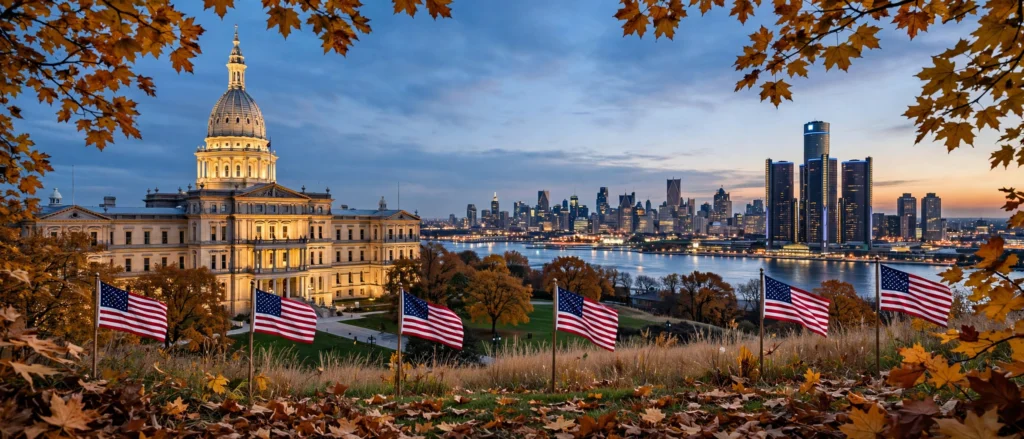
Battle for the Senate: Stevens Backs Rogers in Michigan
Meta description: Democrat Haley Stevens endorsed Republican Mike Rogers for Senate two days before the Michigan vote, capping a bitter party feud.
The battle for the senate took an extraordinary turn in Michigan on Sunday, November 1, 2026, when a Democratic member of Congress publicly backed the Republican candidate in one of the closest Senate contests in the country. Haley Stevens, who represents a Michigan district in the House of Representatives, announced that she would support Mike Rogers, the Republican nominee, rather than Abdul El-Sayed, the Democrat who beat her for the party’s nomination in August. The announcement came just two days before voters go to the polls on Tuesday, November 3, in a race that could help decide which party controls the Senate for the final two years of Donald Trump’s presidency.
Stevens delivered her message in a video recorded in her car, after appearing earlier on Sunday at a church service in Detroit alongside Rogers. In the video, she said that El-Sayed, the Democratic nominee, had told her she was no longer welcome in his campaign and should keep away, and that she agreed with that assessment. That, she said, was why she was endorsing Rogers for the United States Senate that day, adding that she did not belong in El-Sayed’s campaign. The bluntness of the statement, coming from a sitting Democratic congresswoman about her own party’s nominee, is what made the moment so startling. Cross-party endorsements happen in American politics, but they rarely happen this late, this publicly, and from a politician who had herself sought the very seat at stake.
The setting mattered as much as the words. Stevens joined Rogers at Perfecting Church in Detroit, a Black community church in the city, on Sunday morning. According to reporting on the appearance, she praised Rogers for his support for Black-owned businesses, telling those present that investing in such businesses was a policy she believed Rogers would pursue. The appearance had been arranged at short notice, after the two spoke on Sunday morning, and after a separate plan for Stevens to attend a church service with El-Sayed and Representative Jim Clyburn of South Carolina fell through. A fellow Michigan Democrat, Representative Debbie Dingell, who had helped organise that planned appearance, later said she had asked Stevens not to attend because the dispute had become a distraction. The church visit, in other words, was not a routine campaign stop. It was the public climax of a private breakdown that had been building for days, and it was staged, deliberately or not, in front of an audience whose votes both campaigns are courting.
Midterm Elections 2026: Why Michigan Matters So Much
To understand why a single endorsement in Michigan has drawn national attention, it helps to start with the arithmetic of the midterm elections 2026. Democrats currently hold 47 seats in the Senate, against 53 for the Republicans, and they need a net gain of four seats to take control of the chamber. That task was already steep before Sunday. Michigan has been described by observers as the Democrats’ only genuinely vulnerable seat in this cycle, because the seat is open: the outgoing senator, Gary Peters, is not seeking re-election, and the contest to replace him has been fiercely fought on both sides. Losing Michigan would not by itself settle control of the Senate, but it would make an already difficult Democratic path considerably harder, forcing the party to win seats elsewhere that it had not counted on losing ground in.
The broader picture sharpens the point. While the president’s popularity is low and Democrats are widely seen as having a strong chance of winning back the House of Representatives, the Senate outlook is much tighter. Senate races turn on individual states, individual candidates, and the particular issues that dominate each contest, and Michigan has become one of the most closely watched of them all. It is a state that has swung between the parties in recent presidential elections, it has a large and politically engaged Black electorate in Detroit, a substantial Arab American and Muslim population, and a manufacturing economy that makes it sensitive to arguments about jobs, trade, and the cost of living. A race that was already tight did not need a last-minute split in the Democratic camp. It got one anyway.
That is why the reaction from Democratic leaders was so swift and so sharp. Senate Democratic leader Chuck Schumer, who had backed Stevens during the primary contest, posted on Sunday that her move was a despicable betrayal, and insisted that Senate Democrats remained united behind El-Sayed, whom he presented as the candidate who would fight for the economic interests of working families in Michigan. The chair of the Michigan Democratic Party, Curtis Hertel, went further, declaring that Stevens was not a current member of the state party and would not be one in the future. Peters, the outgoing senator and a former mentor to Stevens, said he was extremely disappointed by her choice. Several members of Stevens’s own team announced their resignations after the video was posted. Whatever the electoral effect turns out to be, the political cost to Stevens within her own party was immediate and severe.
Democratic Party News: How a Primary Feud Reopened
The roots of Sunday’s rupture lie in a primary campaign that was, by every account, unusually bitter. Stevens entered the race for the Democratic Senate nomination hoping to succeed Peters, and she carried the backing of much of the party establishment. El-Sayed, a public health physician and former Wayne County health director, ran as a progressive challenger, building his campaign around criticism of the Israeli government’s actions in Gaza, a call to remove money from politics, and a signature proposal to expand the federal Medicare programme to cover all Americans. When the votes were counted in August, El-Sayed won by less than one percentage point, one of the narrowest primary margins in the country this cycle. Stevens then did what losing primary candidates are expected to do: she endorsed the winner, and the party, establishment and insurgent wings together, rallied around El-Sayed for the general election.
That truce held for roughly three months, and then it collapsed in the final week of the campaign. The immediate trigger, according to reporting on the dispute, was a disagreement over Israel and over campaign advertising. Stevens’s fiance, Jason Turkish, said publicly last week that he would vote for Rogers, citing concerns about El-Sayed’s rhetoric on Israel. Stevens herself then demanded that El-Sayed condemn an advertisement run by an outside group supporting him, which linked American military aid to Israel to rising grocery prices in Michigan, language she described as antisemitic. She also demanded that he withdraw a campaign advertisement that featured Tucker Carlson, the conservative commentator. El-Sayed, for his part, accused Stevens of trying to relitigate a primary that had ended three months earlier, and on Friday his campaign said she would not be welcome in his campaign operation. Stevens, in turn, said she had been waiting for an apology from El-Sayed for remarks made during the primary, as well as the condemnation she had sought, conditions his team regarded as unacceptable.
The sequence of calls and messages that followed shows how quickly a manageable disagreement became a public break. Rogers said he would welcome Stevens, and he telephoned her on Friday night. She called him back on Sunday morning, and hours later they were together at the Detroit church. El-Sayed did, on Saturday, explicitly reject the contents of the outside group’s advertisement, and Stevens welcomed those remarks. But by then the personal breach appears to have gone too far to repair. The planned joint church appearance with Clyburn, which might have presented a picture of Democratic unity in the final weekend, was abandoned, and the two candidates spent Sunday at different Black churches in Detroit, each making their own appeal to the same voters. For a campaign that had spent months trying to present a united front, the optics could hardly have been worse.
There is also a longer history behind the feud that helps explain its intensity. During the primary, Stevens was one of the strongest supporters of Israel among Democrats in Congress, while El-Sayed was staunchly critical of Israeli government policy and supportive of Palestinian rights. Pro-Israel advocacy groups poured close to forty million dollars into supporting Stevens’s candidacy or attacking El-Sayed’s, according to reporting on the race, without success. Stevens, in an interview before the primary, had described Rogers in harsh terms, calling him a tool of Donald Trump, and had presented herself as the candidate best placed to defeat him. As recently as Friday, she told a national newspaper that she would vote for the Democratic ticket. The distance between that position and Sunday’s endorsement is a measure of how completely the relationship between the two Democrats broke down in the space of a weekend, and of how personal, as much as ideological, the dispute had become.
Republican Party News: Rogers Welcomes a Democratic Defector
From the Rogers campaign’s perspective, Sunday was an unexpected gift, and the candidate treated it as one. Rogers called Stevens a courageous leader who deserved the respect of every Michigan voter, and his spokesperson confirmed the endorsement to national news organisations. At the church, he told reporters that Stevens’s decision was more a statement about standing together against hate and about the future of the state and the country than it was about party labels, and he noted that Stevens had reminded him she remained a Democrat. That framing was politically shrewd. It allowed Rogers to present the endorsement as a matter of principle rather than opportunism, and to appeal to Democratic-leaning voters who might be uneasy about El-Sayed without asking them to embrace the Republican Party wholesale.
Trump, never one to miss an opening, welcomed the endorsement enthusiastically on his own social media platform. He called the news big, praised Stevens as a highly respected Democrat, and said her following was huge and the respect she commanded in Michigan, particularly among African American and Jewish voters, was virtually unparalleled. Asked by journalists about the development, he said Stevens would be welcome in the Republican Party. The praise carried a certain irony, which did not go unnoticed in Michigan coverage: in August, Trump had described the county Stevens represents as one of the most corrupt voting areas in the United States, if not the world. Sunday’s language was very different, because Sunday’s politics were very different. A Democratic congresswoman endorsing a Republican in a must-win Senate race is useful to Trump in a way that a Democratic congresswoman running against his party’s candidate is not, and his response reflected that calculation plainly.
El-Sayed’s campaign, meanwhile, tried to keep its focus on the race itself rather than on the drama. In a statement on Friday, before the endorsement, El-Sayed said that while Stevens seemed intent on relitigating a primary that ended three months ago, his campaign would focus on beating Rogers, holding Trump accountable, removing money from politics, putting money in people’s pockets, and passing Medicare for All. That message, repeated by his supporters after Sunday’s announcement, is an attempt to turn the story back to the issues that won him the primary: economic fairness, health care, and opposition to Trump. Whether voters hear that message, or whether they hear only the noise of the split, is the question that will decide Tuesday’s result.
Election Polls, Swing States, and What Happens Next
It is tempting to ask whether Stevens’s endorsement will change the outcome, but the honest answer, on the evidence available on Sunday, is that nobody can yet say. The race was already described as tight, and no new polling released alongside the endorsement measured its effect. Endorsements from defeated primary rivals usually matter less than the act of defection itself: they signal to voters that a campaign is divided, they dominate news coverage in the final days when many voters are making up their minds, and they give the opposing campaign a ready-made talking point about unity and judgment. Stevens is well known in Michigan, not least for her role in the team assembled under President Barack Obama to help the automobile industry, an industry deeply woven into Detroit’s history, and her name carries weight with the establishment Democrats and suburban voters whose support El-Sayed needs. At the same time, an endorsement delivered in anger, after a public falling-out, can also look like sour grapes, and El-Sayed’s supporters will argue that voters should judge the candidates, not the feud.
The stakes extend beyond Michigan. The 2026 midterms are, in part, a referendum on the second Trump presidency, and the battle for control of Congress will shape what the president can do in his final two years in office. A Democratic House could block his legislative agenda and pursue investigations; a Democratic Senate could block his judicial and executive appointments. A Republican hold on the Senate would preserve his freedom to shape the courts and the administration. Every seat matters in that calculation, but Michigan matters more than most, because it is the seat Democrats can least afford to lose and the seat Republicans have targeted most aggressively, with rhetoric about El-Sayed that his supporters and many observers have described as hostile and, in some cases, openly prejudiced. El-Sayed, born in Detroit’s suburbs to Egyptian parents, would become the first Muslim to serve in the Senate if he wins on Tuesday, a milestone that has itself become part of the campaign’s symbolism.
Voter turnout will be decisive, as it so often is in midterm elections, and both campaigns spent Sunday making their closing appeals to the voters most likely to turn out. Stevens’s appearance at a Black church in Detroit, and El-Sayed’s appearance at a different Black church in the same city, underline where both sides believe the race will be won: among Black voters in Detroit, whose turnout and preferences have decided Michigan elections before. If Stevens’s endorsement depresses Democratic turnout, or persuades a slice of moderate Democrats to cross over to Rogers, it could tip a race decided by a narrow margin. If, instead, it energises El-Sayed’s base, who may see the endorsement as a betrayal by the party establishment they defeated in August, it could have the opposite effect. Both outcomes are plausible, and the only reliable test is the count on Tuesday night.
There is one further caveat worth stating plainly, because the coverage itself has not been uniform. Some national outlets described Sunday’s church appearance as an endorsement, citing Stevens’s own video, in which she used the word endorsing explicitly. Others, including wire and broadcast reports summarised in later coverage, described the moment more cautiously as an appearance or a show of support, and noted that no formal written endorsement statement had been issued. The distinction matters less than the video itself, in which Stevens said in her own words that she was endorsing Rogers, but readers should be aware that the story was first reported in different terms by different outlets, and that the fullest account rests on Stevens’s video, the Rogers campaign’s confirmation, and the reactions of Democratic leaders that followed. What is not in doubt is that a Democratic congresswoman stood beside the Republican Senate candidate two days before the election and told voters to support him over her own party’s nominee. In a campaign season full of surprises, that remains a remarkable fact, and Michigan voters will deliver their verdict on it on Tuesday.
Source: Axios