Midterm Elections 2026: Trump Heads to Asia After Losses
President Donald Trump leaves Washington on Monday for Asia, carrying a political problem no foreign trip can fully solve and a bet that a week of summit diplomacy can change the subject anyway. Twelve days after the midterm elections 2026 handed control of both the House of Representatives and the Senate to the Democrats, the president will attend the ASEAN summit in the Philippines and then the APEC summit in Shenzhen, China, in a tour his advisers have framed as a chance to show that he remains the central figure in American foreign policy even as his power at home shrinks.
The trip is the first extended foreign travel of Trump's final two years in office, and it comes at a moment when the balance of power in Washington has shifted decisively against him. The Democrats' victories ended unified Republican control of the federal government, and the president now faces a Congress that can investigate his administration, block his legislative agenda and restrict his funding. For a president who is constitutionally barred from seeking a third term in 2028, the remaining two years will be defined less by what he can pass at home than by what he can do abroad, where executive authority still gives him wide room to act. That is the calculation behind the Asia tour: to project strength on the world stage after a defeat at home, meet the leaders of China and Russia in a setting of his choosing, and remind allies and rivals alike that the United States still speaks through him.
Midterm Elections 2026: A New Political Landscape at Home
The midterm elections 2026 delivered a result that reshaped the presidency. Voters handed the Democrats control of both chambers of Congress, a sweeping rebuke that extended into states and districts long considered safe Republican ground. The scale of the defeat has forced the Republican Party into a public reckoning over its leadership, its message and its future, and it has left Trump entering the final two years of his presidency as a lame duck with a hostile Congress.
The political consequences are concrete. A Democratic-controlled Congress can hold hearings into the administration, demand documents, restrict funding for the president's priorities and tighten controls on sensitive exports such as artificial intelligence chips to China. It can also slow the confirmations, appointments and spending decisions that a president relies on to govern. Trump still retains considerable executive authority over foreign policy, and he can negotiate with foreign leaders, impose tariffs and direct the armed forces without asking Congress first, but the days when his party controlled the levers of power in Washington are over.
Analysts who study presidential politics say the pattern is a familiar one. "After bad midterms, this is how presidents reset," Edgard Kagan, an expert at the Center for Strategic and International Studies, said during a news briefing, describing the Asia trip as the classic move of a president who has been weakened at home and turns to the world stage to rebuild his standing.
The domestic backdrop makes the reset harder than usual. Trump is 80 years old and in the final two years of his second term, with no prospect of another election campaign to rally his party around. His approval ratings sank to record lows during the campaign, according to CNN's reporting on the midterm result, as voters punished the administration over the cost of living and the economic fallout from the war with Iran.
The Asia Itinerary: Manila First, Then Shenzhen
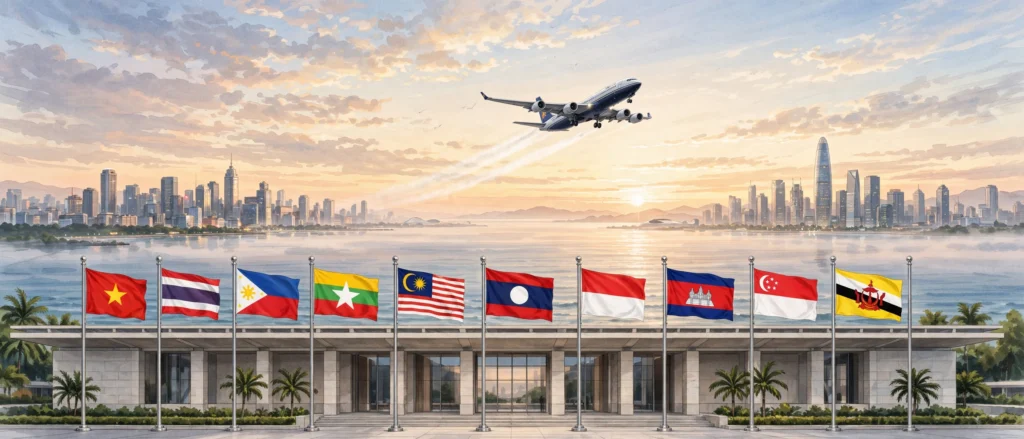
Trump will leave Washington on Monday and arrive in the Philippines on Tuesday for the summit of the Association of Southeast Asian Nations, known as ASEAN, in Manila. The gathering, the 49th ASEAN summit, runs from November 16 to 18, and it will be Trump's second consecutive appearance at the event, following his attendance at the summit in Kuala Lumpur, Malaysia, in 2025. It will also be his return to the Philippines after nearly a decade, since he last attended the ASEAN summit in Manila in 2017.
In Manila, Trump will sit with the leaders of the Quad partners, Australia, Japan and India, a grouping that has become one of the central forums for coordinating policy toward China and the wider Indo-Pacific. For ASEAN, Trump's attendance is itself a win for the bloc, a sign that Washington still treats the grouping as a serious partner rather than a stage for bilateral deals.
From Manila, the president will travel to Shenzhen, the southern Chinese technology hub, for the Asia-Pacific Economic Cooperation summit, known as APEC, which is scheduled for November 18 and 19. Xi Jinping, who is chairing the two-day gathering, is due to hold separate talks and a working lunch with Trump on Thursday before the trilateral session that closes the visit. The White House has said the meeting with Xi will be their fourth since Trump returned to power last year, following the president's trip to Beijing in May and Xi's visit to Washington in September.
The final event of the visit is the first-ever trilateral meeting between the leaders of the United States, China and Russia, set for Thursday, November 19, on the sidelines of the APEC summit in Shenzhen. Trump told reporters this week that he expects to meet Xi and Putin together, and the White House confirmed on Friday that the session will focus on nuclear arms, with Trump pressing for reductions in the world's nuclear arsenals. A senior United States official who briefed reporters said no agreement was expected from the first encounter, describing it instead as an opening discussion that could in time lead to negotiations on a new arms-control framework involving all three countries.
Trump Administration Agenda: Iran, Trade and China
Three subjects dominate the agenda for the trip: Iran, trade and China. Each of them connects the president's foreign policy to the political damage he suffered at home, and each of them will be watched for signs of whether the new balance of power in Washington changes how the United States behaves abroad.
The war with Iran is the most urgent. The conflict has been particularly challenging for the United States' Asian partners and allies, who have watched the fighting disrupt shipping, unsettle energy markets and raise questions about the predictability of American decision-making. Trump has said several times since the midterms that renewed fighting between the United States and Iran is unlikely, and he intends to raise the war with both Xi and Putin during the trilateral session in Shenzhen. The White House has said the president will press his case directly, and a senior official said the topic would be on the table alongside nuclear arms.
Trade is the second strand, and it runs through both summits. China and other top Asian exporters have been stung by Trump's aggressive approach to tariffs, and the United States-China trade truce, extended only until mid-January, hangs on a fragile balance of semiconductor export controls and Chinese access to critical minerals. The minerals question has become one of the sharpest points of friction between the two countries, with Washington trying to loosen Beijing's grip on the supply of materials that go into everything from electric vehicles to advanced weapons, and Beijing using its dominance of processing as leverage of its own.
China's own response to the American election result has been measured. Beijing has described the midterms as an internal matter for the United States and expressed its willingness to continue working with Washington despite the political changes.
The Nvidia Question Hanging Over the Trip
One subject that will not be raised with Xi, according to American officials who briefed reporters on the trip, is the scandal that has engulfed Nvidia, the chipmaker at the centre of the artificial intelligence race. Jensen Huang, the company's co-founder, resigned as chief executive on November 12 following revelations about extramarital relationships, including one involving Alice Huang, a Singapore-based business executive suspected by American intelligence agencies of being a Chinese intelligence asset.
The resignation has added a volatile element to the chip debate that runs underneath the whole Asia trip. The future of Nvidia's powerful H200 artificial intelligence chips, which the Trump administration has permitted to be exported to approved Chinese customers under restrictions, is now a live question, and the Democratic-controlled Congress is expected to press for tighter controls on the export of advanced chips to China. Officials said Trump would not be raising the Huang matter with Xi, a sign that the administration wants to keep the summit focused on the subjects it has chosen rather than the scandal that has dominated the domestic news.
Elon Musk, the Tesla and SpaceX chief, will accompany Trump to Asia, after having publicly signed a petition seeking Huang's reinstatement as Nvidia's chief executive.
A Region Watching Washington's Staying Power
For the countries of Southeast Asia, the trip is a test of whether the United States will stay engaged in the region when its president is weakened at home. The region's unease is visible in the State of Southeast Asia 2026 survey, which has tracked a steady anxiety among governments in the region about Washington's reliability, and in the private warnings from diplomats that American standing will keep slipping if Washington prioritises bilateral interests over ASEAN-led multilateralism.
The Philippines, as host, carries its own complications. President Ferdinand Marcos Jr's approval rating is at its lowest since 2022, his chairmanship year has coincided with a flood-control corruption scandal, the impeachment trial of his ally-turned-political-nemesis Vice President Sara Duterte, and an ailing economy suffering from severe inflation. Philippine-China relations are at a low point, with lingering tensions in the South China Sea and diplomatic skirmishes between Filipino security officials and the Chinese embassy in Manila adding to the strain.
What Happens Next
The week will unfold in a tight sequence. Trump arrives in Manila on Tuesday for the ASEAN summit, where the Quad meeting and the trade discussions will set the tone. He then travels to Shenzhen for the APEC summit on November 18 and 19, where the bilateral meeting and working lunch with Xi come first, followed by the trilateral session with Putin on Thursday, November 19. The trilateral meeting will be the final event of the visit, and the one that historians are most likely to remember, since it brings together the leaders of the world's three most consequential nuclear powers for the first time in this format, even though all three attended the 2019 G20 gathering.
The measure of success for the trip is not a signed agreement. The White House has already said no deal is expected from the trilateral meeting, and the trade and Iran discussions are too complicated to be settled in a week of summitry. The measure is whether Trump returns to Washington with a different story to tell, one in which he is photographed alongside Xi and Putin, talking about nuclear weapons and the war in Iran, rather than answering questions about an election he lost and a Congress he no longer controls.
Source: KTAR News