Iran War News: Iran Hits Bahrain Radar Twice in 3 Days
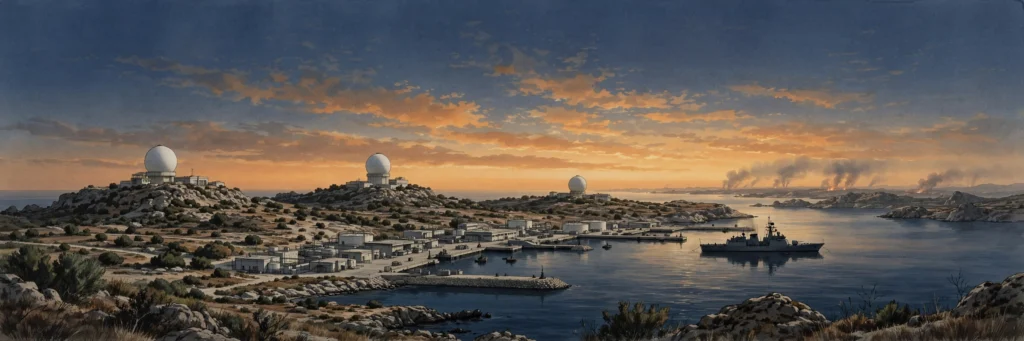
Sirens sounded across Bahrain before dawn on Sunday as explosions echoed over the island kingdom, and within hours Iran's Revolutionary Guard Corps was claiming its second drone attack on an American radar installation there in three days. The claim, carried by Iranian state media, said six drones from the Guard's Aerospace Force had struck a United States air defence radar at the Al-Riffa helicopter base, in what Tehran described as a second phase of retaliation against Washington. It was the sharpest escalation in the Gulf since the early weeks of the war, and it arrived with a warning that any further American action would be answered more forcefully still.
The attack, if confirmed, would mark a clear change in the shape of the conflict. For weeks the fighting between the United States and Iran had settled into a pattern of standoff and sporadic exchanges, with the Strait of Hormuz closed and both sides trading sanctions, blockades and warnings. What remains unresolved is whether the drones hit anything at all. Neither the United States military nor the government of Bahrain had confirmed any damage or casualties by Sunday morning.
Iran War News: What Happened in Bahrain on Sunday
The first signs of trouble came in the dark. Residents reported a first series of explosions at around 4:00 a.m. local time, and a second series at around 6:30 a.m., as sirens sounded across the island. Bahrain's Interior Ministry issued two alerts within about three hours, the first at roughly 4:30 a.m., or 01:30 GMT, warning of a potential threat and urging residents to remain calm, proceed to the nearest safe location and follow news through official channels. The ministry named no source for the threat. The warnings were the first nationwide alerts Bahrain had issued since September.
The Bahrain Defence Force said its air defence systems had thwarted several Iranian aerial attacks targeting the kingdom, and the Foreign Ministry said air defence systems had shot down Iranian drones. In a separate statement, the ministry said Bahrain rejected the use of its territory as an arena for settling scores and held Iran fully responsible for the attacks and their consequences. Whether the blasts residents heard were interceptions or impacts, no government has yet said.
Tehran's account was far more specific. In a statement carried by the Iranian state broadcaster and posted on Telegram, the Revolutionary Guard said the United States air defence radar at the Al-Riffa helicopter base had been targeted by six drones belonging to its Aerospace Force. The statement described the operation as a second round of retaliation against the United States, declared the Strait of Hormuz closed, and warned that any aggression by the American enemy would be met with an even harsher and more forceful response. The claim has not been independently confirmed, and the United States military had not commented on it by the time the reports emerged. That silence matters, because the first claim, made on Friday, was flatly rejected by the American military.
Friday's First Strike, and the American Denial
Sunday's attack did not come out of nowhere. On Friday, November 13, the Revolutionary Guard said it had destroyed an American early-warning radar system in Bahrain, in retaliation for what it described as an air attack on a telecommunications tower in southern Iran. The Guard located that alleged attack in Sirik, on the Hormozgan coast, and called the operation a serious warning over what it described as aerial provocations and oil smuggling in the Strait of Hormuz.
The United States military's Central Command, which oversees American operations across the region, gave a very different account. It said Iranian forces had launched two one-way attack drones toward Bahrain, that American forces had shot both of them down, and that the attack caused no injuries or damage. Reuters reported that Friday marked the first time since early September that Iran had claimed an attack on American military assets in a Gulf country. After more than two months without a claimed strike on Gulf soil, Tehran was announcing a return to direct attacks, and Washington was insisting the attacks had failed.
The pattern repeated on Sunday, with a larger claimed force and a more explicit framing. Where Friday's operation was presented as a warning, Sunday's was presented as a second phase, a numbered campaign with a declared logic. The shift from a single warning strike to a declared and numbered series of attacks is the most important development in the story, because it suggests Tehran has decided that limited, repeated strikes on American sensors in the Gulf are a tool it intends to keep using.
The Strait of Hormuz: Mines, Tankers and a Closed Waterway
The attacks on Bahrain cannot be separated from the wider struggle over the Strait of Hormuz, the narrow waterway through which a large share of the world's seaborne oil passes, and which Iran says is closed. On Saturday, the Revolutionary Guard's navy said two oil tankers had struck sea mines while trying to pass through the strait. The Guard said the vessels had switched off their navigation and tracking systems and were using what it called an unauthorised route, and that two other tankers had turned back after warnings from its maritime traffic control centre.
Reporting from Tehran, Al Jazeera's Mohammed Vall said there had been two similar incidents the previous day and that the number of tankers hitting mines had increased. Iran claims the strait is under its full control, and that only Iran and Oman have the right to control passage through it. The United States rejects that claim outright. The result is a waterway in which commercial shipping must navigate not only mines and warnings but two competing sets of rules, one written in Tehran and one written in Washington.
Why Bahrain Sits at the Centre of the Iran War
Bahrain is a small island with an outsized role in the American military presence in the Gulf. It hosts Naval Support Activity Bahrain, the headquarters of United States Naval Forces Central Command and the Fifth Fleet, and it lies less than 300 kilometres from Iran's southern coast. That geography makes it both a vital American hub and an exposed one. Striking at Bahrain is striking at the command centre of the American naval presence in the region, and doing so with drones rather than missiles keeps the attack below the threshold of the heaviest escalation while still forcing the United States to defend its own headquarters.
The island has been a target since the war began. The conflict started on February 28, 2026, with surprise strikes by the United States and Israel, and Bahrain's base was struck with missiles and drones on that first day. The Bahrain Defence Force said at the time that it had shot down 45 missiles and nine drones. A Pentagon inspector general's report released in September found that Iranian attacks had damaged or destroyed buildings at American installations in eight countries, including Bahrain, in the first four months of the war.
Tehran has also used diplomacy to widen the pressure on Bahrain. It has told the United Nations Security Council that it would respond immediately to renewed American or Israeli attacks, and it has accused Bahrain and other Gulf states of supporting American military operations. Bahrain has called for the full implementation of Security Council Resolution 2817, which condemned Iranian attacks on Bahrain and other countries in the region and demanded that they stop.
Diplomacy Stalled: Seven Conditions and No Answer
Behind the drone strikes and the mine incidents, the diplomatic effort to end the war remains stalled. Iran's parliamentary speaker and chief negotiator, Mohammad Bagher Ghalibaf, told Al Jazeera last week that Tehran wanted to move beyond a state of no war, no peace, and that it had conveyed seven conditions for a deal through a Qatari mediator. The conditions included lifting the American naval blockade and sanctions, releasing frozen Iranian funds, ending hostilities on all fronts and formally declaring the war over. Tehran is still awaiting an official American response.
The Trump administration, meanwhile, has moved in the opposite direction, tightening sanctions and maintaining the blockade on Iranian ports. The contrast captures the deadlock: Iran is asking for the blockade and the sanctions to be lifted as the price of a settlement, while Washington is using them as leverage to force a settlement on its own terms. Neither side has blinked, and the drone campaign in Bahrain can be read as Tehran's answer to that stalemate, a way of raising the cost of the status quo while the negotiations go nowhere.
The wider diplomatic calendar offers one possible opening. President Donald Trump, Chinese President Xi Jinping and Russian President Vladimir Putin are expected to meet on November 19 in Shenzhen, where the war in Iran is on the agenda alongside nuclear arms. The risk, as analysts have warned, is that the space between diplomacy and escalation keeps shrinking. Saeid Golkar, an associate professor of political science at the University of Tennessee at Chattanooga, told Al Jazeera that limited exchanges could escalate into a wider war, warning that both sides may prefer to avoid a full-scale war but that the danger lies in miscalculation.
What Happens Next
The immediate questions are narrow and concrete. The first is whether the United States military confirms or denies Sunday's claim, and whether it releases any evidence about what its radars and interceptors actually saw over Bahrain in the early hours of the morning. The second is whether Bahrain reports any damage, and whether its government takes further steps to protect residents after issuing its first nationwide alerts in months. The third is whether Iran carries out a third attack, and whether the campaign it has now declared continues on the same three-day rhythm or accelerates.
Beyond Bahrain, the questions widen. Tanker traffic through the Strait of Hormuz will be watched closely after the mine incidents, and any further damage to commercial shipping would raise the stakes for every government with an interest in keeping the waterway open. The meeting in Shenzhen on November 19 will be read for any sign that Trump, Xi and Putin have found common ground on Iran.
What is clear is that the lull is over. After two months in which Iran had not claimed an attack on American assets in a Gulf country, it has now claimed two in three days, declared the Strait of Hormuz closed. The sirens over Bahrain on Sunday morning were the sound of that new phase beginning, and the weeks ahead will show whether it stays a limited campaign of drone strikes and warnings, or becomes the wider war that both sides say they want to avoid.
Source: The Washington Post