Iran War News: Trump Says Attacks Hit Yearlong High
The iran war news out of Washington on Sunday carried a new claim from President Donald Trump about the pace of the fighting. The president said Iran has launched more drones and missiles over the past week than at any time in more than a year, and he said American forces shot them all down without any damage. The claim, posted on Truth Social, tied the surge directly to the November 3 midterm elections, in which Democrats won control of both chambers of Congress. It was the president's most detailed public account yet of how intensely Iran has been attacking in recent days, and it came on the same day he told Fox News he is leaning toward resuming large-scale strikes against Iran after the New Year if diplomatic talks fail.
Trump's post framed the past week as a turning point in a confrontation that has now run for nine months. He said the surge vindicated two predictions he made before the midterms: that Democratic victories would send markets down and encourage Iran to grow more aggressive. The post also accused Democrats and Iran of working to keep oil prices high before the election, and it questioned the integrity of the vote itself.
The Truth Social Post: What Trump Said
The post opened with a reminder of the president's own election-eve warnings. "As everyone remembers, I predicted two things concerning the November 3rd Midterm Elections," Trump wrote on Truth Social. The first prediction, he said, was that if the Democrats won, the stock markets would go down, substantially, "which they have." The second was that Iran would grow more aggressive in its attacks, "which has also occurred." The two predictions were presented as a pair, and the president treated both as proven right by the week that followed the vote.
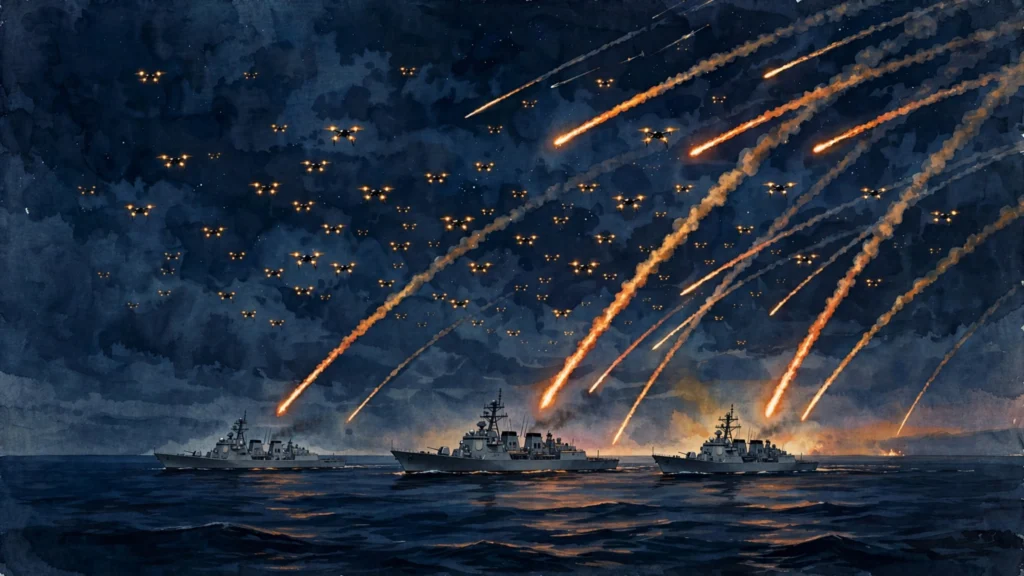
The central claim of the post concerned the scale of the Iranian attacks. Trump said Iran launched "more drones and missiles over the past week than at any time for over a year," and he added a reassurance aimed at the American public. "Don't worry, they've all been knocked down, and done no damage," he wrote. The statement did not give a number of missiles or drones, a list of targets, or a count of interceptions. It rested on the president's word, and on the visible record of recent attacks, rather than on figures that could be checked against an official tally.
The post also carried a sweeping claim about the human cost of the protests inside Iran. Trump wrote that Iran, "which has killed 81,000 protestors as of today," would grow more aggressive in its attacks. The figure was presented as the president's own, offered without a source, and no independent count matching it has been published. Anti-government demonstrations have flared again in several Iranian cities in recent weeks, and the president has encouraged the demonstrators directly.
Trump closed the argument about Iran with a judgment about how Tehran reads American politics. "Iranian leaders consider the Democrats weak, ineffective, and Country destroying, but I won't let that happen!" he wrote. The sentence was the heart of the post's political message: that the election result itself had changed Tehran's calculations, and that the surge in attacks was the proof.
Trump News: Tying the Surge to the Midterms
The midterm elections of November 3 are the hinge of the president's argument, and the results were sweeping. Democrats won control of both chambers of Congress, taking the House with at least 258 seats to the Republicans' 173, a net gain of 44 seats and 47 flips, on a popular-vote margin of about 14 points, the largest for a midterm since 1974. The scale of the defeat has dominated American politics ever since, and the president's own party has been arguing openly about what caused it.
Voter frustration over the war with Iran and rising fuel costs was one of the forces behind the Democratic victories, according to the reporting around the election, and the president's post acknowledged that connection while reversing its meaning. Where his critics say the war cost his party the election, Trump said the election result encouraged Iran to escalate the war. The two readings point in opposite directions, but they agree on one thing: the war and the election are now bound together in American politics.
Vice President JD Vance has blamed the Iran war for the midterm losses, and Trump has responded to that assessment, according to Fox News. The president's post on Sunday was, in that light, also an answer to his own vice president: the war did not cause the defeat, he argued, the defeat caused the war to get worse.
The post went further, accusing both Democrats and Iran of manipulating energy prices for electoral advantage. "Both the Dems and Iran fought like hell to keep the Oil price up as long as possible and, since the Election, the Oil price has dropped by a record level," Trump wrote, adding that it was too bad voters "didn't understand this before they pulled the trigger." The post ended with a swipe at the election itself. "The whole Election was very 'strange,'" Trump wrote. "In the end, America will win!" Fox News reported that the president separately questioned the integrity of the vote without providing evidence.
White House News: The War Powers Vote and the Blockade
The post came days after the Senate rejected a war powers resolution in a 48 to 51 vote on November 19, leaving the president's military authority intact. The vote was a defeat for the effort to restrain the president's freedom to order strikes, and it came as the confrontation with Iran was already escalating. The resolution's failure means the president faces no new congressional limit on his authority to resume large-scale attacks, and it removes one of the few institutional checks that could have complicated a decision in January.
The timing matters because the president has now put a date on his patience. Speaking to Fox News correspondent Trey Yingst earlier on Sunday, Trump said he is inclined to resume strikes on Iran after the New Year if diplomatic talks fail to produce a deal. He described the Iranian negotiators in dismissive terms, calling them "professional tap dancers," and he said the talks, which continue only indirectly, have produced little. The Truth Social post later the same day was the second half of that message: the diplomacy is failing, the attacks are intensifying, and the military option is waiting.
The other half of the president's warning concerned the sea, where the confrontation is most visible. The United States is maintaining a naval blockade of Iranian ports, part of a wider campaign to cut off the country's oil exports. Trump has described the blockade as a central piece of his strategy, and on Sunday he dared Tehran to test it, saying Iranian vessels that tried to break through the American cordon would end up at the bottom of the sea. The warning was aimed at a government that has said publicly that the blockade is about to be tested, and that has warned Washington directly. No convoy has been confirmed sailing, and tracking data has shown no vessel yet attempting the run, but the warning itself has been issued in public by both sides.
The blockade has been enforced with growing force over the past few months. According to Central Command, about 150 ships had been redirected and five disabled since July, and the aircraft carrier Theodore Roosevelt has been operating in the theatre since November 15.
Pentagon News: The Fighting Behind the Claim
The record of the past few weeks shows why the president's claim about the tempo of attacks is plausible even if its exact scale cannot be checked. American forces struck a missile launch site on Qeshm Island on November 17. The next day Iran sent drones at Ali Al Salem air base in Kuwait, a facility used by American forces, and attacked Bahrain.
Bahrain has become one of the most exposed points in the confrontation. The Gulf state hosts major American military facilities, and it has faced two attempted drone attacks in recent days, after a similar interception on Friday. The United States Embassy in Bahrain on Sunday urged Americans to exercise heightened vigilance, citing an increased threat of attacks by Iran-backed Houthis and Iranian efforts to target American government officials and facilities in the region.
Iran has also stepped up attacks on shipping in the Gulf, with almost daily claims, few of them substantiated, that tankers have struck mines as they tried to transit the Strait of Hormuz. The strait carries a large share of the world's seaborne oil, and any fighting there ripples through energy markets within hours. The Houthis, Yemen's Iran-aligned armed group, claimed on Sunday that they had attacked Saudi Arabia's Rabigh oil refinery on the kingdom's Red Sea coast, the latest in a campaign of claims against Saudi energy infrastructure that Riyadh has not confirmed. The claim and the shipping attacks are part of the same pressure campaign, aimed at forcing Washington to accept Tehran's terms.
The pressure on Tehran is also economic, and the calendar on that front may be shorter than the one Trump set for the strikes. Kpler, the commodity-data firm, projects that Iran's crude and condensate export revenue will reach zero by mid-December, a first in the country's history, with losses running at between 200 million and 250 million dollars a day.
What Happens Next
The immediate future of the confrontation is now set by two dates. The first is mid-December, when Iran's oil export revenue is projected to reach zero, a moment that will test whether the government in Tehran can hold its economy together under the blockade. The second is the New Year, when the president has said he will decide whether to resume strikes if no agreement has been reached. Between those dates, the indirect talks will continue, the blockade will be enforced every day, and the tit-for-tat strikes that Trump predicted will go on.
What is not yet decided is whether January is a date for war or a date for a deal. The president has said he wants a permanent agreement, and he has kept the talks going even as he threatens to end them. Tehran has said it will test the blockade, but it has not yet sent a ship to do so. The coming weeks will show whether either side is willing to take the step that would turn a warning into a war, or whether the deadline itself produces the deal that the talks have so far failed to deliver.
The politics at home will shape that choice as much as the fighting. The new Congress takes its seats on January 3, days after the president's deadline, and any decision on new strikes will be taken in the first days of a divided government, with a Republican president and a Democratic Congress. The president's post on Sunday was a marker laid down before the new Congress arrives.
Stay with TrendSignal for the latest Donald Trump news and fresh US news every day.
Source: Fox News