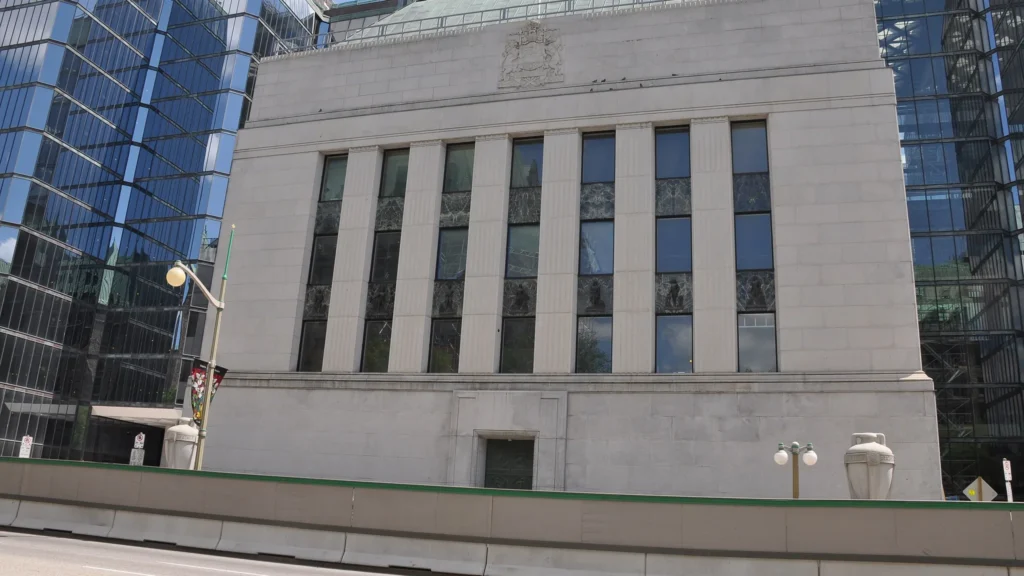
Canada News: Bank of Canada Tipped to Hike Rates in December
The Bank of Canada is expected to raise interest rates again when it announces its next decision on December 9, economists say, in what would be the second increase in as many meetings and a further step in a tightening cycle that has caught many observers by surprise. The Royal Bank of Canada expects the central bank to raise rates in December and again in 2027, taking the overnight rate to 3.25 percent, while BMO Capital Markets expects a 25-basis-point increase in December to 2.75 percent after the Bank's governor signalled that the economy no longer needs stimulus. The decision, which will be announced at 9:45 a.m. ET on December 9, is the most closely watched in Canada this year, and it will determine the cost of borrowing for millions of Canadians, from mortgages to business loans.
The expectation of a December hike follows the Bank's surprise decision on October 28 to raise its overnight rate by a quarter point to 2.50 percent, the first increase since 2023. The decision was well-telegraphed in the days before it was announced, but it still caught many economists off guard, because it came despite current labour market slack and steady core inflation, and because it was the first time in more than three years that the Bank had moved rates upward. The Bank described the move as pre-emptive, an attempt to get ahead of future inflation risks from high energy prices, and it warned that there could be a need to increase the policy rate further.
Mortgage Rates Today: What a December Hike Would Mean
For Canadian homeowners, the December decision matters because it will feed directly into mortgage rates. The Bank's October hike lifted the policy rate to 2.50 percent, and all six of Canada's biggest banks raised their prime lending rates to 4.70 percent, effective October 29, according to Canadian Mortgage Trends. If the Bank raises rates again in December, by 25 basis points to 2.75 percent, prime would rise to 4.95 percent, adding to the cost of every variable-rate mortgage and home equity line of credit in the country. For a homeowner with a variable-rate mortgage, the two hikes together would add hundreds of dollars a year to their payments, at a time when household budgets are already under strain.
The market is pricing in a strong chance of a hike. Market projections for another Bank of Canada rate hike on December 9 put the probability of a 25-basis-point increase at 78 percent, with a 22 percent chance of no change, according to figures published on November 25. The odds have swung widely since the October decision, from 43 percent in the first readings after the announcement, to peaks of 62 and 56 percent, to a low of 35 percent, before settling at roughly even and then rising again. The volatility reflects the uncertainty of the decision, and the fact that economists are split between a hold and a hike.
The economist split for December 9 is roughly even. KPMG and Servus Credit Union expect a hike, with the policy rate rising to 2.75 percent and prime to 4.95 percent. RBC and Rosenberg Research expect a hold at 2.50 percent, with prime remaining at 4.70 percent. Capital Economics, which is closely watched on this decision, has been changing its view, and its most recent publication is the best guide to its current thinking. The division among forecasters is a measure of how close the decision is, and how much depends on the data that arrives between now and December 9, particularly the labour market and inflation figures for October and November.
Why the Bank Is Tightening While Growth Is Soft
The Bank of Canada's decision to raise rates in October, and its apparent willingness to do so again in December, has puzzled some observers, because the Canadian economy is not obviously overheating. Near-term growth and labour-market data have softened, and the Bank itself has acknowledged that the economy is operating with slack. But the Bank's reasoning, set out in its October decision and in subsequent speeches by Governor Tiff Macklem, is that the risks to inflation are rising, and that it is better to act early than to wait until inflation is entrenched.
The key factor is energy prices. The war with Iran, which closed the Strait of Hormuz for eight months and sent oil prices soaring, has pushed up the cost of energy in Canada as it has everywhere else, and the Bank is concerned about spillover from higher energy prices into broader inflation. Canadian inflation in October was unchanged at 3.1 percent, with core measures near the 2 percent target and price pressures relatively contained, according to RBC economist Abbey Xu, but the Bank's revised projections show a problematic increase in consumer prices in 2027, driven by the energy shock. The October hike was described by one portfolio manager as a pre-emptive strike against inflation, and by an economist at RSM Canada as the first hike in a hiking cycle, with Canadians told to expect the next increase as early as December and more to follow in 2027.
Governor Macklem's recent speech in Toronto reinforced the Bank's hawkish messaging. He omitted any mention of the recent run of soft data, and he reiterated worries about spillover from above-target headline inflation, according to Benjamin Reitzes, BMO's Canadian rates and macro strategist. The focus of the speech was the renewal of the inflation targeting framework, and the Governor unveiled that the Bank's preferred core measures are now CPI-Trim and CPIX, a change that signals a new approach to measuring the underlying inflation that the Bank targets. The speech was read by markets as a clear signal that the Bank is serious about further tightening, and BMO changed its forecast on the strength of it, moving to expect a December hike.
The Bank's own language has been consistent. In its October statement, the Bank said: "There could be a need to increase the policy rate further," but it added that it would proceed carefully given the uncertainty. That carefulness is reflected in the division among economists: some see the December hike as a certainty, others as a coin toss, and the Bank itself has left the door open to a hold if the data shows continued labour-market deterioration in October and November. The decision will be made on December 9, and it will be based on the data available at that time.
The Longer View: Rates in 2027 and Beyond
The December decision is one step on a path that forecasters disagree about, and the longer view matters as much as the immediate call. RBC expects the Bank to hike three more times, including one at the December meeting and two additional hikes by mid-2027, bringing the overnight rate to 3.25 percent, provided the economy continues to improve. The Bank expects policy rates to rise further in both Canada and the United States, although the rationale continues to differ, and it expects the federal funds target range in the United States to reach 4.25 to 4.5 percent. The two central banks are moving in the same direction, but for different reasons: the Bank of Canada is responding to energy-driven inflation, while the Federal Reserve is responding to a broader acceleration in prices.
Other forecasters are more cautious. National Bank expects the policy rate to reach 3.00 percent by the end of 2027, with hikes to 2.75 percent in the first quarter and 3.00 percent in the second quarter. TD Economics expects a hike to 2.75 percent in the first quarter of 2027, followed by cuts in the third and fourth quarters, averaging 2.25 percent through 2032. Scotiabank expects gradual hikes through 2027, holding at 3.25 percent through 2028. CIBC expects 2.75 percent by March 2027 and a hold through 2028. Capital Economics expects 2.75 percent in the first quarter of 2027 and 3.00 percent in the second quarter. Oxford Economics expects 2.75 percent in December 2026 or January 2027. The range of forecasts, from 2.25 percent to 3.25 percent by the end of 2027, is a full percentage point, and it reflects genuine uncertainty about the path of the economy.
For Canadian borrowers, the uncertainty is itself a cost. A homeowner deciding whether to lock in a fixed rate or stay variable, a business deciding whether to borrow to expand, and a first-time buyer deciding whether to enter the market all face the same question: how high will rates go, and how long will they stay there? The Bank's December decision will answer part of that question, but the path beyond December remains open, and the forecasters' disagreement is a reminder that no one knows for certain. The one thing that is clear is that the era of low rates, which lasted for more than three years with the policy rate at 2.25 percent, is over, and that borrowing in Canada is about to become more expensive.
What to Watch Before December 9
The weeks between now and December 9 will be decisive, and the data that arrives in that window will determine whether the Bank hikes or holds. The labour market figures for October and November will show whether the softening that the Bank has acknowledged is deepening or stabilising. The inflation figures will show whether the energy shock is feeding through to broader prices, or whether core inflation remains contained. And the Bank's own communications, including any speeches by the Governor or the Deputy Governors, will be parsed for signals about the direction of the decision.
The Bank will publish its summary of deliberations for the December decision on December 23, two weeks after the announcement, and that document will show how close the Governing Council's discussion was. If the decision is a hike, the summary will show whether it was unanimous or whether some members argued for a hold. If it is a hold, the summary will show whether the Council was divided, and whether a hike was seriously considered. Either way, the summary will be read closely by markets and economists, and it will shape expectations for the Bank's next meeting in early 2027.
For now, the market's judgment is that a hike is more likely than not, with odds of 78 percent for a 25-basis-point increase on December 9. The economists are split, the Bank has signalled that it is willing to move, and the Governor's speech has reinforced the hawkish message. The decision is not yet made, and the data could still change it, but the direction of travel is clear: the Bank of Canada is tightening, and Canadian borrowers should prepare for higher rates in December and beyond.
The Bank of Canada's Mandate and the Inflation Target
The Bank of Canada's job is to keep inflation low, stable and predictable, and it does so by targeting an inflation rate of 2 percent, the midpoint of a control range of 1 to 3 percent. The target is set jointly by the Bank and the federal government, and it is renewed every five years, a process that is currently under way and that was the subject of Governor Macklem's recent speech in Toronto. The renewal is an opportunity to review the framework, to consider whether the target is still appropriate, and to decide how the Bank measures the inflation it is trying to control.
The choice of how to measure core inflation matters, because the headline rate, which includes volatile items like food and energy, can be misleading. The Bank has traditionally looked at several measures of core inflation, which strip out the most volatile prices to give a better guide to the underlying trend. The Governor's announcement that the Bank's preferred core measures are now CPI-Trim and CPIX, a change unveiled in the Toronto speech, is a significant shift, and it signals a new approach to judging whether inflation is under control. CPI-Trim excludes the prices that move most extremely in any given month, while CPIX excludes a fixed set of volatile items, and together they are meant to give a clearer picture of the persistent inflation that the Bank needs to respond to.
The framework matters because it determines when the Bank acts and when it holds back. A central bank that targets headline inflation will react to every spike in energy prices, even if the spike is temporary. A central bank that targets core inflation will look through the temporary spikes and focus on the underlying trend. The Bank of Canada's decision to emphasise CPI-Trim and CPIX suggests that it is trying to do the latter, to distinguish between the inflation that matters and the inflation that will fade on its own. But the October figures, with headline inflation at 3.1 percent and core measures near the 2 percent target, show the difficulty of that task: the headline and the core are telling different stories, and the Bank must decide which one to believe.
Source: Royal Bank of Canada