
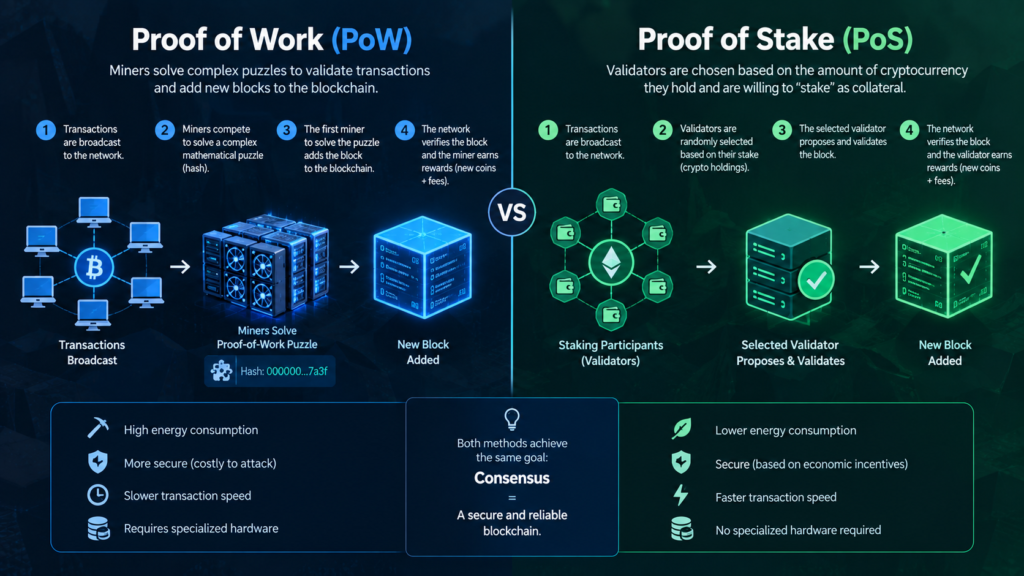
Proof of Work vs. Proof of Stake: How Blockchain Networks Reach Consensus
Author: Malik Mohsin Saleem Khan
Introduction: Why Does Blockchain Need Consensus?
Blockchain technology is built around an unusual idea: a network of computers can maintain a shared record of transactions without relying on one central authority to control the database.
But this creates an important question:
If thousands of independent computers are maintaining the same blockchain, how do they agree on what transactions should be included?
This is the problem that consensus mechanisms are designed to address.
A blockchain needs rules that help participating computers agree on the valid state of the network. Without an effective consensus mechanism, different participants could disagree about transaction history, attempt to spend the same cryptocurrency more than once, or create conflicting versions of the ledger.
Two of the most important consensus mechanisms in cryptocurrency are:
Proof of Work (PoW)
Proof of Stake (PoS)
Proof of Work became famous through Bitcoin and was one of the first widely deployed mechanisms for securing a decentralized cryptocurrency network.
Proof of Stake takes a different approach. Instead of requiring participants to compete using computational work, it uses economic value committed to the network through staking.
Both systems attempt to solve the same broad problem—reaching agreement in a decentralized environment—but they do so in fundamentally different ways.
In this guide, we’ll explore Proof of Work vs. Proof of Stake, how each mechanism operates, how they handle security, what mining and staking actually mean, how rewards work, and why different blockchain networks choose different approaches.
What Is Blockchain Consensus?
Before comparing Proof of Work and Proof of Stake, it is important to understand what blockchain consensus means.
Consensus is the process through which participants in a decentralized network agree on which transactions and blocks should be accepted as part of the blockchain.
A blockchain network may contain:
Users
Nodes
Miners
Validators
Wallets
Developers
Applications
These participants don’t necessarily trust each other.
Consensus rules therefore provide a common framework.
A simplified blockchain process looks like this:
A user creates a transaction.
The transaction is broadcast to the network.
Network participants verify it according to protocol rules.
Valid transactions are organized into blocks.
A consensus mechanism determines who gets to propose or add the next block.
Other participants verify the block.
The blockchain progresses to its next state.
The exact process differs between blockchains.
What Problem Does a Consensus Mechanism Solve?
One of the most important problems in decentralized digital money is the double-spending problem.
Imagine someone has 1 digital coin.
They attempt to send that same coin to two different people simultaneously.
In a centralized database, a trusted authority could decide which transaction happened first.
A decentralized blockchain cannot simply rely on a central authority.
Instead, the network needs a mechanism that allows participants to agree on which transaction is valid.
Consensus mechanisms help establish that agreement.
They also help defend the network against participants attempting to manipulate transaction history.
Proof of Work Explained
Proof of Work, commonly abbreviated as PoW, is a consensus mechanism that requires participants known as miners to perform computational work.
Bitcoin is the most famous example of a blockchain using Proof of Work.
The fundamental idea is:
Participants demonstrate that they have expended computational resources in order to compete for the opportunity to add a new block.
The work involves repeatedly calculating cryptographic hashes until a result satisfies the network’s current difficulty requirement.
This process requires:
Specialized hardware
Electricity
Time
Computational resources
The winning miner receives the opportunity to propose a block according to the protocol’s rules.
How Proof of Work Mining Works
Let’s simplify the mining process.
Suppose a Bitcoin miner wants to create the next block.
The miner collects valid transactions and constructs a candidate block.
The miner then repeatedly changes a value called a nonce and calculates the block’s hash.
The goal is to find a hash that satisfies the network’s difficulty target.
Because cryptographic hash functions are designed to behave unpredictably, miners generally cannot simply calculate the correct nonce mathematically.
Instead, they perform enormous numbers of attempts.
For example:
Attempt 1 → Invalid
Attempt 2 → Invalid
Attempt 3 → Invalid
…
Attempt millions → Valid
Once a miner discovers a valid result, it broadcasts the block to the network.
Other nodes can verify the result relatively quickly.
This creates an interesting asymmetry:
Finding the solution is computationally expensive, but verifying it is comparatively easy.
What Is Mining?
Mining is the process through which Proof of Work networks use computational resources to secure the blockchain and participate in block production.
Bitcoin mining involves specialized hardware known as ASICs, or Application-Specific Integrated Circuits.
Modern Bitcoin mining is highly competitive.
Miners generally operate specialized equipment in facilities designed around:
Electricity costs
Cooling
Hardware efficiency
Network connectivity
Operational reliability
The economics of mining depend on multiple factors, including the cryptocurrency’s market value, mining difficulty, electricity costs, hardware efficiency, and block rewards.
What Is Hashing?
Hashing is fundamental to Proof of Work.
A cryptographic hash function takes input data and produces a fixed-length output.
For example:
Input → Hash function → Hash
Even a tiny change to the input produces a substantially different output.
Hash functions are useful for blockchain systems because they provide properties such as:
Deterministic output
Fast computation
Difficulty of reversing the input
Resistance to certain forms of manipulation
Proof of Work uses this computational unpredictability to create a resource-based competition for block production.
Why Does Proof of Work Require Energy?
Mining requires repeated hash calculations.
A miner may perform enormous numbers of calculations before discovering a valid result.
Those calculations require electricity.
The more competitive the network becomes, the more computational resources miners may deploy.
This is one of the defining characteristics of Proof of Work:
Security is connected to real-world resource expenditure.
Attackers attempting to overpower a sufficiently decentralized PoW network would generally need to acquire or control substantial computational capacity and pay the associated energy and infrastructure costs.
What Is a 51% Attack?
A 51% attack is a commonly discussed scenario in Proof of Work networks.
It refers broadly to an entity or coordinated group obtaining majority control of the network’s relevant mining power.
With majority hash power, an attacker could potentially reorganize certain recent transaction history and attempt actions such as double-spending their own funds.
However, a 51% attack does not mean the attacker can arbitrarily:
Create unlimited coins
Steal coins from unrelated addresses
Ignore cryptographic signatures
Change the rules without broader network acceptance
The exact consequences depend on the blockchain’s design and the attacker’s capabilities.
The possibility of majority attacks is one reason network decentralization and mining distribution matter.
Proof of Stake Explained
Proof of Stake, abbreviated PoS, takes a different approach to blockchain consensus.
Instead of requiring participants to compete through computational work, Proof of Stake uses economic value committed to the network.
Participants known as validators stake cryptocurrency.
The protocol uses staking mechanisms to determine which validators can propose and/or attest to blocks.
The basic idea is:
Economic commitment replaces computational competition.
Rather than spending large amounts of electricity to perform hash calculations, validators commit capital that can potentially be penalized if they violate the protocol’s rules.
How Proof of Stake Works
A simplified Proof of Stake system works like this:
A participant acquires the network’s cryptocurrency.
The participant locks or commits some amount through the protocol’s staking system.
The participant becomes eligible to participate as a validator.
The protocol selects validators according to its consensus rules.
A selected validator proposes or participates in confirming a block.
Other validators verify and attest to the block.
Honest validators receive rewards according to the protocol.
Validators that violate protocol rules may face penalties.
The exact process differs considerably between Proof of Stake blockchains.
There is no single universal PoS algorithm.
What Is Staking?
Staking involves committing cryptocurrency to support a blockchain’s consensus process.
Depending on the blockchain, staking may involve:
Running validator software
Locking tokens
Delegating tokens to another validator
Participating in block validation
Receiving protocol rewards
The term “staking” is therefore broader than simply depositing coins somewhere and receiving interest.
In a true blockchain consensus context, staking is connected to network security and validator participation.
What Is a Validator?
A validator is a participant responsible for performing certain consensus duties in a Proof of Stake network.
Depending on the protocol, validators may:
Propose blocks
Verify blocks
Attest to blocks
Participate in consensus votes
Maintain network software
Earn rewards
Receive penalties for certain forms of misconduct
Validators generally need to operate reliable infrastructure.
A validator that is offline may miss opportunities to participate or earn rewards, depending on the protocol.
Proof of Work vs. Proof of Stake: The Core Difference
The simplest way to understand the difference is:
Proof of Work
Security through computational work and resource expenditure.
Proof of Stake
Security through economic stake and validator incentives.
Both attempt to make dishonest behavior costly.
PoW makes attacks expensive because an attacker needs substantial computational resources and energy.
PoS can make certain attacks expensive because an attacker needs substantial economic stake, and protocol rules can impose penalties on misbehavior.
Proof of Work vs. Proof of Stake Comparison
| Feature | Proof of Work | Proof of Stake |
|---|---|---|
| Main participants | Miners | Validators |
| Primary resource | Computing power | Staked cryptocurrency |
| Energy consumption | Generally higher | Generally lower |
| Block selection | Computational competition | Protocol-based validator selection |
| Security cost | Hardware + electricity | Economic stake |
| Specialized hardware | Often required | Generally not required for consensus itself |
| Main reward mechanism | Mining rewards + fees | Staking rewards + fees, depending on protocol |
| Misbehavior | Can waste resources and lose expected rewards | May result in penalties/slashing depending on protocol |
| Example | Bitcoin | Ethereum |
These are broad characteristics. Individual blockchain implementations can differ substantially.
How Proof of Work and Proof of Stake Secure a Network
At first glance, PoW and PoS look completely different.
But they share an important goal:
Make attacks expensive while making honest participation economically rational.
Proof of Work
An attacker needs substantial computing power.
That means acquiring:
Mining hardware
Electricity
Infrastructure
Cooling
Operational resources
Proof of Stake
An attacker may need to acquire substantial amounts of the network’s cryptocurrency or otherwise gain control over sufficient voting weight.
Depending on the protocol, dishonest behavior can result in:
Lost rewards
Penalties
Slashing
Loss of staked funds
The mechanisms differ, but the economic principle is similar.
Energy Consumption: PoW vs. PoS
Energy consumption is one of the most widely discussed differences.
Proof of Work intentionally requires computational expenditure.
Bitcoin miners run specialized hardware continuously because the network’s competitive mining process rewards successful block production.
Proof of Stake does not require miners to perform the same type of continuous hash competition.
Validators generally need computing infrastructure, but the consensus process does not depend on enormous quantities of hashing power.
As a result, Proof of Stake can reduce the direct energy requirements associated with consensus compared with comparable Proof of Work systems.
However, the environmental impact of any blockchain depends on its complete infrastructure and energy sources.
Why Bitcoin Uses Proof of Work
Bitcoin was designed around a decentralized electronic cash system that does not depend on a central institution.
Proof of Work was central to Bitcoin’s original design.
It provides a mechanism through which miners compete to produce blocks while nodes independently verify those blocks.
Bitcoin’s security model therefore depends heavily on:
Hash rate
Mining economics
Network difficulty
Miner distribution
Block rewards
Transaction fees
Node verification
Changing Bitcoin’s consensus mechanism would be a major protocol change with significant technical and economic implications.
Why Ethereum Uses Proof of Stake
Ethereum historically used Proof of Work but transitioned to Proof of Stake through a major protocol upgrade.
The change fundamentally altered how Ethereum’s consensus layer operates.
Under its Proof of Stake model, validators commit ETH and participate in block proposal and attestation processes.
This allows Ethereum to secure the network without relying on Bitcoin-style mining competition.
The transition demonstrated that a large established blockchain can change its consensus mechanism, although such changes require extensive engineering, coordination, testing, and community agreement.
What Are Block Rewards?
Blockchain networks generally need incentives for participants who contribute to network security.
In Proof of Work, miners can receive rewards for successfully producing valid blocks.
A block reward may include:
Newly issued cryptocurrency
Transaction fees
In Proof of Stake, validators can receive protocol rewards for participating according to the network’s rules.
The exact reward system varies significantly between blockchains.
What Is Slashing?
Slashing is a penalty mechanism used by some Proof of Stake systems.
A validator can potentially lose part of its staked assets if it performs certain prohibited actions.
Depending on the protocol, examples can include:
Signing conflicting blocks
Violating consensus rules
Attempting certain forms of manipulation
Slashing is intended to align economic incentives with honest participation.
The exact rules and severity of penalties differ by blockchain.
Not every Proof of Stake system uses identical slashing mechanisms.
What Happens if a Validator Goes Offline?
Being offline is generally different from deliberately violating consensus rules.
A validator may miss duties because:
Its server crashes
Internet connectivity fails
Software stops running
Hardware experiences problems
Depending on the blockchain, an inactive validator may lose potential rewards or receive relatively small penalties.
More serious malicious behavior can trigger stronger penalties.
This distinction is important because Proof of Stake requires validators to maintain reliable infrastructure.
Is Proof of Stake More Centralized?
Centralization is a complex issue.
Proof of Stake can create concerns because voting power is often connected to the amount of cryptocurrency staked.
If a small number of participants control a large percentage of stake, they may have substantial influence over consensus.
Proof of Work has its own centralization concerns.
Mining can become concentrated because large-scale operators may benefit from:
Economies of scale
Cheaper electricity
Specialized hardware
Access to capital
Large mining facilities
Therefore, neither consensus model automatically guarantees perfect decentralization.
The important question is how decentralized the actual network is.
Mining Pools and PoW Centralization
Individual miners often join mining pools.
A mining pool combines the computational power of many miners.
When the pool successfully mines a block, rewards are distributed among participating miners according to the pool’s rules and their contributed work.
Mining pools can make income more predictable for individual miners.
However, very large pools can create concerns about concentration of mining power.
This does not necessarily mean the individual miners themselves are controlled by the pool operator in every respect, but pool concentration is an important part of analyzing Proof of Work decentralization.
Staking Pools and PoS Centralization
Proof of Stake has a comparable issue.
Not everyone wants to operate validator infrastructure directly.
Some users may delegate their assets to staking services or participate through staking pools.
This can make staking easier.
However, if large providers accumulate substantial amounts of stake, they can become important participants in network governance or consensus.
The result is an important lesson:
Decentralization depends on actual participation and distribution, not simply on whether a blockchain uses PoW or PoS.
Security Trade-Offs Between PoW and PoS
There is no simple one-line answer to which consensus model has better security.
The models have different assumptions and attack costs.
Proof of Work Security
PoW relies on:
Hash power
Energy expenditure
Mining hardware
Economic incentives
Honest node verification
Proof of Stake Security
PoS relies on:
Staked capital
Validator participation
Cryptographic signatures
Economic penalties
Consensus voting
Each system has different attack scenarios and failure modes.
Evaluating security requires examining the specific blockchain rather than treating all PoW or PoS networks as identical.
What Happens During a Blockchain Reorganization?
A blockchain reorganization, commonly called a reorg, occurs when nodes temporarily disagree about the preferred chain history and eventually converge on another valid chain.
In Proof of Work, the protocol generally chooses the valid chain with the greatest accumulated work according to its rules.
In Proof of Stake systems, the chain-selection and finality mechanisms can work differently.
Modern PoS systems may use concepts such as:
Attestations
Checkpoints
Voting
Finality
Validator committees
These mechanisms can provide stronger forms of transaction finality under certain conditions.
What Is Finality?
Finality refers to the point at which a blockchain transaction or block is considered irreversible or extremely difficult to reverse under the network’s consensus rules.
Different blockchains have different approaches.
Some PoW systems rely on increasing confirmation depth.
As more blocks are added after a transaction, reversing that transaction generally becomes increasingly difficult.
Some PoS systems use explicit finality mechanisms involving validator votes.
Understanding finality is important for exchanges, payment processors, decentralized applications, and users who need confidence that a transaction will remain part of the canonical chain.
Proof of Work Advantages
Proof of Work has several notable characteristics.
Battle-tested architecture
PoW has been used by Bitcoin for many years.
Strong connection to physical resources
Attackers need computational infrastructure and energy.
Simple conceptual security model
The basic concept of competing through computational work is relatively straightforward.
Open participation
In many PoW systems, participation does not require owning a particular quantity of coins.
However, competitive mining can require substantial hardware and electricity.
Proof of Work Disadvantages
PoW also has trade-offs.
Energy consumption
The computational competition requires significant electricity.
Hardware requirements
Competitive mining can require specialized equipment.
Mining concentration
Large operations and mining pools can influence the distribution of hash power.
Capital expenditure
Mining hardware can become obsolete or unprofitable.
Physical infrastructure
Mining requires electricity, cooling, networking, and physical facilities.
Proof of Stake Advantages
Proof of Stake offers a different set of characteristics.
Lower direct energy requirements
It does not require massive hash-rate competition.
No mining hardware race
Validators don’t need Bitcoin-style ASIC mining equipment.
Economic security
Capital can be placed at risk through staking and protocol penalties.
Potential scalability benefits
Some PoS architectures are designed alongside mechanisms that support high transaction throughput and faster finality.
Proof of Stake Disadvantages
PoS also introduces trade-offs.
Wealth concentration concerns
Voting power may be connected to stake.
Technical complexity
Some PoS systems involve sophisticated validator and finality mechanisms.
Validator operational requirements
Validators need reliable infrastructure.
Slashing risks
Certain protocol violations can result in financial penalties.
Staking centralization
Large staking providers can become influential network participants.
Does Proof of Stake Eliminate Mining?
Yes, in the sense that a blockchain that has transitioned from PoW to PoS no longer relies on mining as its consensus mechanism.
However, the term “mining” is sometimes incorrectly used as a general term for earning cryptocurrency through staking.
They are different processes.
Mining = computational Proof of Work
Staking = economic participation in Proof of Stake
Understanding the difference helps avoid confusion when discussing cryptocurrency networks.
Can Proof of Work and Proof of Stake Be Combined?
Some blockchain systems have explored hybrid approaches.
A hybrid consensus design may combine aspects of computational work and staking.
The purpose can vary.
Potential goals include:
Increasing decentralization
Improving security
Balancing economic incentives
Changing block-production mechanisms
However, hybrid designs add complexity and are less common than straightforward PoW or PoS architectures.
Why Consensus Mechanisms Matter to Users
Consensus may seem like a technical subject reserved for blockchain developers.
But it affects ordinary users too.
Consensus influences:
Transaction confirmation
Network security
Finality
Block times
Fees
Decentralization
Energy requirements
Validator or miner incentives
When choosing a blockchain for an application, developers may consider its consensus mechanism as part of the network’s overall architecture.
How Consensus Affects Transaction Speed
Consensus mechanisms can influence how quickly a network produces blocks and reaches finality.
However, consensus mechanism alone does not determine transaction speed.
Other factors include:
Block size
Block capacity
Network architecture
Number of transactions
Propagation speed
Execution requirements
Layer-2 systems
Therefore, saying “PoS is always faster than PoW” would be an oversimplification.
Individual implementations matter.
Proof of Work vs. Proof of Stake for Investors
For cryptocurrency users and investors, understanding consensus can help explain why different blockchain assets behave differently.
Consensus can influence:
Token issuance
Validator or miner economics
Network security
Decentralization
Energy narratives
Staking opportunities
Infrastructure requirements
However, consensus is only one factor among many.
Other considerations include:
Technology
Adoption
Developer activity
Token economics
Regulation
Competition
Market conditions
Application ecosystem
Consensus should therefore be viewed as one component of a much larger blockchain ecosystem.
Frequently Asked Questions
What is Proof of Work?
Proof of Work is a blockchain consensus mechanism in which miners compete using computational power to produce valid blocks.
What is Proof of Stake?
Proof of Stake is a consensus mechanism in which participants commit cryptocurrency as stake and validators participate in block production and verification.
What is the main difference between PoW and PoS?
PoW uses computational work and energy as a major security resource, while PoS uses economic stake and validator incentives.
Is Bitcoin Proof of Work?
Yes. Bitcoin uses Proof of Work for its consensus mechanism.
Is Ethereum Proof of Stake?
Yes. Ethereum uses a Proof of Stake consensus system.
Is Proof of Stake better for the environment?
Proof of Stake generally requires substantially less direct energy for consensus than comparable Proof of Work systems because it does not rely on large-scale computational mining competition.
Does Proof of Stake require mining?
No. Proof of Stake uses validators rather than miners for its consensus process.
What is staking?
Staking involves committing cryptocurrency to participate in or support a Proof of Stake blockchain’s consensus system.
What is mining?
Mining is the process of using computational resources to participate in a Proof of Work blockchain’s block-production process.
Can Proof of Work be attacked?
Like any consensus system, Proof of Work networks have theoretical and practical attack scenarios. A majority-hash-power attack is one well-known example.
Can Proof of Stake be attacked?
Yes. PoS networks have their own attack models, including attempts to obtain or control substantial stake or manipulate validator participation. Protocol penalties and finality mechanisms are designed to address certain threats.
Final Thoughts
Proof of Work vs. Proof of Stake is ultimately a comparison between two different approaches to achieving decentralized blockchain consensus.
Proof of Work uses computational competition. Miners spend electricity and use hardware to compete for the opportunity to produce blocks.
Proof of Stake uses economic commitment. Validators stake cryptocurrency and participate in the network’s consensus process according to protocol rules.
Neither mechanism should be viewed in isolation.
A blockchain’s real-world security depends on its specific implementation, the distribution of miners or validators, economic incentives, software, node participation, network architecture, and the behavior of its users.
Proof of Work offers a security model built around measurable computational expenditure and has been demonstrated at enormous scale by Bitcoin.
Proof of Stake offers a different model in which economic stake replaces large-scale mining competition, potentially reducing energy requirements while introducing its own questions around staking concentration, validator incentives, and protocol complexity.
The most useful way to understand the debate is not simply to ask which mechanism sounds better.
Instead, ask:
What assumptions does this blockchain make, how does it make attacks expensive, how are honest participants rewarded, and how decentralized is the network in practice?
Once those questions become clear, Proof of Work and Proof of Stake stop looking like mysterious technical concepts and become understandable examples of how decentralized networks coordinate without relying on a single central authority.
Leave a Reply