Wildfire News: Trump Exempts Firefighting From Water Rules
The wildfire news out of Washington this week is a presidential decision that removes, for one year, a layer of water-pollution regulation from the way the federal government fights wildfires. President Donald Trump signed a memorandum on Tuesday, November 10, 2026, exempting federal firefighting activities, including the aerial use, deployment and discharge of fire retardants, from federal, state, interstate and local requirements governing the control and abatement of water pollution. The exemption runs for one year, from November 10, 2026, through November 10, 2027, and it is aimed squarely at the 2027 fire season.
The decision lands in the middle of an unresolved legal fight over whether the Forest Service needs a permit under the Clean Water Act to drop fire retardant from aircraft. The White House says a federal court decision now requires such a permit, and that the Forest Service has tried repeatedly to obtain one without success. The memorandum is the administration’s answer: use the president’s authority under the water-pollution law itself to set the permit question aside for a year so firefighters can work without the threat of enforcement hanging over the retardant drops.
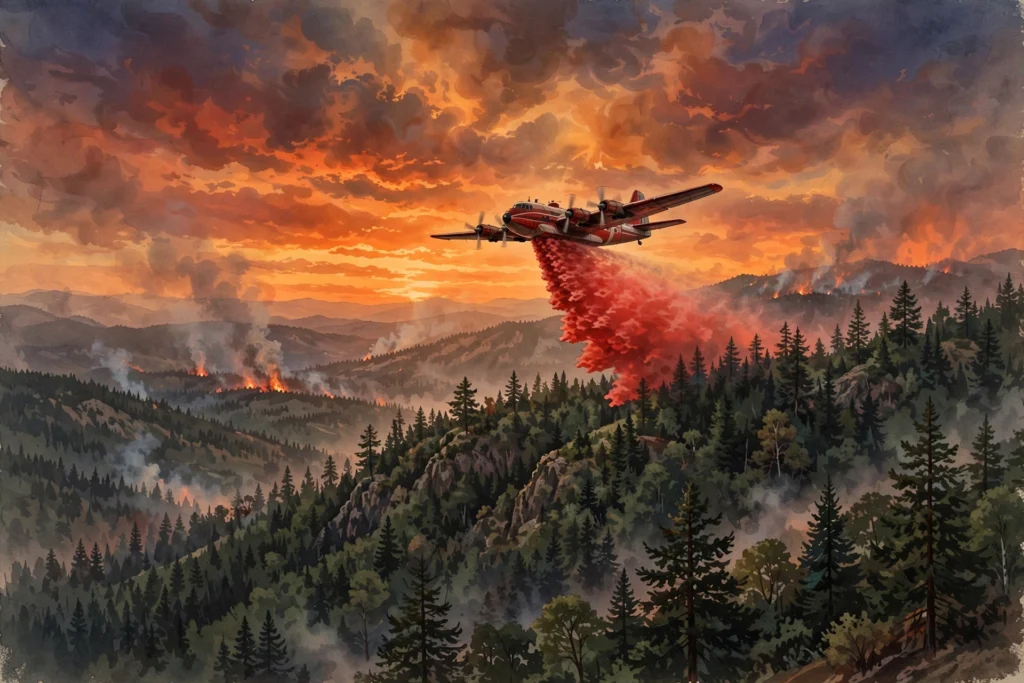
The move matters because aerial retardant is one of the main tools federal crews use to slow a wildfire’s spread. Tankers fly low over a fire line and release long ribbons of red slurry ahead of the flames, coating vegetation so the fire cannot advance as quickly and giving ground crews time to cut lines and protect homes. When those drops fall near streams, lakes and rivers, the retardant enters the water, and that is where the legal question begins.
What the memorandum actually does
The memorandum is addressed to the secretary of the interior, the secretary of agriculture and the administrator of the Environmental Protection Agency, the three officials whose departments carry the federal firefighting mission. It invokes section 313 of the Federal Water Pollution Control Act, the statute most Americans know as the Clean Water Act, and specifically subsection 313(a), which allows the president to exempt federal facilities and activities from the law’s pollution-control requirements when he determines that doing so is in the paramount interest of the United States. The memorandum makes that determination in plain terms.
The exemption covers firefighting activities conducted by the United States Forest Service, the Department of the Interior and any other executive departments and agencies, along with their contractors. That last point matters, because much of the aerial firefighting fleet is flown by private companies under contract to the government. The exemption reaches federal, state, interstate and local requirements, administrative authority, process and sanctions respecting the control and abatement of water pollution, which is the broadest form of relief the statute allows.
There are two deliberate limits. First, the memorandum grants no exemption from the requirements of two specific provisions of the law, sections 1316 and 1317 of Title 33 of the United States Code, which correspond to sections 306 and 307 of the Clean Water Act. Those provisions cover national standards of performance for new sources of pollution and the control of toxic pollutants, and the statute itself forbids the president from exempting anyone from them. Second, the memorandum states that it does not limit the applicability or enforcement of other legal requirements governing federal firefighting activities. The exemption is confined to water-pollution rules, and everything else that governs how federal crews fight fires stays in force.
The memorandum also carries a careful piece of legal framing. It states that it is not meant to imply that, without the exemption, the Clean Water Act would require the Forest Service or other agencies to obtain permits for the covered operations. The administration is not conceding that permits were ever legally required. It is removing the question for a year rather than litigating it, on the ground that the uncertainty itself is the problem.
The Montana lawsuit behind the decision
The memorandum names the lawsuit that forced the issue: Forest Service Employees for Environmental Ethics v. U.S. Forest Service, case number CV-22-168-M-DLC, in the United States District Court for the District of Montana. The group that brought the case is made up of Forest Service employees who argue that the agency’s use of aerial fire retardant violates the Clean Water Act, because the retardant that falls into waterways amounts to a discharge of a pollutant without a permit.
A federal judge in Montana agreed, at least in part, and the ruling is the reason the White House acted. According to a White House fact sheet released with the memorandum, an adverse district court decision now requires a Clean Water Act permit for aerial fire retardant in federal wildland firefighting, and the Forest Service has not obtained one because of what the fact sheet calls significant regulatory hurdles. The memorandum itself refers to the litigation directly, noting that aspects of the covered activities are the subject of the Montana case.
The permit question has been tangled for years. The Environmental Protection Agency had drafted a general permit for wildfire retardant, which would have given the Forest Service a single authorisation covering drops across the country. But according to a court order issued in May 2025, the EPA withdrew that draft permit after the change of administration and later resubmitted it to the Office of Management and Budget for review. The result was a gap: a court saying a permit is required, and no permit in existence to obtain.
The timing is deliberate. By starting the exemption on November 10, 2026, and running it through November 10, 2027, the administration has covered the whole of the 2027 fire season, when the Forest Service will be flying its heaviest retardant missions. The White House said the memorandum meets the permitting requirements for a year so firefighters can use aerial retardant during that season, which is the practical heart of the decision.
Why the permit question matters on the fire line
To understand why a water-pollution permit became a firefighting problem, it helps to understand how retardant is used. When a wildfire is running through dry timber, ground crews cannot always reach the fire’s edge safely, and water dropped from the air evaporates quickly in the heat. Fire retardant is different: it is a slurry, usually coloured red so pilots can see where it has landed, that coats vegetation and slows combustion even after the water in it has dried. A single tanker can lay down a line of retardant hundreds of feet long in seconds, and that line can hold a fire long enough for crews to work behind it.
The environmental concern is what happens when that slurry reaches a stream. Retardant contains chemicals that can harm fish and other aquatic life, and environmental groups have argued for years that drops near waterways should be governed by the same permit system that applies to other discharges into American waters. The Forest Service has long maintained that its retardant use is already governed by its own rules, including buffer zones around waterways, and that a Clean Water Act permit is not the right tool for an emergency operation that cannot wait for paperwork. That argument is what the Montana court rejected, and it is what the memorandum now sidesteps.
What the exemption leaves in place
It would be a mistake to read the memorandum as removing all environmental protection from wildfire operations, and the text itself guards against that reading. The two provisions it expressly leaves untouched, sections 1316 and 1317, are the parts of the Clean Water Act that set national performance standards and control toxic pollutants. Those cannot be waived by presidential determination, and the memorandum does not try.
The memorandum also says nothing that would stop other laws from applying. The Endangered Species Act, the National Environmental Policy Act and the Forest Service’s own operating rules all continue to govern how crews fight fires. The exemption is about water-pollution requirements specifically, and about the permit question specifically. Firefighters still have to follow the rules that govern where they can drop retardant, how they protect sensitive habitat and how they report what they use.
The distinction matters because the public debate over the memorandum is likely to be framed in absolute terms, as either a necessary rescue of firefighting or a reckless giveaway to polluters. The document itself is neither. It is a one-year pause on one category of regulation, tied to one court case, with the most serious pollution standards left standing.
A wider push on forests and fire
The memorandum does not stand alone. It adds to a series of measures the administration has taken on federal forests since the start of the second term. In March 2025, Trump signed executive orders to increase domestic timber production and reduce wildfire risk, directing agencies to cut the red tape around logging on federal land. In June 2025, he signed an executive order on wildfire prevention and response, aimed at speeding up the work of clearing hazardous fuels and coordinating the federal response to large fires.
The thread running through those orders is the same one running through the memorandum: the federal government should be able to manage its forests and fight its fires without being slowed by its own rules. Supporters of that approach argue that decades of regulation have left federal forests overgrown and fire-prone. Critics argue that the same rules exist to protect the water, wildlife and air that those communities depend on, and that removing them trades one risk for another.
What happens next
The first question is whether the exemption will be challenged in court. As of November 11, no response from Forest Service Employees for Environmental Ethics, the plaintiff in the Montana case, had been published, and whether the group will challenge the exemption had not been reported. The group won the underlying ruling, and it has an obvious interest in defending it, but challenging a presidential determination under section 313 is a different kind of case from challenging a permit.
The second question is administrative. The memorandum directs the secretary of agriculture to publish the determination in the Federal Register, the government’s official journal, and as of November 11 the determination had not yet appeared there. Publication is a formality, but it is the step that makes the exemption official in the eyes of the agencies that have to apply it, and it is the step that starts the clock on any legal challenge.
The third question is what happens when the year runs out. The memorandum does not say whether the exemption will be renewed after November 10, 2027, and the White House has not said either. If the EPA’s general permit is in place by then, the question may be moot. If it is not, the administration will face the same choice again. For now, the practical effect is straightforward. Federal firefighters heading into the 2027 fire season can use aerial retardant without the permit dispute hanging over them, and the streams below the drop zones will be governed, for one year, by the Forest Service’s own rules rather than by the Clean Water Act’s permit system. That is the trade the memorandum makes, and it is a trade the country will be watching, in the air and in the water, all through next summer.
Source: The White House