White House Press Briefing: Dana White Declines Press Job
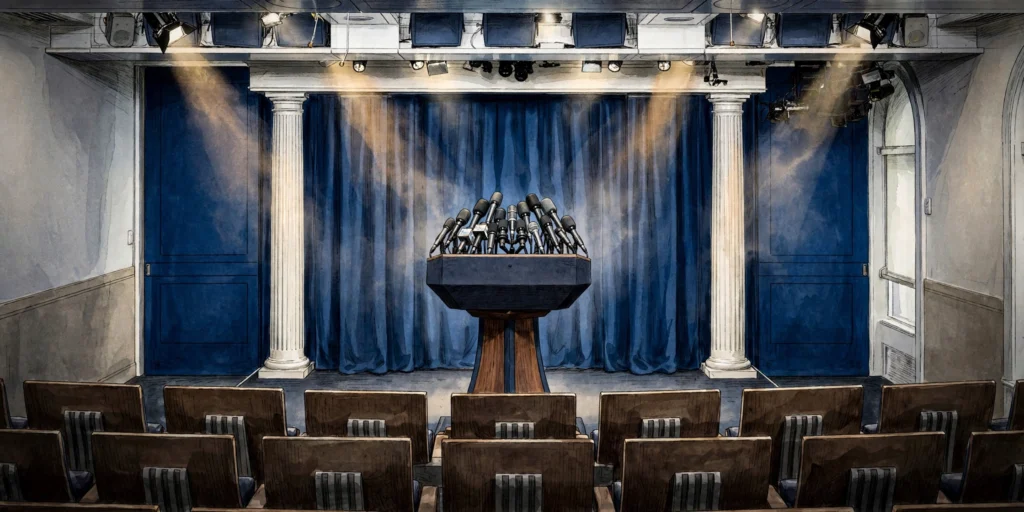
The latest white house press briefing was not a briefing at all, at least not in the usual sense. It was a surprise appearance, staged with almost no notice, built around a joke, and starring a man who has spent his career running cage fights rather than fielding questions from reporters. On Monday, President Donald Trump walked into the James Brady Press Briefing Room with Dana White, the president and chief executive of the Ultimate Fighting Championship, at his side, and for the next half hour the most powerful room in American political communications belonged, briefly, to the world of mixed martial arts. The appearance was so sudden that aides had no time to place the presidential seal on the podium. A press assistant's voice came over the loudspeaker with an urgent instruction: everyone should take a seat in the briefing room right now. Television technicians scrambled to plug in cables and set up microphones. Reporters stampeded for their seats. And when the president finally spoke, the spot on the lectern where the seal would normally hang was left vacant.
The scene was the latest in a series of unexpected choices by the president since Republicans suffered sweeping losses in last week's midterm elections. Trump was eager to show off White, a close friend who is far more comfortable watching fighters face each other in the Octagon than mixing it up with reporters. The joke at the centre of it all had begun two days earlier, when Trump announced on social media that he had offered White the job of White House press secretary. On Sunday he said he had only been teasing. On Monday, White came to the White House anyway, took the podium, answered questions as if he were the press secretary, and then, when the president asked him directly whether he wanted the job, politely and firmly said no.
A Joke That Started on Truth Social
The whole episode began on Saturday, when Trump posted on Truth Social that he had offered the press secretary job to White. The president called him "the Great Dana White, a violent Fighter and Warrior," and urged him to "defend us against the Lunatic Left." The post went further, asking White to bring with him a group of assistants drawn from the world of fighting: Islam Makhachev, Khabib Nurmagomedov, Justin Gaethje, Daniel Cormier, Amanda Nunes, and Kayla Harrison.
The announcement drew attention immediately, not least because the press secretary job is genuinely vacant. Karoline Leavitt left the post at the end of August, and her successor, Katie Zacharia, lasted only five days before being dismissed. The White House has been searching for a replacement ever since, and the idea that the president might hand the most visible communications job in the administration to the head of a fight promotion was, for a few hours, taken seriously in some quarters. It was also taken seriously by the wrong person entirely. Another Dana White, a former top Pentagon spokeswoman, began receiving congratulatory messages, and on Saturday she posted on LinkedIn: "To everyone texting me congratulations: thank you, but you have the wrong Dana White."
By Sunday, Trump was already walking the announcement back. He said he had been joking, and that the post should have given the joke away. "You see a lot of rough faces there," he said of the fighters he had named. On Monday, in the briefing room, he put it more plainly. "We were having a very bad press day and I don't know why," he said. "I was sort of kidding. They wrote the story as if I wasn't kidding." The president said he was having "a little fun" when he suggested White would make a good replacement for Zacharia, who had been, in the words of one report, the much-derided successor to Leavitt.
Bedlam in the Briefing Room
Whatever the joke had been, the briefing itself was real enough, and it began in chaos. Trump made a surprise appearance before reporters on Monday with White, and the haste of the arrangements was visible to everyone in the room. The presidential seal, which normally hangs on the front of the lectern, was missing. The press corps, summoned at a moment's notice, rushed in as technicians worked to get the cameras and microphones ready. It was, by every account, bedlam, and the president seemed to enjoy it. "Dana is really very unique," he said. "The only problem is he'll talk for a little while and then he's going to beat the hell out of you."
White, who organised a series of UFC bouts on the White House grounds in June, played along at first. Standing at the podium, he joked: "I've always wanted to do this." Then he made his position clear. "I have zero political aspirations," he said, while nonetheless taking a few questions from the reporters in front of him. The man who runs the world's biggest mixed martial arts promotion was, for a few minutes, the de facto White House press secretary, answering questions he had no preparation for and no intention of ever answering again. White had said he was flying to Washington for a meeting with the president on Monday, and Trump confirmed the visit, while saying the meeting was for other reasons.
The Questions White Took
The questions White faced were exactly the kind of questions a press secretary would dread and a fight promoter would relish. He was asked whether Trump or Joe Biden, who has prostate cancer, would win in a UFC fight. He was asked how the president would do against a woman UFC fighter. And Trump himself turned the briefing into a preview of the weekend's fights, announcing that a UFC event this weekend at Madison Square Garden in New York will feature what he called "the two greatest women fighters of all time," Kayla Harrison against Amanda Nunes. "How would I do against one of them?" Trump asked White. "Would I do well?" "I don't think so," White replied. On another telling, the president asked: "Would I do well?" and White answered: "Not well, sir."
The exchange was light, but it was not the whole briefing. Trump eventually took over, and after answering about half an hour of questions on the midterms, the war in Iran, Ukraine, and a variety of serious topics, he turned back to White. The president had taken questions on Defence Secretary Pete Hegseth and on Nvidia chief executive Jensen Huang, among others, before returning to the question that had brought them all into the room. "Would you like to be press secretary of the United States of America?" he asked White. "Would you like that, or do you just want to stay with that ridiculous UFC?" White's answer was polite, direct, and final. "Thanks for the offer, sir," he said. "I do not want to be in politics, no."
A Press Secretary Search That Keeps Stalling
The joke landed because the underlying problem is real. The White House press secretary position has been open since Leavitt left at the end of August, and the search for her replacement has become one of the more visible embarrassments of the administration's second term. Zacharia, the successor Trump chose, lasted five days in the role before being dismissed, a tenure so brief that it became a punchline in its own right. The invitation to White came three weeks after Zacharia's dismissal, and it arrived in the middle of a broader staffing reshuffle after the Republicans' crushing defeat in the midterm elections on Tuesday.
The reshuffle is the context that gives the episode its edge. The president has spent the days since the election huddling with advisers, rethinking his team, and looking for ways to change the story. Bringing White into the briefing room was, in that light, less a joke about a job than a piece of theatre designed to do what the administration has struggled to do since the midterms: get the press talking about something other than the election results.
The vacancy matters because the press secretary is the administration's daily voice, the person who stands at the podium and defends the president's decisions to the press corps and, through them, to the country. A White House without one is a White House without a routine, and the administration has now been without one for more than two months. The search has produced one five-day tenure and one joke offer to a fight promoter. Neither has filled the job, and the briefing room on Monday was, in the end, a reminder of how long the search has gone on and how little progress it has made.
What the Briefing Was Really About
Strip away the theatre, and the briefing was a window into a White House trying to find its footing after a defeat. Trump took questions for about half an hour on the subjects that have dominated his second term: the midterm results, the war in Iran, the war in Ukraine, his defence secretary, and the chief executive of the world's most valuable chipmaker. The range of the questions was a measure of how many fronts the administration is fighting on at once, and the president's willingness to take them, in a room he had not been scheduled to enter, was a measure of his confidence that he could handle them. The presence of White, standing beside him, was the part that made the briefing memorable, but the questions Trump answered were the part that made it matter.
The moment that will be remembered, though, is the one at the end. After half an hour of serious questions, Trump turned back to White and asked him, one more time, whether he wanted the job. The question was framed as a choice between the White House and the UFC, between politics and the fight business, and White's answer, that he did not want to be in politics, was the only serious answer in a briefing full of jokes. The exchange said something about both men: about a president who treats the machinery of government as a stage, and about a fight promoter who knows exactly where his stage is.
What Happens Next
The press secretary job is still vacant, and the search goes on. Nothing in Monday's briefing suggested that a permanent appointment is close, and nothing in the president's remarks suggested that he has settled on a candidate. The job will be filled eventually, by someone willing to stand at the podium every day and defend an administration that has just lost both chambers of Congress. That person will inherit a briefing room that has now hosted a fight promoter, a missing seal, and a stampede of reporters summoned by loudspeaker.
White, for his part, is going back to the UFC. The fight he promoted from the podium, Harrison against Nunes at Madison Square Garden this weekend, will go ahead as planned, and the president's prediction that it will feature the two greatest women fighters of all time will be tested in the Octagon rather than in the briefing room. White has made it clear, twice in one appearance, that he has no political ambitions and no interest in the job he was jokingly offered. The White House, meanwhile, is still looking for someone who does. The briefing is over, the seal is back on the podium, and the vacancy remains exactly where it was: open, visible, and waiting for a candidate who actually wants it.
Source: Reuters