White House News: Xi Warns Trump on Taiwan at Shenzhen
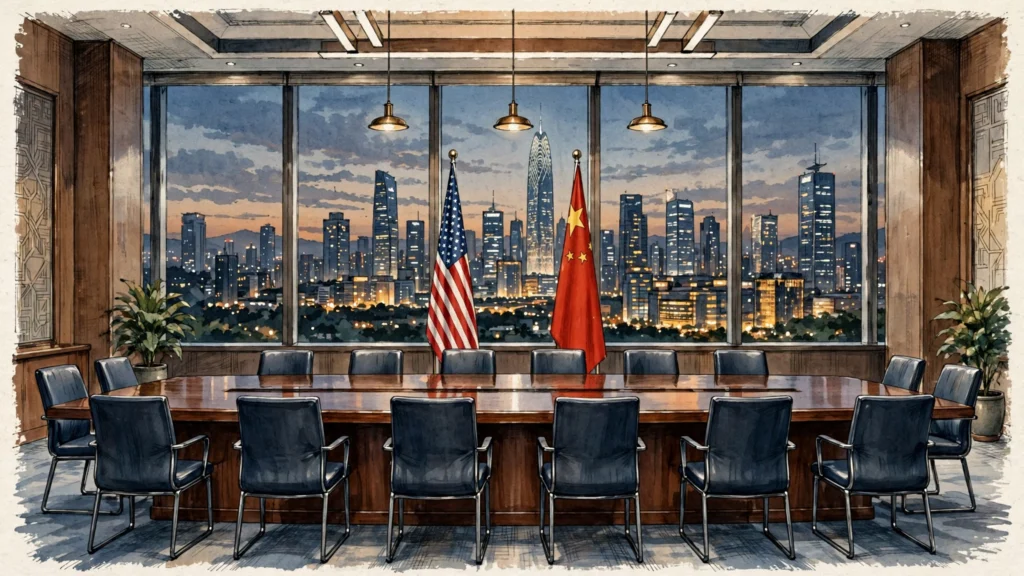
In the latest white house news from Asia, the most sensitive issue in the relationship between the United States and China was laid on the table in blunt terms. Chinese President Xi Jinping told President Donald Trump that the United States should keep doing the right thing on Taiwan to avoid major setbacks in the relationship between the two countries, according to the Chinese state news agency Xinhua. The warning came during a meeting between the two leaders on Thursday, November 19, in the southern Chinese city of Shenzhen, on the sidelines of the Asia-Pacific Economic Cooperation summit. It was the third meeting between Trump and Xi this year, and it produced warm handshakes, a historic three-way summit with Russia, and very little agreement on the issues that divide the two countries.
The Taiwan exchange is the part of the meeting that has drawn the most attention since, and it is also the part that is most disputed. Xinhua reported that Trump told Xi the United States does not support Taiwan independence. Taiwan's government says that is not true. The disagreement over a single sentence has become a story of its own, and it has underlined how differently Beijing, Taipei, and Washington describe the same conversation. The American side has not confirmed the wording reported by Xinhua, and the White House has not publicly repeated it.
China views the democratically governed island of Taiwan as its own territory, a claim Taipei rejects. Beijing says Taiwan is the most important and sensitive issue in its relations with Washington, and its military operates around the island daily. For Xi, the message to Trump was simple: handle Taiwan correctly, or the relationship will suffer.
White House News: The Taiwan Warning in Shenzhen
The meeting between Xi and Trump lasted about an hour, according to reports, and took place before the formal start of the APEC summit. Xi broke with protocol to greet Trump at the airport in Shenzhen, a gesture that set the tone for the day. The two men shared a hug on the tarmac, and Trump called Xi his friend. It was the kind of public warmth that both leaders have used to signal that the relationship is on track, even when the substance behind it is thin.
Behind closed doors, Xi was direct. On the question of Taiwan, the American side should keep doing the right thing and avoid major setbacks in China-U.S. relations, he said, according to Xinhua. The wording was short, and the Chinese readout did not explain what doing the right thing meant in practice. Chinese commentators later filled in the blanks, saying it meant Washington should stop using Taiwan as a card to play against Beijing and stop sending signals of encouragement to forces on the island that seek independence. The message was aimed as much at the American public and at Taipei as it was at Trump himself: a public reminder that Beijing regards Taiwan as a red line.
Xinhua described the meeting as positive and constructive, and said the two leaders had agreed to draw up an action plan for what they called a constructive and strategically stable relationship. The Chinese agency said Xi had proposed a new definition for the relationship, based on respect, fairness, and reciprocity, and that he had told Trump the two countries should extend the list of cooperation and shorten the list of problems. He added that the two countries should strengthen communication and coordination on artificial intelligence, to prevent safety risks and to ensure that AI is always under human control.
Trump, for his part, told reporters after the meeting that he and Xi had spoken about AI, trade, and oil flows through the Strait of Hormuz. The American side's demands were clear enough: Washington wants Beijing to buy more American farm goods, to ease its curbs on rare-earth minerals that are vital to key industries, and to release two Americans who Washington says are wrongfully detained. None of those items appeared in Beijing's readout of the meeting. The Chinese account did not mention the fragile trade truce between the two countries, China's agricultural commitments, rare earths, chip controls, the scandal over the American chip giant Nvidia, or the detained Americans, and it did not name Iran.
Taiwan Disputes Beijing's Account
The most consequential sentence in the Chinese readout was the one attributed to Trump. Xinhua reported that the president said the United States does not support Taiwan independence. Within a day, Taiwan's government had pushed back. Chiu Chui-cheng, the chairman of Taiwan's Mainland Affairs Council, told reporters on November 20 that the relevant reports were not true. It was an unusually direct rebuttal, and it put Taipei in the position of publicly contradicting Beijing's account of a conversation between two presidents.
The American side has not settled the question. Coverage reviewed by Clash Report noted that the United States had not confirmed the wording in the Chinese account. The White House has not publicly repeated the statement, and no American readout of the meeting has included it. The silence leaves the matter unresolved: Beijing says Trump said it, Taipei says he did not, and Washington has not said either way.
The dispute matters because the words attributed to Trump would be a significant statement if they were made. American policy on Taiwan has long been built on careful ambiguity, and a presidential statement of that kind, made in a private meeting and reported only by the other side, would be read closely in Taipei, in Beijing, and in capitals across Asia.
Taiwan was present at the summit in its own way. The island is a member of APEC, though it does not send its president to summits, to avoid political problems. Its envoy to the meeting was Stan Shih, the founder of the computer maker Acer, who shook hands with both Trump and Russian President Vladimir Putin when the leaders posed for a group photograph. He was accompanied in Shenzhen by Vincent Chao, the deputy secretary-general of Taiwan's National Security Council, in a rare trip to China by a senior Taiwanese government official.
Trump News: Handshakes, a Hug and a Trilateral
The bilateral meeting with Xi was only part of Trump's day in Shenzhen. Later on November 19, the three leaders held the first-ever trilateral meeting of the heads of state of the United States, China, and Russia, sitting together for around 90 minutes at Kylin Villa, a secluded government guesthouse. Trump opened the session by saying he was honored to sit next to the two men, and he framed the trio, the leaders of the world's three largest nuclear powers, as uniquely placed to work together for a safer future. The meeting produced a joint declaration pledging dialogue on nuclear risks, energy supplies, and reform of the United Nations, but few concrete steps.
The Unfinished Business: Farms, Rare Earths and Detainees
The gap between the imagery and the substance was widest on the issues Trump had said he wanted to resolve. The American president went into the meeting with a list of demands: more farm purchases, looser rare-earth curbs, and the release of two detained Americans. He came out with none of them settled. China's Foreign Ministry said the two sides had agreed to map out an action plan for building their relationship, but it gave no details and no timeline.
The farm trade picture illustrates the problem. China is on track to meet its soybean pledge for 2026, but it has delivered only a fraction of the other farm purchases it promised, according to reporting on the meeting. Rare-earth shipments, which matter to American manufacturers of everything from electric vehicles to defense systems, remain far below the levels seen before the trade war escalated last year. And neither of the two detained Americans has been freed.
Trump Administration: Analysts Say Xi Gained the Most
The verdict of analysts who have studied the summit is that Xi came out ahead. A Reuters analysis of the meeting concluded that Trump had gained little from three summits with Xi this year, while the Chinese leader had strengthened his position on the world stage. Xi emerged from the gathering as a statesman who could convene the first China-U.S.-Russia summit, and he kept the fragile trade truce in a holding pattern where Beijing likes it, even as Washington has taken a harder line.
Dan Wang, the China director at the Eurasia Group think tank, said China had secured additional strategic space, including the American stance on the Taiwan issue and the easing of the technology embargo. Strategically, he said, the United States had gained nothing. Kuo Yu-jen, the director of Taiwan's National Sun Yat-sen University Institute of China and Asia-Pacific Studies, said Beijing's goal had been to keep dragging things out and keep talking, and that the summit had achieved exactly that.
What Happens Next
The two sides have agreed to draw up an action plan for their relationship, but there is no public timetable for it, and no detail about what it will contain. The trade truce will be tested in the coming months, as American farmers wait for the purchases they were promised and American manufacturers wait for the rare earths they need. The two detained Americans remain in custody, and their cases will return to the agenda at the next meeting.
Taiwan will remain the most sensitive issue of all. Beijing has now put its position on the record in the bluntest terms, and Taipei has publicly rejected Beijing's account of what Trump said. Washington has not clarified the matter, and the ambiguity is likely to persist. The next test will come when the United States makes its next decision on arms sales to Taipei, an issue Beijing has repeatedly demanded Washington end, and one that the Chinese readout of the Shenzhen meeting did not mention.
For now, the Shenzhen summit stands as a portrait of the relationship as it is: warm in public, unresolved in private, and shaped by leaders who are content to talk while the hardest questions wait. Xi got his warning on Taiwan into the record. Trump got his summit. And the two countries, as Xi put it, will keep steering the big ship along its course, wherever that course may lead.
Source: ABC News