White House News: Democrats Target Trump’s Ballroom Project
The white house news since the midterm elections has been dominated by a question that has nothing to do with legislation: what happens to President Donald Trump’s construction projects now that Democrats have won Congress? The answer, according to Democratic lawmakers and their staff, is that the projects are about to face the kind of scrutiny they have escaped for the first two years of Trump’s second term. The ballroom rising over the demolished East Wing, the triumphal arch planned for the far side of the Potomac, the overhauled Reflecting Pool on the National Mall, the renamed Kennedy Center and the remade public golf course are all, Democrats say, on the list for oversight when the new Congress convenes on January 3, 2027.
The stakes are high because the projects are not ordinary public works. They are the physical expression of how Trump has remade the capital in his own image, and they have been built at a speed and with a disregard for the usual approvals that has alarmed preservationists, judges and now, with the power of the gavel behind them, the opposition party. Democrats won control of both the House and the Senate on November 3, flipping seats in states as deeply Republican as Texas, South Carolina and Kansas, and they have made clear that the building projects will be among their first targets.
The ballroom tour that followed the defeat
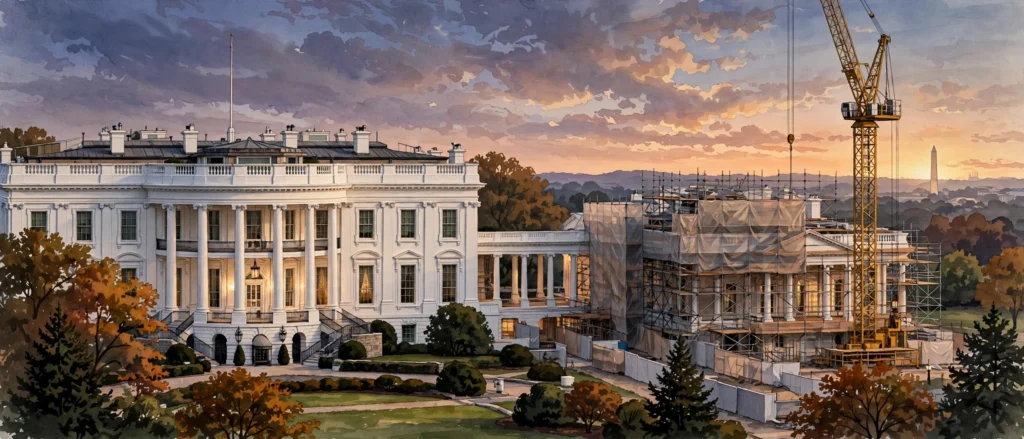
On Wednesday, November 4, the morning after Republicans lost control of Congress, Trump called reporters to the construction site of the new White House ballroom and spent around forty minutes showing off the project. He spoke about the marble floors, the Corinthian columns and the elaborate chandeliers, and he described a building with ceilings more than fifty feet high that will seat 2,000 to 2,500 guests at state dinners. He said the project is ahead of schedule and under budget, that the steel frame went up in about two and a half weeks, and that the ballroom should be finished by the middle to the end of next year. He put the number of workers on the project at about 525, and he watched as the final steel beam, signed by the workers on the site, was hoisted into place.
It was a striking choice of stage for a president who had just suffered one of the worst midterm defeats in modern American history. Trump turned only briefly to the elections during his nearly hour-long appearance, telling reporters he would probably get along with the Democrats, unless they want to be destructive, and reminding them that he has the power of the veto. He conceded that higher gasoline prices tied to the war with Iran were probably the main reason for his party’s defeat. But most of his time was spent on the building: its underground facilities, five levels below ground built to military specifications, a roof strong enough to hold helicopters, and a rooftop drone port he said can hold more than a hundred drones.
The ballroom is being built on the site of the East Wing, which Trump tore down without congressional approval to make room for it. He has said the project is being paid for by private donors, whom he did not name, and that no taxpayers’ money was used to build it. The primary contractor, identified by Trump only as Jared, is Jared Oldroyd, a division president of the Clark Construction Group. The donors are now a matter of congressional interest: Senator Richard Blumenthal of Connecticut, who is set to chair the Senate Permanent Subcommittee on Investigations, has sent letters to companies known to have contributed to the ballroom, including Amazon, Apple, BlackRock, Booz Allen, Coinbase, Alphabet’s Google, Microsoft, Salesforce, ServiceNow and Union Pacific, telling them they are targets of investigation and setting a deadline of January 4, the first full day of the new Congress, to produce records.
The projects in Democrats’ sights
The ballroom is only the most visible of the projects. Democratic committee staffers have told NPR that the oversight will extend to the East Wing remodel, the planned memorial arch and the Reflecting Pool renovation, as part of a broader fight over Congress’s authority to decide how federal money is spent. The list, as described in reporting since the election, is long: the 250-foot arch planned for Memorial Circle, directly across the Memorial Bridge from the Lincoln Memorial; the renovation of the Lincoln Memorial Reflecting Pool; the renaming of and renovation plans for the Kennedy Center; the remaking of a public golf course, the East Potomac Golf Links; a fence around Lafayette Square; and a development plan for the Tidal Basin.
Trump has been deeply involved in how the capital looks, and he made the projects a central theme of his final days of campaigning. The day before balloting began, he used what was billed as a speech outlining his closing argument for why his party deserved to continue to control Congress to instead talk up his effort to overhaul the Reflecting Pool, a project the Associated Press has described as costly and problem-plagued. The following day, after the results were in, he declared the Oval Office a national monument, a move that will not prevent future presidents from undoing the gilded flourishes he has packed into it. On Friday, the White House promoted a glitzy new website celebrating plans for the memorial arch, despite a court order blocking work on it.
The arch, the court order and the race to build
The memorial arch is the project that best captures the conflict. Trump has proposed a 250-foot arch, a hundred feet taller than the Statue of Liberty without its pedestal, to be built in Memorial Circle across the river from the Lincoln Memorial. A commission gave the arch its final approval on an eight-to-four vote, but before midnight on the day of the vote a federal judge stepped in to block the administration from breaking ground for fourteen days. Judge Tanya Chutkan is considering a motion from three veterans and an architectural historian to stop any work until the lawsuit is resolved.
The court order has not stopped the administration from promoting the project, and it has not stopped the Democrats from preparing to fight it. Representative Don Beyer of Virginia made the point at a public hearing on Thursday, when he opposed construction of the arch, and his spokesman noted that the appropriations process beginning on January 3 will be controlled by Democrats, which is one of the ways the congressman will step in. The power of the purse is the most direct tool the new majority has: if Congress refuses to appropriate money for a project, the project cannot proceed on federal funds, whatever the commission has approved.
The arch is also the project that has drawn the most attention from the courts, and the legal fight is far from over. The fourteen-day block is temporary, and the judge’s decision on the motion to stop work until the lawsuit is resolved will determine whether the administration can break ground at all. The Democrats’ oversight will run alongside that litigation, and the two tracks may reinforce each other: documents produced to Congress could find their way into court, and findings in court could shape the questions Congress asks.
The paper trail: letters, donors and deadlines
The most concrete step the Democrats have taken so far is the preservation letter, prompted by whistleblowers who warned the House Natural Resources Committee that the administration is rushing work on the arch and the golf course and destroying documentation so that as much as possible is done before Democrats gain the power to investigate. The Interior Department has denied claims that it is deleting key records. On November 10, Representative Jared Huffman of California, the top Democrat on the House Natural Resources Committee, sent a letter to the Interior Department, federal agencies and private companies involved in building the president’s structures, demanding that they preserve existing records, identify and recover any deleted information, and suspend any destruction and deletion practices. Lockheed Martin and John Deere are among the private companies that received the letter. When the new Congress is sworn in in January, Huffman will become chairman of the committee, and he has said he will ensure that its full investigative and oversight authority is used to uncover wrongdoing, demand accountability and protect the public interest.
Huffman has spent much of the past year probing and questioning the projects, laying the groundwork for this moment, and his committee has jurisdiction over the Interior Department, which is involved with operations at parks and federal lands. The letter is a standard tool of congressional oversight, but its timing, two days after the election, and its scope, covering agencies and companies alike, make it a signal of intent. The message is that the new majority will not wait until January to start building its case.
The broader investigation is taking shape alongside it. Democrats on the Senate Banking Committee released a report on the eve of the election titled Nine Ways Trump’s Corruption Is Costing You, naming Toyota, Walmart, Live Nation and major banks among companies that allegedly received favourable treatment from the government after contributing to Trump’s inauguration. Blumenthal has sent additional letters to cryptocurrency firms about their ties to the Trump family, and he has warned all of the recipients that failure to respond by January 4 will leave him no choice but to consider alternative measures to obtain compliance.
What happens next
The first test will come in January, when the new Congress convenes and the committees organise. The Democrats have said they need to act quickly, because voter anger over the high cost of living and the war on Iran is what defeated Republicans in the midterms, and both sides will be campaigning on the next two years in 2028, when the White House is at stake along with Congress. The investigations of the construction projects will be part of a wider programme that also covers the war, tariffs, the immigration crackdown, and the administration’s handling of records related to Jeffrey Epstein.
The second test will be the courts. The arch case is already before a federal judge, and the ballroom’s donors are already receiving letters with a January 4 deadline. If the administration resists producing documents, the committees will have to decide whether to issue subpoenas, and the White House has already signalled that it will challenge them. The result could be months of legal wrangling, with the projects continuing to rise in the meantime.
The third test is the one Trump himself has set: speed. The administration is rushing to finish as much as possible before the Democrats take power, and the ballroom, the arch and the golf course are all being pushed forward at a pace that the whistleblowers say is designed to make the work irreversible. If the steel is up and the concrete is poured, a committee hearing cannot unbuild it. That is why the Democrats’ first move was a letter about documents rather than a hearing about policy: the paper trail is the one thing that can still be saved.
For the president, the projects are a legacy written in stone and steel, a physical mark on the capital that will outlast his term. For the Democrats, they are a symbol of a presidency that spent public attention and private money on monuments to itself while voters worried about the price of groceries and gasoline. The midterm elections 2026 gave the Democrats the power to investigate. The next two years will show whether that power can stop a building, or only document how it was built.
Source: Fast Company