Technology News: Vulcan Rocket Fails, 40 Satellites Lost
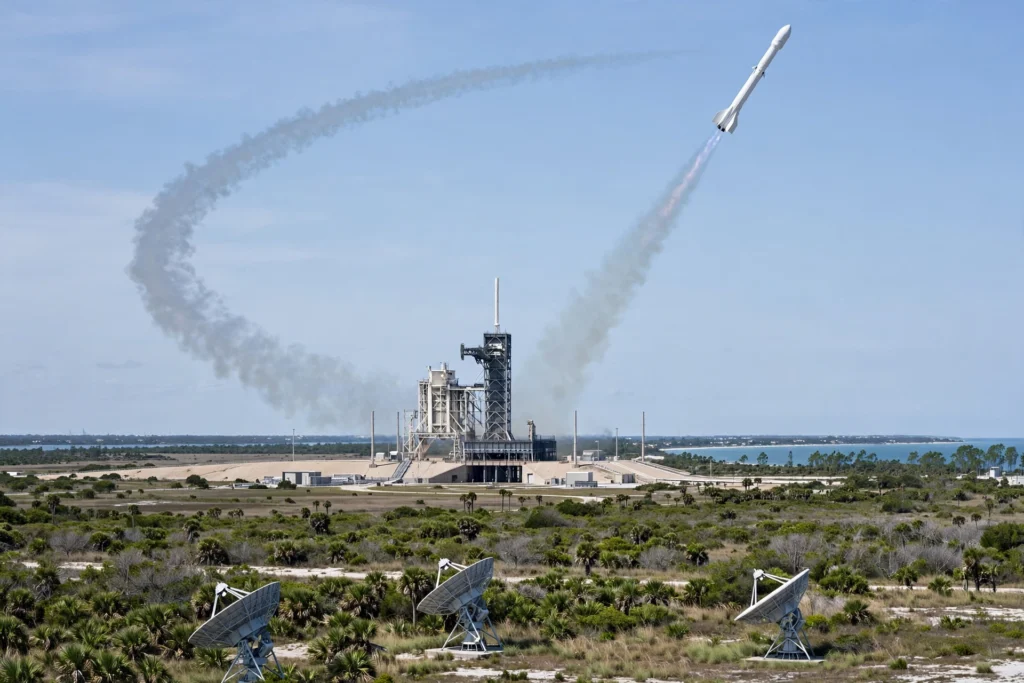
A United Launch Alliance Vulcan rocket malfunctioned about ten minutes after liftoff on Sunday, November 15, 2026, and failed to reach orbit, destroying the 40 Amazon Leo internet satellites it carried. The rocket lifted off from Space Launch Complex 41 at the Cape Canaveral Space Force Station in Florida at 12:40 p.m. Eastern time, atop 3.8 million pounds of thrust from six strap-on solid rocket boosters and two methane-burning BE-4 engines. About ten minutes into the flight, during the burn of the Centaur upper stage, something went wrong, and the mission could not deliver its payload to orbit. It was the first outright failure of a United Launch Alliance rocket since the company, a partnership between Boeing and Lockheed Martin, was formed in 2006.
The failure is a major setback for both companies. For ULA, it is the first total mission loss in the alliance's twenty-year history, and it grounds a rocket that was supposed to replace the workhorse Atlas 5 and carry the bulk of Amazon's satellite constellation into orbit. For Amazon, it is the loss of 40 satellites from a constellation that is already far behind its regulatory schedule, and it threatens the company's plan to start initial satellite internet service before the end of 2026. The flight was only the fifth for the Vulcan rocket, and the first in nine months.
Technology News: What Went Wrong on the Vulcan Flight
The launch began well. The 214-foot-tall Vulcan blasted off from pad 41 at 12:40 p.m. Eastern time, after two days of delays and a countdown hold with 20 seconds left on the clock to resolve a technical issue. The six solid rocket boosters, made by Northrop Grumman and the source of problems on two earlier Vulcan flights, appeared to perform normally and burned out less than two minutes after liftoff, peeling away from the first stage one minute and 35 seconds into flight. The first stage, powered by two BE-4 engines from Blue Origin, fired from liftoff and carried the rocket to an altitude of 95 miles.
Six minutes into the mission, the main booster and the payload fairing both separated as planned, and ULA lit the engines of the Centaur V upper stage for the first of the planned firings needed to reach low Earth orbit. The Centaur was to burn for about 12 and a quarter minutes. But the anomaly came during that burn, and the mission failed to deliver the Amazon satellites to orbit. ULA said in a statement about 50 minutes after liftoff that, based on data received by its launch director, the Vulcan vehicle had suffered an anomaly ten minutes into the flight and failed to deliver the Amazon mission to orbit. The company added that it would work closely with its customer and other appropriate organizations to find the cause, determine the appropriate corrective action, and return to flight as quickly as possible.
What exactly went wrong is not yet publicly known. ULA said it did not yet have specific data on what happened, and that the cause would take time to establish. Early reporting pointed to the booster stage rather than the Centaur or the solid rocket boosters. Spaceflight Now noted that the first-stage methane engines fired longer than expected based on ULA's estimated timeline, and Ars Technica reported, citing sources, that the twin BE-4 engines kept burning at least 30 seconds past their planned shutdown near the five-minute mark, which could mean the booster stage was underperforming. If the first stage underperformed, the Centaur may not have had enough propellant to make up the difference. The flight had already been delayed twice, after a refuelling issue scrubbed a Friday launch attempt, and the rocket eventually flew on Sunday after the problem was resolved before the end of the launch window.
Amazon Leo: The Constellation at Stake
The payload on Sunday's flight was 40 satellites for Amazon Leo, the low Earth orbit broadband network Amazon spent six years calling Project Kuiper before renaming it. The mission, code-named LV-01, was the first of 38 Vulcan flights Amazon has purchased to launch its Leo satellites, which are designed to compete head-to-head with Elon Musk's Starlink and other space-based internet providers. The larger Vulcan carried 40 satellites on Sunday, compared with 29 on the last Atlas 5 launch, and the rocket is slated to carry more than 1,500 of Amazon's first-generation satellites, more than any other rocket in the program. Amazon put 40 satellites aboard the Sunday mission and said it is already planning larger configurations for subsequent missions.
Amazon Leo is a big bet on satellite internet. The company plans more than 3,300 first-generation satellites, with 3,232 authorized by the Federal Communications Commission, and it had about 396 in orbit before Sunday's failure, across 14 successful missions using Atlas V, Falcon 9 and Ariane 6 rockets. Sunday's flight would have pushed the total launched to date to 436. Amazon already has more than 200 satellites in orbit, had hoped to launch its satellite broadband service this year, and says Leo will start initial service before the end of 2026 in the United States and the United Kingdom, along with a few other countries. The service is not on general sale yet and no price has been published.
The loss of 40 satellites is not, on its own, a fatal blow to a constellation of more than 3,000. Amazon builds its satellites in volume, and 40 spacecraft represent a small fraction of the total system. But the failure matters because of what it does to the launch schedule. Amazon Leo will now have to wait on ULA's failure investigation to run its course before trying again with a Vulcan, and the LV-02 mission, which had been expected to follow within weeks, is now on hold. With launch cadence already the binding constraint on the constellation, any grounding of the rocket meant to carry more than 1,500 of its satellites is a serious problem. The company has other launch providers, but Vulcan was supposed to be the workhorse of the deployment, and its absence leaves a hole in the schedule that will be hard to fill quickly.
Technology News: The FCC Clock and the 2029 Deadline
The failure also tightens a regulatory clock that was already working against Amazon. The company's FCC licence required half of the first-generation constellation, 1,616 satellites, to be in orbit by July 30, 2026, and all 3,232 by July 30, 2029. Amazon missed the halfway milestone by a wide margin, with only about 396 satellites in orbit. On June 5, 2026, the FCC's Space Bureau granted a limited waiver in order DA-26-553 that kept the licence in force and declined to move the final 2029 milestone, but the relief came with a price written into the spectrum.
Under the waiver, every Leo satellite Amazon launches after the missed July 2026 milestone operates on a non-interference basis, meaning it must accept interference from and avoid causing interference to other operators in the shared band, until Amazon reaches 50 percent deployment or March 30, 2028, whichever comes first. The window shortens to 15 months, ending October 30, 2027, if Amazon certifies that it has built the satellites and secured the launches needed for 50 percent deployment. Amazon also forfeits the surety bond it posted against the original milestone. SpaceX, whose Starlink system is the market leader Amazon is chasing, opposed the waiver. The gap is large: with about 396 production satellites up, Amazon still needs roughly 2,836 more to reach 3,232 by July 30, 2029.
The waiver bought time on the midpoint, not on the finish line. If Amazon falls well short in 2029, the FCC can reduce the authorized constellation to the number of satellites actually in orbit, which would shrink the system permanently. That is why the launch cadence matters so much, and why the Vulcan failure is more than a lost batch of satellites. Amazon needs to launch more than 2,800 satellites in less than three years, a pace that requires every rocket in its manifest to fly on schedule. A grounding of Vulcan makes that pace harder to hit, and a long one would force Amazon to find replacement launches on rockets already booked by other customers. The company's satellite factory can build the spacecraft, but only rockets can put them in orbit.
What Happens Next for ULA and Amazon
The immediate next step is ULA's failure investigation, and the Vulcan rocket will face a potentially significant grounding while engineers review telemetry and implement fixes for whatever caused the mishap. ULA has not said how long the investigation will take, and it has not identified a cause. The company said it would work closely with Amazon and other appropriate organizations to find the cause and return to flight as quickly as possible, but the history of rocket failures suggests the process will take months rather than weeks. The investigation will focus first on the booster stage, where the BE-4 engines ran longer than planned, and on whether the extended burn was a symptom of a deeper problem or the cause of the failure itself.
For ULA, the failure is a blow to a reputation built on reliability. The alliance's Atlas 5 rocket was known for its dependability, and ULA had never lost a mission outright in twenty years. The Vulcan, by contrast, is off to a troubled start: nozzle problems marred two earlier flights, the rocket had not flown in nine months before Sunday, and now its fifth flight has ended in the loss of its payload. The Vulcan is meant to replace the Atlas 5 fleet, and it is central to ULA's future. A long grounding would raise questions about the rocket's design and about the company's ability to deliver on the launch contracts it has signed, including the 38 Amazon flights.
For Amazon, the question is how quickly it can recover the lost schedule. The company has other rockets in its manifest, and it could shift some launches to Falcon 9 or Ariane 6 while Vulcan is grounded, but those rockets have their own queues. The more important question is whether the initial service launch, planned before the end of 2026, can still happen on time. Amazon has said Leo will start initial service this year in the United States and the United Kingdom, and a delay would hand more time to Starlink, which already has thousands of satellites in orbit and millions of customers. What to watch is narrow and specific: the cause ULA identifies and how long the grounding lasts, whether Amazon shifts launches to other rockets, and whether the initial service date slips. The 40 satellites lost on Sunday can be rebuilt, but the months lost to an investigation cannot.
Source: Reuters