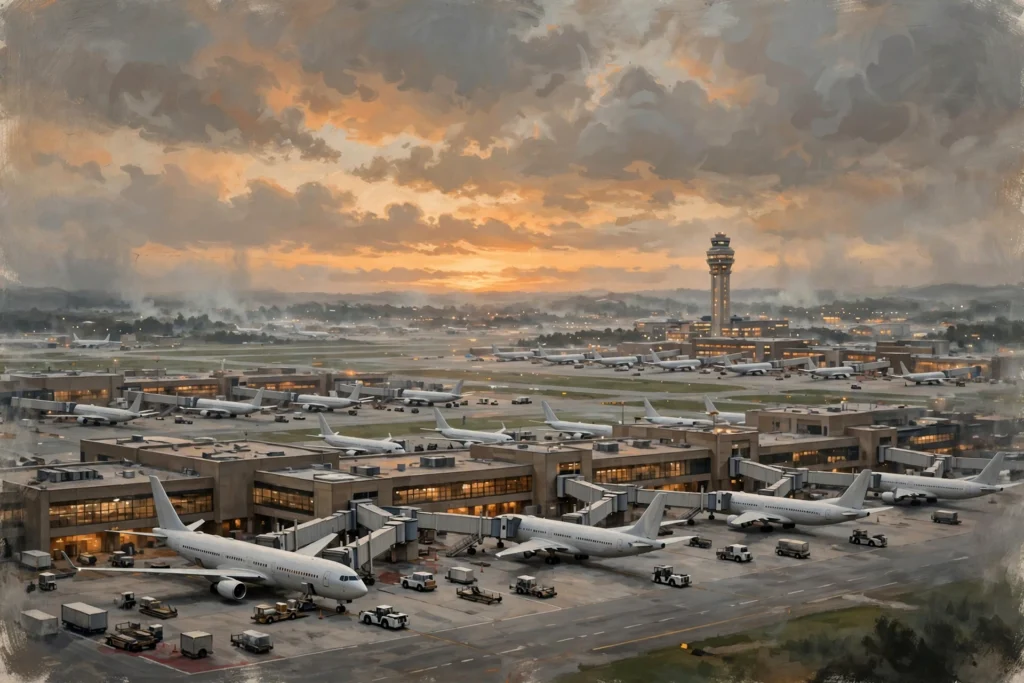
US News Today: FAA Lifts Nationwide Ground Stop
The top story in US news today is one that brought American aviation to a standstill. The Federal Aviation Administration lifted a nationwide ground stop on Friday evening, November 13, after a communications outage forced every departing flight in the United States to remain on the ground for more than four hours. The order was only the second nationwide grounding of American flights since the September 11 attacks, and it left tens of thousands of travellers stranded at airports from New York to Los Angeles while airlines scrambled to recover. The FAA announced shortly after 8pm Eastern time that the stop had been lifted and departures could resume, but the disruption did not end with the announcement: more than 10,000 flights had been delayed and more than 4,000 cancelled by the time planes started moving again, according to flight-tracking data reported by CBS News, and airlines warned that the knock-on delays would continue well into the night. Officials were quick to say what the outage was not. It was not a cyberattack, they said, and it was not a threat. It was a failure inside the telecommunications network that carries the air traffic control system’s voice and data — the ageing backbone that keeps America’s skies moving.
What happened on Friday afternoon
The trouble began in the middle of the afternoon. At 3:36pm Eastern time, radar and communications systems at air traffic control centres and terminal radar approach control facilities across the country became unstable, according to Transportation Secretary Sean Duffy. Within minutes the FAA’s Air Traffic Control System Command Center sent an order to every aircraft operator in the United States: because of extraordinary circumstances and for reasons of safety, all airports were ground stopped and all departing traffic was to remain on the ground until further notice. The formal order went out at 3:54pm. In a post on X, the FAA said there had been a temporary telecommunications outage and that, out of an abundance of caution, all flights had been halted. Every flight had been accounted for, the agency said, and international flights would be handled on a case-by-case basis.
Planes already in the air were allowed to continue to their destinations and land: more than 4,000 flights were airborne when the order was issued, according to the tracking site Flightradar24, and Duffy said more than 3,500 aircraft had been in the air at the height of the disruption, with fewer than 400 still flying as they were brought in to land. Flights within Alaska and Hawaii were not affected. Medical evacuation flights, cargo carrying essential medicines and law enforcement movements continued to operate. But for everyone else, the system stopped. In the event, the agency began lifting the order gradually and announced shortly after 8pm that it had been cancelled, a little more than four hours after it began.
The scale of the disruption
The numbers describe the biggest single-day aviation disruption in the United States in years. FlightAware data cited by CBS News put the toll at more than 10,000 delayed flights and more than 4,000 cancellations, and later tallies reported by weather.com put cancellations above 6,000, with more than 15,000 flights affected in total. Aviation analytics firm Cirium recorded at least 600 diverted flights by 5:50pm Eastern time, of which 496 returned to their departure airports and 104 were sent to other airports. Around 11,000 flights carrying more than 1.5 million passengers had been scheduled to depart American airports after 4pm Eastern on Friday, according to figures reported by the Economic Times, which gives a sense of how many journeys the stop touched. Chicago’s O’Hare and Midway airports, Dallas-Fort Worth and New York’s LaGuardia were among the hubs reporting severe disruption, and at Cincinnati nearly every flight scheduled after 3:30pm was delayed or cancelled.
The pain did not stop when the order was lifted. Airlines warned that cancellations and delays would continue as they worked to get aircraft and crews back into position, a process that in an industry built on tight turnaround schedules can take a day or more. American Airlines told passengers that disruptions would continue despite the gradual resumption of services. Duffy warned at an evening White House news conference that restoring normal operations would take time. The count of delayed and cancelled flights kept rising into the evening as the system worked through the backlog.
What caused the outage
What actually broke is still being established, but the outline was clear by Friday night. The communications outage was tied to an update on a network operated by L3Harris, the contractor that runs the FAA’s telecommunications infrastructure, according to reporting by CBS News and weather.com. The update failed, forcing a reboot of the system, and the reboot then crashed, cutting communications across the country’s 22 Air Route Traffic Control Centres — the facilities that guide aircraft between airports. A former air traffic controller told Scientific American the failure may have been a software problem, such as an update gone wrong in the system that manages communications between pilots and controllers. Duffy blamed outdated air traffic control technology for the outage, saying the instability had hit radar and communications in the centres and in terminal radar approach control facilities alike.
The timing drew attention to a separate FAA programme. The disruption came three days after the agency expanded SMART, its AI-powered air traffic management system, across all 22 air traffic regions, after testing it around Washington DC in September, according to Scientific American. Air Space Intelligence, the company behind the FAA’s AI-powered air traffic management system, said its technology was not responsible for the nationwide ground stop. Officials did not link the SMART expansion to the outage, and the reported cause pointed instead at the underlying telecommunications network. The FAA’s telecommunications infrastructure is managed by L3Harris, a Silicon Valley-based aerospace and defence company and a contractor for federal government agencies, which did not immediately respond to requests for comment. The FAA itself said only that its technicians were investigating the issue and would provide updates.
“No cyberattack”: what officials said
Within hours of the grounding, the question on everyone’s mind was whether the failure had been caused deliberately. Officials at the White House moved quickly to close that question down. Homeland Security Secretary Markwayne Mullin told reporters outside the White House that there was no indication the ground stop had been triggered by a threat to the United States, and that investigators had found no evidence of a cyberattack. The FBI does not believe a cyberattack or criminal activity caused the failure, Bloomberg reported, citing an official familiar with the matter. Mullin said there was no connection between the incident and Microsoft, and the White House said there was no indication of a terrorist threat or a cyberattack connected to the outage. Duffy, speaking at the White House after the stop was lifted, said the FAA had not lost all of its radar or all of its telecommunications, but that the instability was serious enough that, out of an abundance of caution and to keep American flyers safe, the agency had ordered the ground stop.
The only other nationwide ground stop since then came on January 11, 2023, when a damaged database file in the FAA’s Notice to Air Missions system — the system that sends pilots safety information — halted departures for about 90 minutes and delayed more than 10,000 flights. Friday’s stop lasted more than twice as long and disrupted far more flights, and it arrived against a background of repeated warnings about the state of the country’s air traffic control equipment. A Reuters review published on Friday noted that old air traffic control equipment has regularly disrupted American flights over the past three years, including a data service outage at the Dallas terminal radar facility that forced ground stops at two Dallas-area airports. The FAA later said contractor L3Harris had failed to make sure redundancies were in place in Dallas, while L3Harris said the outages were preventable and a direct result of a lack of government investment to replace legacy, end-of-life analogue telecom circuits. In September 2026, an old primary data circuit at Philadelphia failed, and the backup — a Verizon fibre line — had already been cut by a construction crew, leaving the facility without its link for eight hours.
A system under strain
The outage landed in the middle of a long-running argument about the state of American air traffic control, one of the busiest systems in the world. Much of its underlying equipment dates back decades, and the replacement programme has repeatedly run into delays and funding fights. Duffy has made modernisation a central theme of his time as Transportation Secretary, and on Friday night he pointed directly at the age of the technology as the cause of the failure.
For the travelling public, the episode was a reminder of how much of modern life depends on systems that are invisible until they fail. The fact that no aircraft was put at risk — every flight in the air landed safely, and the ground stop itself was the safety measure — will be counted as a success for the controllers and the FAA’s procedures. But the fact that the stop was needed at all, and that it lasted more than four hours, will be counted as a failure of the infrastructure underneath those procedures.
What happens next
The immediate question is how quickly the system returns to normal. Airlines were rebooking passengers through Friday night, and the knock-on effects — aircraft out of position, crews timed out, missed connections — can take a day or more to clear after a disruption on this scale. The longer question is what the investigation finds. FAA technicians were still working on Friday night to establish exactly what failed in the L3Harris-operated network and why the safeguards that are supposed to catch a bad update did not.
The political consequences will follow the technical ones. The Trump administration has made air traffic control modernisation a priority, and a nationwide grounding caused by ageing equipment and a failed contractor update will sharpen the argument in Congress about how fast that modernisation should move and who should pay for it. Duffy’s framing on Friday night — that outdated technology was to blame — points in that direction. For now, the skies are open again, the planes are moving, and the count of delayed and cancelled flights is still climbing. What happened in the news today was a four-hour failure that stopped a nation’s aviation system. What happens next will be decided by what the investigation finds, and by whether the system that failed on Friday is fixed before it fails again.
Source: AP News