Trump Tariffs: Softer Canada Tone at SC Rally
A trump tariffs story took an unexpected turn on the campaign trail this week, when President Donald Trump spoke about Canada in terms strikingly different from the language he has used for much of the year. Speaking at a campaign rally in Rock Hill, South Carolina, on Thursday, October 29, Trump told supporters that Canada had been treating the United States extremely nicely recently. The remark stood out because it came from a president who has spent months locked in a tariff war with Ottawa, imposing heavy duties on Canadian goods and accusing Canadian leaders of unfair trade practices. For one evening, the tone was praise rather than punishment, and Trump offered his own explanation: in his telling, it was the tariffs themselves that had produced the better mood.
The comment was brief, delivered in the middle of a midterm campaign rally rather than at a trade announcement or a diplomatic event. Trump was in Rock Hill campaigning for Republican Senate candidate Darline Graham, one stop in a final-week tour designed to energise Republican voters before Election Day on Tuesday, November 3. That setting matters, because it helps explain both why the remark was made and why it should not be over-read. Campaign rallies are built for applause lines, not for the careful language of negotiation, and a warmer word about a trading partner on a rally stage is not the same thing as a change in policy. What Trump did not do at Rock Hill is just as important as what he did say. He did not announce a trade deal, he did not say tariffs would come down, he did not point to a specific Canadian concession, and the accounts of the rally reviewed for this article quote no Canadian official responding to his description. For now, the only confirmed change is in how the president talks about Canada, not in the duties that American importers and Canadian exporters actually face.
Trump Rally in South Carolina: What Was Actually Said
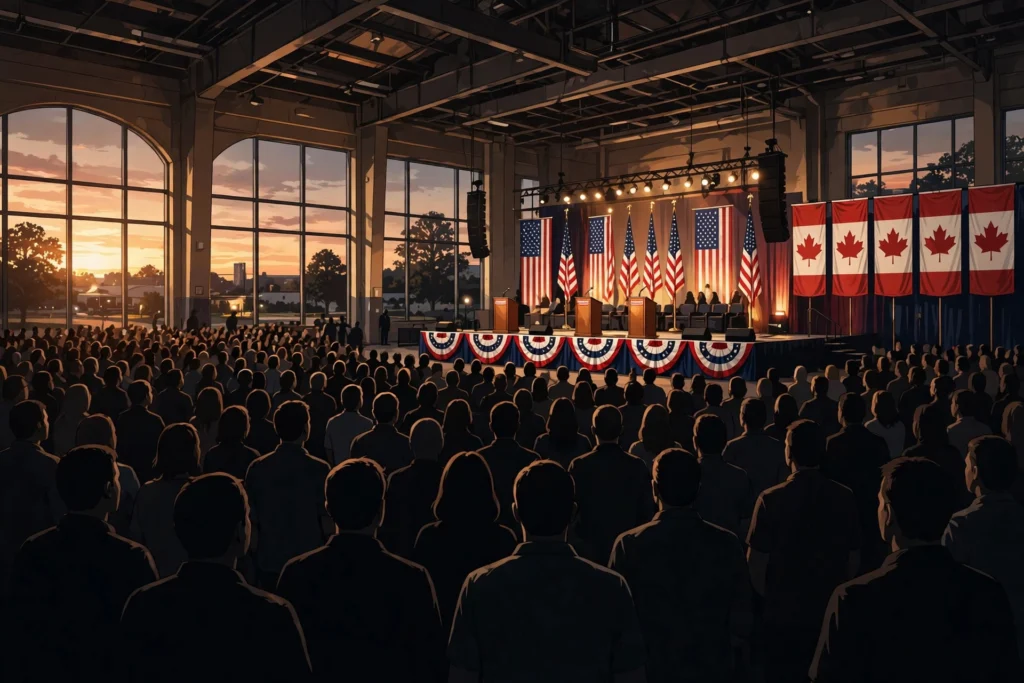
The Rock Hill rally followed the familiar shape of Trump’s closing campaign events: a hall decked out for a Republican campaign stop, with the South Carolina Senate race as the stated reason for the visit. Graham is seeking re-election, and Trump has returned to South Carolina more than once in recent weeks to support Republican candidates there, a sign of how seriously his party is taking races that in a calmer year might have been considered safe. The rally came at the end of a long month of travel for the president, who has held more than two dozen rallies since the start of October as part of a final push to hold Republican majorities in Congress.
It was in that setting that Trump turned to Canada. According to the accounts of the rally, he told the crowd that Canada had been treating the United States extremely nicely lately, and he linked that improvement directly to the tariffs he had imposed. The logic he offered was simple and characteristically blunt: pressure works, and a trading partner that faces American tariffs becomes a friendlier partner. He did not describe a thaw in formal terms, and he did not present the warmer tone as the result of a negotiation breakthrough. Instead, he presented the tariffs as the cause of the better relationship, as though the duties were not an obstacle to good relations but the instrument that had produced them.
That framing is notable because it reverses the usual way trade disputes are described. Normally, tariffs are presented as punishment imposed when talks fail, and their removal is presented as the reward when talks succeed. At Rock Hill, however, Trump described the tariffs as already doing the work of improving the relationship, without saying they would be lifted as a result. Supporters in the hall heard a success story; critics will hear a claim without evidence, since no Canadian concession was named and no document was produced. Both reactions are possible precisely because the remark was so short. A single sentence at a rally can carry a great deal of political meaning while carrying very little policy detail, and this sentence is a good example of that.
Tariff News: How the Trade Fight Reached This Point
To understand why a warmer word from Trump counts as news at all, it helps to retrace how the relationship reached this point. Advanced trade talks between Washington and Ottawa collapsed in August, after Canada rejected American terms it considered unfair and economically damaging. Since then, the Trump administration has imposed tariffs of 50 percent on hundreds of categories of Canadian imports, according to reporting of the dispute, and Ottawa has responded with tariffs of its own. The two sides have continued to talk in some form, but no comprehensive agreement has emerged, and each side has described the state of the talks differently, which is itself a sign of how far apart they remain.
The stakes are large, because the United States is by far Canada’s biggest export market, accounting for 71.7 percent of Canada’s merchandise exports in 2025, according to reporting of the trade relationship. When Washington raises tariffs on Canadian goods, the effect is felt quickly across Canadian industry, from steel and aluminium to cars, lumber and energy. When Ottawa answers with tariffs of its own, American businesses and consumers feel the return blow. The two economies are so closely woven together, through supply chains that cross the border many times before a finished product reaches a shop, that a tariff war between them is not an abstract diplomatic quarrel. It shows up in prices, in factory orders, and in border towns whose livelihoods depend on trade flowing freely.
The months since August have also produced a series of public frictions beyond tariffs. Trump has cheered election victories by a Quebec separatist leader and a British Columbia Conservative premier-designate, presenting both results as setbacks for Canadian Prime Minister Mark Carney. Analysts quoted in coverage of those remarks have pushed back, noting that neither election was a referendum on Carney, whose federal Liberal Party is separate from British Columbia’s provincial Conservatives, and that both results reflected provincial politics rather than declining support for the prime minister. The American embassy in Ottawa added another layer of tension in the final week of October, accusing Canadian politicians of seeking to influence the November 3 midterms, citing comments by Industry Minister Mélanie Joly about targeting Republican states with retaliatory tariffs and an advertisement by Ontario Premier Doug Ford featuring former President Ronald Reagan criticising tariffs. Carney rejected the allegations, saying they had no merit. Against that background, a rally remark praising Canada looks less like a sudden change of heart and more like one more swing in a relationship that has lurched between confrontation and cautious optimism for months.
White House News: Two Accounts of the Same Talks
One of the most striking features of the Canada dispute in recent days is how differently the two governments have described the same negotiations. Carney told reporters in Ottawa on Monday, October 26, that trade talks with Washington had seen a slight intensification in recent days. He added, however, that to the extent any progress had been made, it was because the United States was coming closer to Canada’s position, not the other way around. He also restated Canada’s red lines, saying his government had been clear about the bottom lines it would not cross, and that it had not been willing to sign what was offered in August. That is the language of a negotiator who believes his side held firm and is now being met part-way.
Trump, by contrast, has described the same period in terms that put the United States in the driving seat. Over the weekend before the Rock Hill rally, he told reporters that a potential trade deal with Canada would be settled pretty soon, and added that Canada was willing to give the United States anything at that moment. Kevin Hassett, the director of the National Economic Council, went further on television, suggesting that the two countries were very close to finally having a deal. The White House news picture, in other words, is one of a deal nearly done, while the Canadian picture is one of talks that have intensified slightly, with progress measured in small steps and no agreement yet in sight. Both accounts cannot be fully right in every detail, and the gap between them is itself informative: each side is describing the talks in the terms most useful to its own domestic audience.
There is also a wider dimension to the dispute. Trump has suggested that Canada’s proposed arrangement with the European Union could be a hostile act, and has threatened tariffs on Europe if he considered such an arrangement unfriendly. A senior Canadian government official, asked about possible retaliation, told reporters that the closer relationship with Europe was not directed against the United States but reflected longstanding shared interests. That exchange underlines how the Canada dispute is no longer only about trade between two neighbours. It sits inside a wider argument about alliances, and about how Washington responds when a close ally builds closer ties elsewhere. A warmer word at a rally does not settle any of those questions, but it does suggest the White House does not want the argument to harden into a permanent breach, at least not in the week of an election.
Midterm Elections 2026: Why Canada Matters on the Trail
The reason a remark about Canada belongs in a story about the midterm elections 2026 is that trade policy has become domestic politics in the border states. Voters in Michigan, Maine and other states that depend on cross-border trade do not experience tariffs as an abstract debate about leverage. They experience them as higher costs for businesses that import Canadian materials, as uncertainty for factories whose supply chains cross the border, and as political arguments in television advertisements. When Trump tells a rally crowd that Canada is treating America nicely, he is speaking to those voters as much as to the crowd in the hall, offering his party’s candidates a closing argument: the tariffs are working, the pressure is paying off, and the relationship is improving on American terms.
That argument will be tested against the reality voters feel in their own communities, and against the polling picture that has dominated the final week of the campaign. National polls have shown Democrats leading Republicans in the race for Congress, and Trump’s own approval rating has been under pressure in recent surveys, including a Marquette Law School poll in Wisconsin that put his approval at 37 percent and disapproval at 61 percent. Pollsters themselves warn that polls are not perfect predictions of outcomes, but the numbers help explain why the final days have been so frantic, with the president travelling constantly and his party shifting some events to telephone rallies to reach more states in less time. Early voting is already under way in many states, which means many ballots will have been cast before the final rallies take place — yet a clip of the president praising Canada can still travel quickly online, reaching voters who did not attend the rally and shaping the conversation in the final days.
What Happens Next for the Tariff Dispute
What happens next will be decided less by rally rhetoric than by what negotiators do in the days after the election. If the warmer tone at Rock Hill is followed by a return to the negotiating table, and if either side can point to a concrete step — a meeting, a framework, a tariff reduction, a concession on a specific sector — then the remark will look in hindsight like an early signal of a thaw. If, on the other hand, the tariffs stay exactly where they are and the talks remain stalled, then the remark will look like campaign language, useful for a rally crowd but without lasting policy meaning. The honest position, on the evidence available now, is that neither outcome can be assumed. No deal has been announced, no tariff cut has been signalled, and no Canadian official has been quoted endorsing Trump’s description of the relationship.
There are several things to watch. The first is whether Canadian officials respond publicly to Trump’s praise, and if so, whether they welcome it, correct it, or ignore it. A warm response from Ottawa would suggest both sides see value in lowering the temperature; silence, or a careful restatement of Canada’s red lines, would suggest Ottawa does not want to be drawn into an American campaign narrative. The second is whether the White House follows the rally remark with any formal step, such as announcing a meeting between Trump and Carney or a new round of talks. The third is whether the tariffs themselves change, since that is the concrete measure by which businesses on both sides of the border will judge whether anything has actually improved.
For American voters, the most immediate test is the election itself. On November 3, voters will decide whether Republicans keep their narrow majorities in the Senate and the House of Representatives, and the result will shape how much freedom the administration has to pursue its trade strategy. Either way, the Canada dispute will not end on election night. The two countries will still share the world’s longest undefended border, the United States will still be Canada’s dominant export market, and the disagreements over tariffs, dairy, steel, aluminium and energy will still need to be negotiated. The Rock Hill remark is best understood as a small but telling moment in a long dispute: the tone changed for an evening in South Carolina, the tariffs did not, and the negotiation continues.
Source: Daily Sabah