Trump Rally: Rock Hill Stop in Final Midterm Push
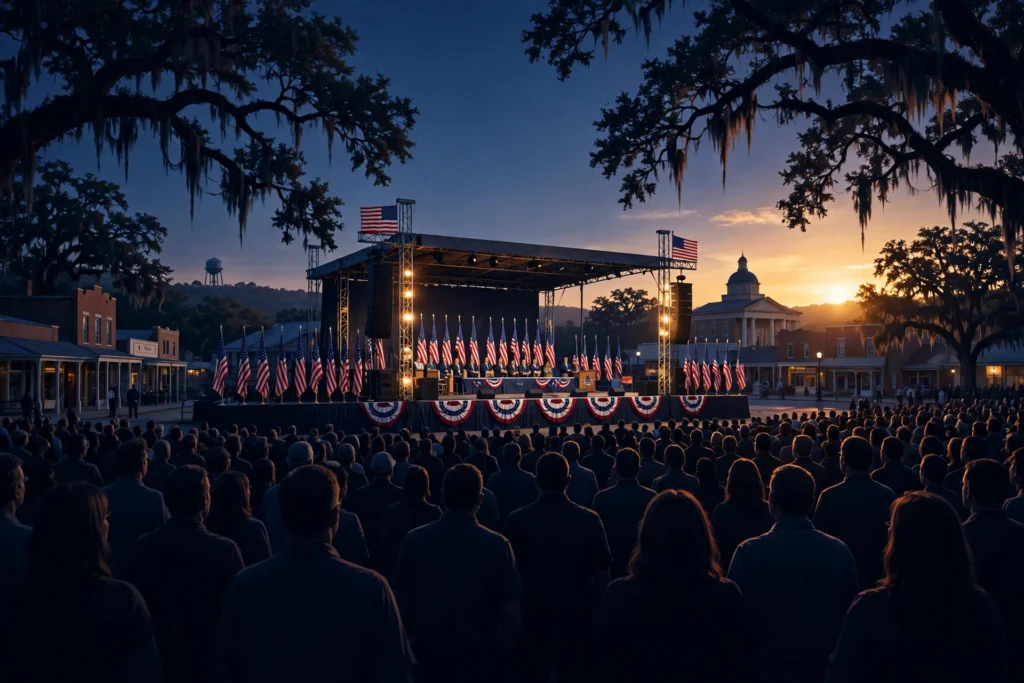
President Donald Trump will campaign in Rock Hill, South Carolina, on Thursday, Oct. 29, in the final days before the midterm elections, the Republican National Committee announced on Monday. The stop will be his second visit to the state in a week and his third South Carolina appearance of the year, putting him in a border city where a single rally can reach voters in two states at once. He is expected to speak at around 12:30 p.m., with doors opening at 9 a.m. and tickets available online, although the venue had not yet been announced.
The immediate purpose is to rally support for Sen. Darline Graham against Charleston Democrat Annie Andrews. But Rock Hill sits near the North Carolina border and inside the Charlotte media market, so the event is also expected to lift Republican Michael Whatley in his Senate contest across the state line against former North Carolina Gov. Roy Cooper. With both races tightening, the White House is using one of the president’s last campaign stops to work two Senate battlegrounds at once.
The announcement came as Trump moved through a closing blitz of more than 30 campaign stops, having campaigned in Georgia on Saturday, Michigan on Sunday, and Mississippi on Monday, with Texas, Ohio, South Carolina, Florida, and Iowa still to come. The Rock Hill rally is one stop in a final-week push that Republicans are counting on to do what history says is hard: keep the president’s party in control of Congress in a midterm year.
Trump Rally: Why Rock Hill Is a Two-State Stop
The geography of the Rock Hill stop is the story. The city is part of the Charlotte television market, which reaches deep into North Carolina, and a rally there speaks to voters on both sides of the border. Trump campaigned for Whatley last Tuesday in Greenville, in eastern North Carolina, and Rock Hill gives him a second chance in a week to put the party’s case to North Carolina voters without leaving South Carolina.
Both Senate races have become more competitive as Election Day has approached. The Cook Political Report rates North Carolina as likely Democrat, and last week it moved South Carolina from likely Republican to lean Republican in an Oct. 20 update, a shift that reflects a race tighter than Republicans expected in a state Trump carried comfortably in the last presidential election.
The two candidates have spent the closing days criss-crossing the state. Graham campaigned on Monday, Oct. 26, in Myrtle Beach with Republican gubernatorial candidate Alan Wilson, Rep. Russell Fry, and U.S. Sen. Ted Cruz of Texas, while Andrews stopped in St. Helena for a get-out-the-vote event. Both are expected back in the Upstate before the polls open, with Andrews in Greenville on Oct. 27 and Graham in Greenville on Oct. 28, the day before the president arrives.
The Rock Hill visit also completes a map for Trump inside South Carolina. After the stop, he will have campaigned in three regions where Republican voters backed Graham’s opponents: Myrtle Beach in late August, ahead of a special primary runoff on Aug. 25; Pendleton, in the northwest Clemson area, on Oct. 21; and now Rock Hill, in the Charlotte suburbs around York County, where Graham’s primary challengers were strongest.
Midterm Elections 2026: The Final-Week Swing
The Rock Hill stop sits in the middle of a final-week itinerary that shows how heavily Republicans are leaning on the president: Mississippi on Monday, Texas on Tuesday, where he has two stops planned, Ohio on Wednesday, South Carolina on Thursday, Florida on Friday, and Iowa on Sunday. It follows a weekend in which he campaigned in Georgia on Saturday and Michigan on Sunday, part of a broader run of more than 30 campaign appearances ahead of Election Day.
The pace has been audible as well as visible. At his Monday rally in Mississippi, Trump acknowledged that his voice was wearing thin after days of back-to-back events, telling the crowd that vocal cords were not made for a rally every day. It was the reality of a closing schedule that has the president flying from state to state and speaking to packed rooms night after night.
The Mississippi rally also showed the argument Trump is making in states where Republicans are heavily favored. He told supporters that Sen. Cindy Hyde-Smith was doing great, but that he had come to the deep-red state to make sure, because when voters believe a candidate is doing so well, they stay home. “Sometimes when you think somebody’s doing so well, nobody votes. They all stay home,” he said. “Then bad things happen.” It was the turnout warning that runs through the whole final-week push: in a midterm, the party that gets its own voters to the polls wins, and even safe seats are not safe if supporters assume the result is decided.
The president has added attention-grabbing promises to the turnout pitch. He has told voters to pretend he is on the ballot even though his name appears nowhere, a line he first used at a recent midterm convention in Dallas, and he has pledged to pay every adult $5,000 if Republicans win both chambers of Congress. The proposals have been widely mocked, but they target the voters Trump most needs in a midterm: his own supporters, who turn out in large numbers for presidential elections and far less reliably when he is not on the ticket.
Vice President JD Vance has been running a parallel schedule in Republican-leaning states where Senate races have tightened, campaigning in Kansas for Sen. Roger Marshall, who faces Democrat Adam Hamilton in a state where Democrats have not won a Senate race since 1932, and in Montana with Republican candidates. Sen. Tim Scott of South Carolina, who chairs the National Republican Senatorial Committee, told the Associated Press on Monday that Republican candidates were closing very strongly across the country.
Election Polls: The Battle for the Senate in the Carolinas
The South Carolina race has tightened because of a primary season that left scars. Trump used his August visit to Myrtle Beach to campaign for Graham before a special Republican primary runoff, after Rep. Russell Fry of the 7th District won the area in the special primary but failed to advance. Graham went on to win the runoff over Rep. Ralph Norman of the 5th District by five percentage points, carrying counties that had initially swung toward Fry.
Norman, however, kept his popularity in the Upstate on runoff day, winning the 12 counties between Oconee and York counties, including Greenville and Spartanburg. After his loss, a campaign emerged to vote for Norman as a write-in candidate, a sign of the frustration among the voters Trump is now returning to court. His closing schedule reflects that map: he has gone to the two regions where Norman was popular, the Upstate and the area around Rock Hill, to shore up support among voters who backed the challenger.
The North Carolina race has moved in the opposite direction from what Republicans hoped, with the Cook Political Report rating it as likely Democrat and Whatley trailing former Gov. Roy Cooper. That is why the Rock Hill location matters: a rally in the Charlotte market lets Trump speak to the North Carolina voters who decide that race while standing in a state where his own party’s candidate also needs help. It is a two-for-one stop in a week when the president has no spare days.
The broader Senate picture explains the urgency. Republicans are defending a narrow majority in the House and a series of competitive seats, and strategists believe traditional strongholds including Texas, Iowa, Ohio, Kansas, and Alaska are in play, alongside the usual swing states. Democrats need to win several red-state races to take control of the Senate, and they have been encouraged by polling that shows voters disgruntled over the cost of groceries, fuel, and health care. An Associated Press and KFF Health News survey found that about half of rural voters still approve of Trump’s job performance, but that many do not believe he has delivered the economic revival he promised, with affordability named as the defining issue of the election.
2026 Midterms: The Turnout Test and What Happens Next
Republican National Committee Chair Joe Gruters has been blunt about what the closing push is for. He told Newsmax last week that Trump is the party’s secret weapon in the effort to hold Congress, and that the president’s campaigning would help Republicans overcome the historical trends that favor the opposition party in a midterm. “He is an absolute machine. He’s crushing it out there,” Gruters said. “I’m with him a lot. He’s delivering our voters.”
Gruters said the party’s prospects depend on whether Trump can persuade voters who backed him in past presidential elections to return to the polls. “The only way we’re going to defy history and win this cycle is if people turn out,” he said. “Our best asset is the president putting him front and center, putting him on the ballot. He’s going to deliver. We’re going to win.” It is a candid admission: the Republican midterm strategy rests on one man’s ability to turn his own supporters out in an election in which his name is not on the ballot.
That is the test the Rock Hill rally is designed to meet. The president’s party has historically struggled in midterm elections, particularly in the House, where Republicans are defending a narrow majority and competitive seats. The pattern is why the Cook Political Report’s downgrade rattled Republicans: if a seat in a state Trump won by a wide margin is rated only lean Republican, the map is tighter than the party’s national standing would suggest.
What happens after Rock Hill will be decided quickly. The rally is followed by stops in Florida on Friday and Iowa on Sunday, then by Election Day on Tuesday, Nov. 3, when voters will decide which party controls Congress for the final two years of Trump’s presidency. Early voting is already under way in many states, and the candidates in both Carolina races are spending their last days in the Upstate and the Charlotte suburbs.
For Graham, the Rock Hill rally is the biggest event of her closing campaign, a presidential visit to the region where her primary support was weakest. For Whatley, it is a free shot at North Carolina voters in the Charlotte market while his race is rated as leaning away from him. For Trump, it is one more stop in a 30-stop closing run that ends only when the polls close. Whether the rallies move enough voters to defy midterm history will be known on Nov. 3, when the first results come in from the states he spent his final week touring.
Source: WCNC