Trump Rally in Ohio: Ramaswamy Ad Backlash Grows
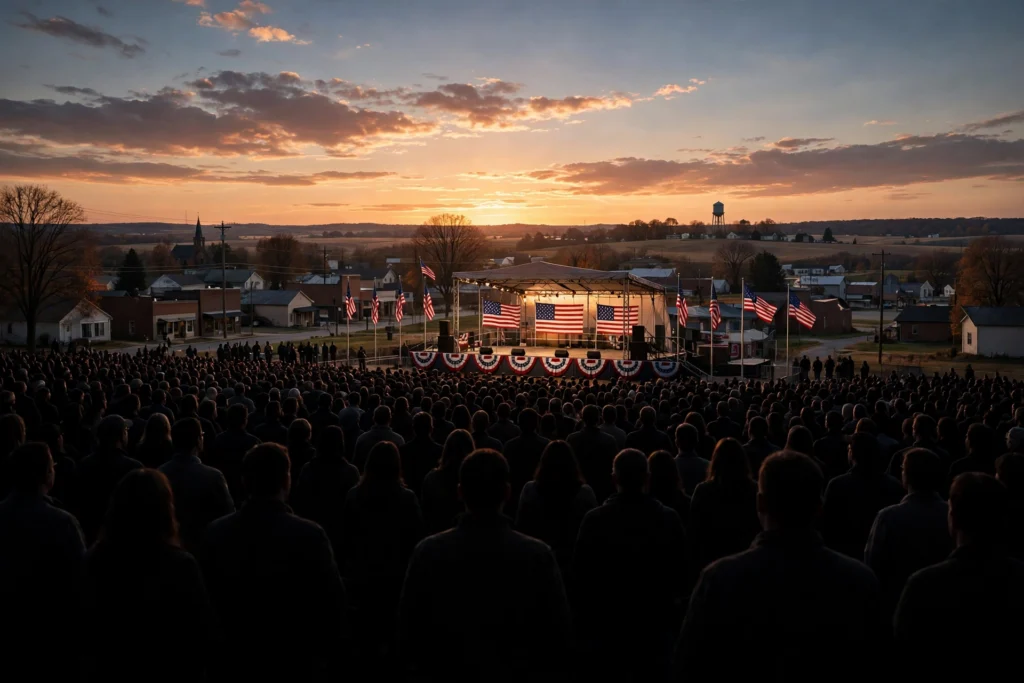
President Donald Trump is returning to Ohio on Wednesday for a trump rally in Chillicothe, his third campaign stop in the state during the midterm elections 2026, at a moment when the Ohio governor’s race has become one of the most closely watched in the country. The visit puts Trump in Ross County, which he has carried three times, as his party’s nominee for governor, Vivek Ramaswamy, faces a backlash over a campaign advertisement that has divided Ohio Republicans and shifted the outlook of the race.
Trump comes to fire up supporters in a state he has won three times, most recently by 11 percentage points. But Ramaswamy and Republican Senator Jon Husted both face headwinds as voters express frustration with high gas prices driven by the unpopular Iran War, spiking property tax bills, and opposition to data centers, which have been particularly prolific in Ohio.
With Election Day on November 3 less than a week away and early voting already under way, the rally is a test of whether Trump’s presence can steady a Republican ticket that has spent the closing days of the campaign defending one of its own advertisements.
Trump Rally: A Third Ohio Stop in the Final Week
The Chillicothe rally follows visits to Vandalia near Dayton and to Youngstown earlier in the cycle, as well as a stop in northern Kentucky, across the river from Cincinnati. Vice President JD Vance, who is from Ohio, has made his own stops in the Cincinnati area and in Lima. The frequency of the visits underscores the competitiveness of a state that has not elected a Democratic governor since 2006.
On Wednesday, Trump is campaigning in Ross County, which he won three times, including by 39 percentage points in 2024. Chillicothe, the county seat and Ohio’s first capital, has faced hardships in recent years. In August 2025, a major employer, the Pixelle Specialty Solutions paper mill, closed and hundreds of people lost their jobs. More recently, the plant has transitioned to making nitrile gloves, a data center company is leasing some of the land, and U.S. Paper Mill is bringing back some paper production employees.
The choice of Chillicothe is a reminder of how Trump’s coalition is built. Ross County is the kind of place where his margins have been widest, and a rally there is designed to energise the voters his party most needs to turn out. In a midterm where turnout often decides close races, the campaign is betting a presidential visit in a friendly county will drive supporters to the polls in the final days of early voting and on Election Day.
The Ad at the Centre of the Ohio Governor’s Race
The Ohio governor’s race has drawn national attention since Ramaswamy launched an ad featuring the estranged mother of Democratic gubernatorial candidate Amy Acton. In the advertisement, Donna Arthur accuses her daughter of lying about her upbringing, which Acton has described as filled with neglect and abuse. Acton has said she has not seen her mother since 1978. That year, Arthur’s husband and Acton’s stepfather, Cledith Arthur, was indicted on a rape charge involving Acton. Arthur and her husband fled Ohio for Pennsylvania. Cledith Arthur was never convicted.
Acton says her mother’s second husband molested her between the ages of nine and twelve, charges were filed, Acton testified against him, he pleaded not guilty, fled the state before trial and never appeared before a judge. He died in 2004. Acton and her brother were removed from their mother’s custody when Acton was twelve, and she has had no contact with her mother since. Her brother, Philip Stearns, has publicly supported her account of their childhood.
The advertisement presents Arthur as a concerned parent questioning her daughter’s honesty, without any reference to the criminal case that ended the family relationship. Critics across the political spectrum have called the spot exploitative, arguing it uses a vulnerable family member to attack a candidate over the trauma she has spoken about openly. Acton said she had always known her mother was deeply sick and unwell, and called it sad to see Ramaswamy exploit her for his own political gain.
The advertisement first leaked online before Ramaswamy’s campaign confirmed it would spend four million dollars to air it across Ohio, and the campaign has since said it will spend more than that to keep it on television through Election Day. Acton responded with an advertisement of her own, posted on October 20, in which she declared that Ramaswamy was not fit to lead, turning the dispute into a direct exchange between the two campaigns.
Election Polls: Forecasters Shift Ohio Toward Acton
Polling suggests Acton might have a slight lead on Ramaswamy, and political forecasters have moved the race from a toss-up to leans Democrat amid the backlash over the ad. The Cook Political Report and Sabato’s Crystal Ball, two closely watched nonpartisan forecasters, have both made the shift. Sabato’s editors wrote that while Democrats still face long odds in Ohio, the direction of the race has changed, and that a lot appears to be going right for a party that has struggled in the state for years.
The forecasters had initially given Ramaswamy the upper hand, reflecting years of Democratic losses in Ohio, before the race was rated a toss-up as polling tightened. Recent surveys now show Acton gaining ground, and analysts attribute the movement in part to Republican voters’ unease about the cost of living, with the advertisement controversy amplifying the shift and giving Acton a sympathetic hearing from voters who might otherwise have been unmoved.
Acton’s background is part of why the story has resonated beyond Ohio. Before entering politics, she served as director of the Ohio Department of Health, a role that made her a familiar figure during the pandemic, and she has built her campaign around public health, education and the cost of living. She made her appeal in an interview with ABC News on Saturday, after a rally in Cleveland alongside former President Barack Obama, pointing to the paper trail behind her account and urging Trump and Vance to look at the facts.
Midterm Elections 2026: The Headwinds Facing Ohio Republicans
The backlash over the advertisement is not the only problem facing Ohio Republicans in the final week. Voters have expressed frustration with high gas prices driven by the Iran War, with spiking property tax bills, and with opposition to data centers, which have spread rapidly across Ohio. Gas prices today average 4.26 dollars a gallon across the United States, according to AAA, up 1.21 dollars from a year earlier, and three in four voters disapprove of the president’s handling of pump prices. The war with Iran, which began on February 28, is the largest driver of the oil-price shock behind the pump.
Those pressures are felt acutely in a state where driving is a daily necessity and where property tax bills have climbed sharply. The data center boom has added another source of discontent, as communities weigh the promise of jobs and tax revenue against the demands the facilities place on land, water and electricity. In Ross County itself, the leasing of former mill land to a data center company is part of the same story, a reminder that the economic changes reshaping Ohio are visible in the very town where Trump is holding his rally.
Husted, meanwhile, is locked in a tight race with former Democratic Senator Sherrod Brown, who lost re-election in 2024 to Republican Bernie Moreno. Brown is seeking a comeback against Husted, whom Governor Mike DeWine appointed to serve the remainder of Vice President JD Vance’s Senate term. A strong Democratic showing in Ohio could put both the governor’s office and a Senate seat in play on the same night, a result few forecasters expected when the cycle began.
Obama’s Return and the Republican Split
Democrats brought in their own heavy hitter on October 24, when former President Barack Obama rallied with Brown and Acton, bashed Trump and criticised Ramaswamy’s ad decision. Obama had not campaigned in Ohio since 2018, when Democrat Richard Cordray lost the governor’s race to DeWine, and his return was the highest-profile moment of Acton’s campaign so far. He told the Cleveland crowd that there had to be something inside a candidate that said no office was worth stooping that low.
Obama’s appearance also produced the most-shared line of his swing through Ohio and Michigan, when he mocked the gold decorations Trump has added to the White House by saying he had made the executive mansion look like Saddam Hussein had opened a Cheesecake Factory. The line went viral and drew a furious response from Trump, who spent part of a rally in Mississippi defending the renovation projects and praising the restaurant chain.
The backlash inside the Republican Party has been unusually public. Governor Mike DeWine and former Governor John Kasich called on Ramaswamy to take the ad down. DeWine called it deeply, deeply troubling, especially in light of Acton’s childhood abuse, and said it was just wrong to run the ad. Kasich called it completely inappropriate. Senator Jon Husted and Secretary of State Frank LaRose said they would not have run it, and former Attorney General Dave Yost, who briefly ran against Ramaswamy in the Republican primary, said there was a better way to lead.
Trump and Vance have stood by the advertisement. Trump called it a very powerful ad on Truth Social, asking who would not use such an ad, and has encouraged Ramaswamy to keep it on the air. Leaving the White House for Iowa on October 22, he told reporters he knew nothing about the abuse Acton suffered, only that her mother had said very bad things about her. Vance praised what he called Ramaswamy’s audacity to run a television commercial which calls it out like it is, and told fellow Republicans to stop complaining about the spot, a remark that came a day before DeWine publicly condemned it.
What Happens Next in Ohio
The immediate question is whether Ramaswamy’s campaign will keep the advertisement on the air through Election Day. The campaign has already rebuffed DeWine’s call to withdraw it, and Trump’s encouragement suggests it will stay. With more than four million dollars committed, the spot will reach most Ohio television viewers multiple times before November 3, and its effect will depend on whether voters see it as a legitimate attack or an overreach.
Acton’s campaign will continue to press its advantage, using the forecasters’ shift and the bipartisan condemnation to argue that the race has turned. The Chillicothe rally is Trump’s answer: a presidential visit to a county he has won three times, in the final week of a campaign his party cannot afford to lose. Whether it steadies the Republican ticket will be clear on November 3, when Ohio decides the governor’s race, the Senate race, and the direction of a state that has not elected a Democratic governor in twenty years.
Source: The Columbus Dispatch