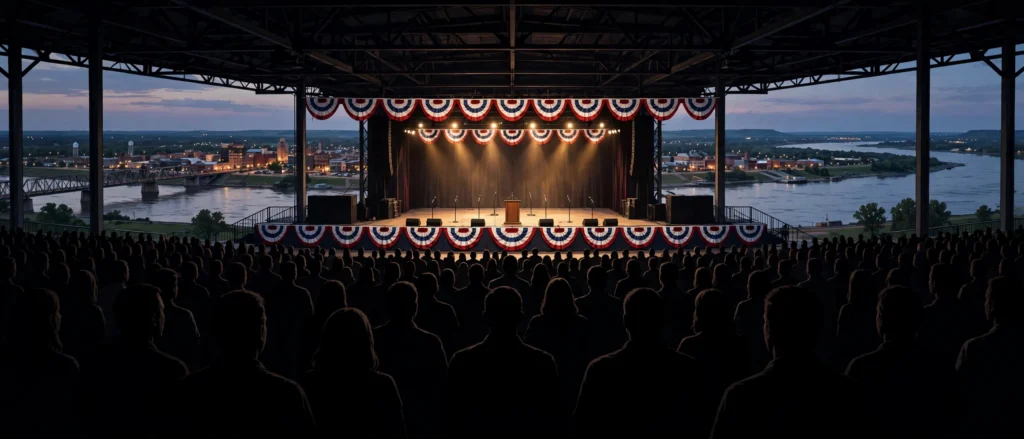
Trump Rally in Dubuque: Nov. 1 Iowa Stop Before Midterms
President Donald Trump is heading back to Iowa. The president will hold a trump rally in Dubuque on Sunday, November 1, two days before the midterm elections, bringing his closing argument to a corner of the state that flipped from blue to red a decade ago and has stayed in the Republican column ever since. The stop is the second of two Iowa rallies Trump announced for the final stretch, and it lands in one of the most closely watched House races in the country, where Republican Joe Mitchell and Democrat Lindsay James are fighting over health care, farm policy, and a district Trump carried by double digits.
The Dubuque rally was confirmed by the Republican Party of Iowa, and local television station KWWL reported on Tuesday that Trump will rally with supporters in the city. The exact venue had not been publicly announced. What is settled is the date, the city, and the stakes: with control of the House of Representatives on the line on November 3, the president is spending the last weekend of the campaign in a district his party cannot afford to lose.
Trump announced the pair of Iowa visits himself. Writing on Truth Social, he said he was coming to Iowa to help elect what he called truly fantastic warriors. The state party announced the two rallies on October 15, although at that point it named only the first location, Sioux City, and left the second to be confirmed. Republican Party of Iowa Chair Jeff Kaufmann revealed the plan after a phone call with the president, posting that Trump had told him he would be in Iowa on October 22 and November 1.
Trump Rally: What We Know About the Dubuque Stop
The details of the Dubuque rally have moved since they were first published. According to the original online event listing, doors were to open at 2:30 p.m. on November 1, with a program of speakers beginning at 6 p.m. and Trump himself scheduled to speak at 6 p.m. An updated listing has since moved the whole schedule earlier: doors now open at 11:30 a.m., the rally program begins at 1:30 p.m., and the president’s remarks are set for 3:00 p.m. The location remains to be announced.
The Dubuque County Democrats, Indivisible Dubuque County, and the Dubuque Visibility Brigade are collaborating on a community demonstration during the president’s visit, planned as an informal public gathering with no formal program of speakers. Details of the protest, including its time and location, were still to be announced.
Dubuque sits on the Mississippi River in northeastern Iowa, in the state’s 2nd Congressional District. The city and the county around it were Democratic strongholds for decades before they swung in favor of Trump in 2016, a change central to the Republican Party’s gains in the state over the last ten years. Kaufmann said the area literally became red because of Trump, and that the president was revisiting it for that reason. Trump specifically wanted to visit somewhere in eastern Iowa after his first trip of the campaign took him to the northwest corner of the state.
That first trip was the Sioux City rally on October 22, Trump’s first visit to Iowa since a January rally in Clive. At that event, the president campaigned for Ashley Hinson, who is running for the United States Senate, and for Zach Lahn, who is running for governor. He called Hinson a mother, a warrior, and a patriot, and said he had known her for a long time and that she was fantastic. He called Lahn a real Trumper for a long time. Each candidate took the stage before Trump’s speech and urged the crowd to show up to vote and to ignore the polls, which have shown signs of trouble for Republicans. Lahn told the crowd that if a blue wave was coming to the country, it would crash into a red wall in Iowa.
Midterm Elections 2026: Why Iowa’s 2nd District Matters
The reason Trump is coming to Dubuque is the race for Iowa’s 2nd District seat in the House of Representatives. The seat is open because its current holder, Ashley Hinson, is running for the Senate instead, and the contest to replace her has become one of the most competitive House races in the country. Republican Joe Mitchell and Democrat Lindsay James are vying for the seat, and the outcome could help decide which party controls the House after November 3.
The district covers northeastern Iowa, including Dubuque and Cedar Rapids. Trump carried it by double digits in 2024, and on paper it should be safe Republican territory. But the race has tightened, and health care has become the defining issue. According to reporting on the contest, seven in ten patients at the Eastern Iowa Health Center in Cedar Rapids use Medicaid, and providers have warned that the new 80-hour work requirements for the program will take effect after the midterms. Some clinics and hospitals in the district have already closed or trimmed services.
James has made the issue central to her campaign, arguing for reversing the Medicaid changes and restoring the enhanced subsidies under the Affordable Care Act that are set to expire. Mitchell has argued that the changes are work rules rather than cuts, and has blamed the health care law itself for high costs. Recent polling has shown James narrowly ahead in some surveys, although Republicans say Mitchell can still hold the seat if the rally helps drive base turnout.
That is why the president is coming. A rally in Dubuque two days before the election is designed to drive voter turnout among supporters who might not otherwise vote in a midterm. Kaufmann has said the two Trump visits are not a sign that Republicans are struggling in Iowa, but a sign that the party is very serious about turnout.
Election Polls and the Battle for the Senate
The Dubuque rally is not only about the House race. Hinson is running for the Senate against Democratic state Representative Josh Turek, and Lahn is running for governor against Democratic state Auditor Rob Sand. Both races are on the ballot on November 3, and both will be shaped by how many Republican voters turn out. Trump’s visit to Sioux City was aimed squarely at those races, and the Dubuque stop extends the same effort to the eastern side of Iowa.
The polls have given Republicans reason to work hard in the final week. National surveys have shown Democrats with an edge in the generic ballot, and the president’s own approval ratings have been under pressure. In Iowa, the Republican Party holds a statewide registration advantage of about 180,000 voters over the Democrats, but registration is not the same as turnout, and midterm elections are often decided by which side’s supporters actually show up. The president’s schedule reflects that: a string of rallies in red-leaning states he won, often handily, in 2024, aimed at shoring up the Republican base as the party faces strong headwinds in the 2026 midterms.
The arithmetic of Iowa politics explains the focus on turnout. As of October 1, there were more than 212,000 active registered Republican voters in the 4th District, compared with just under 95,000 Democrats, an edge of about 117,000 that makes up more than half of the party’s statewide advantage. In 2018, that district made the difference for Republican Governor Kim Reynolds, who lost three of the state’s four congressional districts but won statewide by less than three percentage points thanks to large margins in northwest Iowa.
The 2nd District is the other half of the equation. If Republicans hold it, they keep a seat in a district Trump won comfortably and deny Democrats one of their best pickup opportunities. If they lose it, it will be a sign that the health care debate and the national mood have overwhelmed the district’s Republican lean. That is the calculation behind a presidential visit to a city of fewer than 60,000 people on the banks of the Mississippi.
Swing States and the Final Weekend: A County That Turned Red
Dubuque County is one of many clustered along the Mississippi River that had historically supported Democrats before swinging in favor of Trump in 2016, part of a broader realignment across the upper Midwest, where counties built on manufacturing and river trade moved toward the Republican Party. For Republicans, the flip was proof that Trump’s message about trade, manufacturing, and cultural change could win over voters who had backed Democrats for generations. For Democrats, it has been a warning that no part of their old coalition can be taken for granted.
The president has spent the final weeks of the campaign rallying in red-leaning states that he won in 2024, in an effort to shore up the Republican base. The strategy reflects the reality of midterm elections: the party that holds the White House almost always loses seats, and the best defence is to maximize turnout among its most loyal supporters. Iowa is not a swing state in the traditional sense, and Republican leaders have said the two Trump visits are not a sign of weakness. But the president spending the last weekend of the campaign in Dubuque shows how seriously the party takes the races in Iowa’s 2nd District and for the Senate and governor’s office.
Early Voting and What Happens Next
Early voting is already underway in Iowa, and some of the votes that will decide the 2nd District race have already been cast. That is one reason the timing of the rally matters: with ballots already being returned, the president’s visit is aimed as much at the voters who have not yet made up their minds as at those who need a final push to the polls. The rally is also a signal to the rest of the country: a presidential visit to a small city in northeastern Iowa in the final days of a campaign tells the national parties where the races are close.
For the candidates, the next five days will be a sprint. Mitchell and James will spend them making their closing arguments in a district where health care has become the central issue and where the president’s visit could tip the balance. Hinson and Turek will do the same in the Senate race, and Lahn and Sand in the governor’s race.
After Sunday, the campaign moves to its final hours. Election Day is Tuesday, November 3, and the results in Iowa’s 2nd District will be among the first indications of whether the president’s closing rallies worked. If Mitchell holds the seat, Republicans will say the Dubuque rally did its job. If James wins, Democrats will say the health care debate and the national mood were stronger than any rally.
Source: Des Moines Register