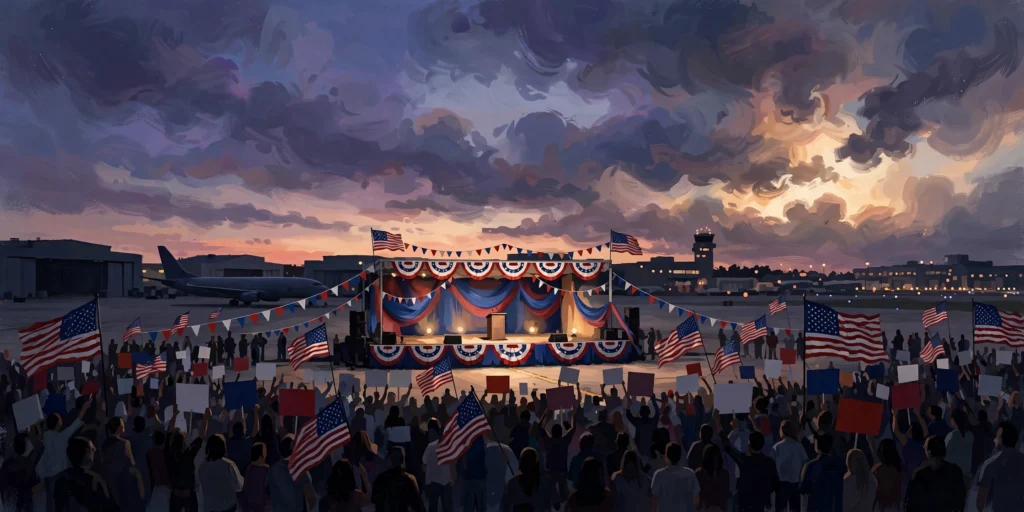
Trump Rally Greenville: North Carolina Senate Push
The latest trump rally on the president’s midterm blitz lands Tuesday evening in Greenville, North Carolina, where Donald Trump will campaign for Republican Senate candidate Michael Whatley at Pitt-Greenville Airport. The visit is part of a rapid six-state swing through territory he carried in 2024, and it lands in the state that may decide the battle for the senate — at a moment when every major survey shows former Governor Roy Cooper opening a commanding lead.
WRAL, the Raleigh television station covering the trip, framed the stakes bluntly: the president’s North Carolina visit is designed to lift Republican candidates in the midterm elections 2026, and it drew a tart response from the other side — a top Democrat’s message for Trump ahead of the rally essentially amounted to “keep doing it,” a wink at the notion that the president’s appearances energize Democrats as much as they do his own base.
The Greenville stop comes one month after Trump’s September rally in Gastonia for the same candidate, a day after Vice President JD Vance campaigned in Hendersonville, and in the middle of early voting — with Democrats banking a sizable share of ballots cast so far. For a White House staring down national polls that put Trump’s approval in the low thirties, North Carolina has become the clearest test of whether the president’s personal campaigning can still rescue a badly trailing Republican candidate.
Trump Rally Greenville: What Tuesday’s Airport Event Looks Like
Doors open at 3:30 p.m. at Pitt-Greenville Airport, with Trump scheduled to speak at 7 p.m. The Trump 47 Committee-hosted event is aimed at two races: the open U.S. Senate seat where Whatley faces Cooper, and North Carolina’s 1st Congressional District, where Republican Laurie Buckhout is challenging Democratic Rep. Don Davis in a contest the Cook Political Report now rates a toss-up.
Whatley is scheduled to appear and speak at the rally, his campaign confirmed. The former Republican National Committee chairman has positioned himself as the president’s chosen candidate — Trump has called him a “fierce and loyal competitor” — while branding Cooper an “extreme liberal.”
The rally is also expected to benefit down-ballot Republicans in eastern North Carolina, including Rep. Greg Murphy, who is campaigning for reelection in the region. Whatley campaign spokesman D.J. Griffin said the campaign welcomes Trump and Vance back “any time,” adding: “We all know President Trump drives N.C. GOP turnout better than anyone else.”
For Trump, the North Carolina trip is also a return engagement. He campaigned in Gastonia in mid-September for Whatley and other GOP candidates, and he has won the state in all three of his presidential campaigns — a record Whatley’s team hopes can transfer to a midterm race where the president himself is not on the ballot. At recent stops, Trump has urged supporters to vote as though he were on the ballot anyway.
Election Polls: Cooper Opens a 14-Point Lead Over Whatley
The urgent backdrop for the rally is the latest round of election polls, and they are grim reading for Republicans. A WRAL/WSOC poll released Tuesday showed Cooper leading Whatley 54 percent to 40 percent among likely voters, with about 5 percent undecided and 1 percent backing another candidate — a 14-point margin in a race that will help decide Senate control.
An Elon University poll in September had Cooper ahead by 11 points among likely voters. Cooper, a two-term governor and former state attorney general with near-universal name recognition, has led virtually every public survey of the race, while Whatley — a party operative making his first bid for office — has struggled to introduce himself beyond the president’s endorsement.
The Cook Political Report, the nonpartisan newsletter grading every competitive race, recently moved the North Carolina Senate contest to “Likely Democrat” — a striking downgrade for a Republican-held seat. In the same update, it moved the 1st District House race to “Toss Up” and named Rep. Don Davis “without a doubt, the most vulnerable House Democrat in the country,” despite the state’s redrawn congressional map favoring GOP candidates.
Democrats are treating the open seat as one of their clearest pickup opportunities, and Cooper’s campaign has hammered cost-of-living issues, branding his statewide swing a “Make Stuff Cost Less” tour and tying Whatley to the rise in prices voters have felt during Trump’s second term. A Davidson College political scientist said most voters will treat the midterms as “a referendum on the economy — and what Trump might have wrought.”
Midterm Elections 2026: Why North Carolina Is Ground Zero in the Battle for the Senate
The arithmetic of the battle for the senate is tight: Republicans hold 53 seats to 47 for Democrats and aligned independents, so Democrats need a net gain of four to capture the chamber. Reuters has identified North Carolina as one of the contests most likely to determine Senate control, alongside Georgia, Maine, Michigan, New Hampshire and Ohio.
The seat is open because Republican Sen. Thom Tillis, who clashed with Trump, opted not to seek reelection — turning a defensive fight into an open-seat scramble and handing Democrats their best pickup chance. If Cooper wins, Republicans must compensate by protecting tougher seats elsewhere or defeating Democratic incumbents.
The Greenville rally is one stop in a six-day blitz through Kansas, the Carolinas, Iowa, Florida, Georgia and Michigan — all states Trump won in 2024, though narrowly in Michigan, Georgia and North Carolina. The schedule suggests the aim is less to persuade undecided voters than to fire up loyal supporters who might sit out a midterm. North Carolina and Iowa amount to damage control in Republican-held seats, and many national party officials have privately all but written off North Carolina; elsewhere the party is on offense, targeting a Democratic-held seat in Michigan.
A Washington Post-ABC News-Ipsos survey published Sunday put Trump’s approval rating at 33 percent, the lowest of either of his terms in that poll, with 66 percent disapproving; an NBC News poll released the same day had him at 34 percent. On the generic congressional ballot, Democrats led by eight points among likely voters and ten among registered voters. National polls can miss by several points and do not translate neatly into seats — particularly after partisan redistricting.
Early Voting and Voter Turnout: Democrats Bank an Early Ballot Advantage
The rally’s timing reflects the early-voting calendar, already underway in North Carolina — and the early numbers favor Democrats. As of October 18, registered Democrats accounted for 45 percent of early ballots cast, compared with 19 percent for Republicans and the rest unaffiliated.
Early voting totals do not predict outcomes — they measure which side’s voters are showing up first, not how the final electorate will look — but the gap explains the urgency of the Republican turnout operation. Vice President Vance’s Monday stop in Hendersonville, one day before Trump’s Greenville rally, was aimed at the same goal: converting national messaging into local votes and countering what one outlet described as stronger-than-usual early participation by Democrats and unaffiliated voters.
An AP-NORC poll found Democratic voters more enthusiastic about casting a ballot than Republicans, with more voters saying they want Democrats to win control of Congress. That is the dynamic Trump’s personal appearances are meant to disrupt — the president’s camp argues no one activates the Republican base like Trump himself, and that in a midterm the difference between a fired-up base and a complacent one can decide close races.
The state remains closely divided, and Whatley can try to nationalize the contest by tying Cooper to congressional Democrats on immigration, crime, taxes and the Biden-era policy record — a late shift in the national environment could narrow Cooper’s advantage quickly. The Republican campaign’s challenge is to do that without losing voters more concerned about prices and health care than partisan cultural conflict.
Money Problems: Paused Ads and a PAC Pullback Rattle the Whatley Campaign
The Whatley campaign is also fighting a resource battle it appears to be losing. Earlier this month, Whatley paused his television advertisements, with his campaign saying adjustments were being made. Around the same time, a top political action committee pulled money out of North Carolina and redirected it to the U.S. Senate race in Kansas, according to the Associated Press — a public signal that national Republican donors were downgrading Whatley’s chances.
The fundraising gap is stark: as of June 30, Cooper’s campaign reported nearly $21 million available versus $3.5 million for Whatley. In a state as large and media-expensive as North Carolina, a six-to-one cash disadvantage limits a campaign’s ability to define itself.
Whatley’s team has pushed back, insisting the race is winnable and that Trump’s visits change the math. The campaign’s argument is straightforward: Trump’s endorsement and personal campaigning are worth more than any advertising buy, because the president can dominate a news cycle and summon thousands of volunteers and donors with a single appearance. That case was on display at the September Gastonia rally, where Trump spent much of his speech attacking Cooper’s record as governor and framing crime as a defining midterm issue.
Democrats are treating the visits as a gift. Cooper’s campaign has said Whatley “is getting desperate,” arguing the former governor and ex-attorney general “spent his career putting rapists and violent criminals behind bars and signing tough on crime laws.” Local Democrats have mocked the timing, noting Trump is arriving as voters complain about costs “eating into everybody’s budgets.”
What’s Next: A Six-State Sprint to November 3
After Greenville, the rally machine keeps moving through Iowa, Florida, Georgia and Michigan, with Vance campaigning separately in North Carolina, Ohio and Nebraska. The two tracks reflect a division of labor: the president fires up the base in person, while the vice president carries the administration’s message on the economy and government waste into targeted states.
The immediate question is whether Tuesday night’s rally can move any of the numbers that matter: the 14-point polling gap, the early-vote deficit, the cash crunch. Trump has never lost North Carolina, and his appeal to the state’s Republican base is unmatched — but midterm electorates are smaller and different, and his national approval is at its weakest point of either term.
The midterms are set for November 3, 2026, with all 435 House seats and 34 Senate seats on the ballot. North Carolina’s Senate race, once considered a Republican hold, is now one of the clearest windows into whether the president’s late-campaign intervention can still bend a race back toward his party — or whether the state has already slipped beyond rescue. Tuesday night in Greenville will offer the first real clue.
Source: WRAL