Trump News: US Does Not Support Taiwan Independence
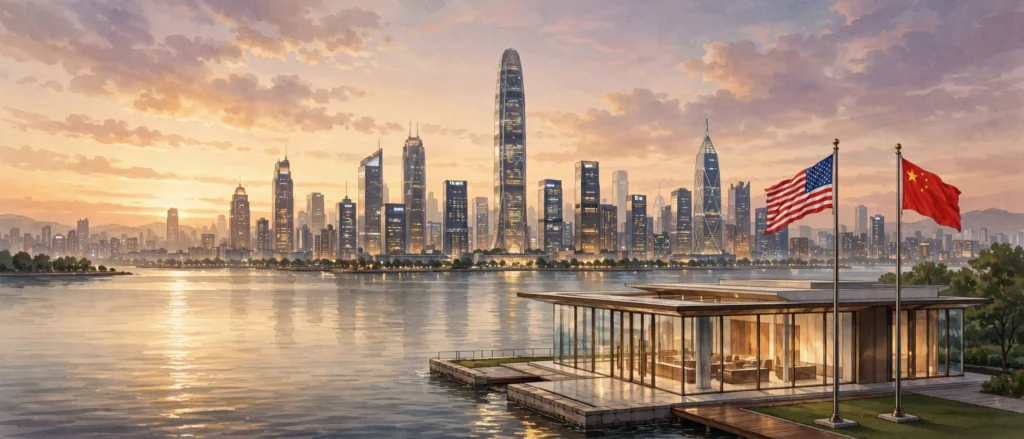
In the latest trump news, President Donald Trump told Chinese President Xi Jinping on Thursday that the United States does not support Taiwan independence, during their bilateral meeting in Shenzhen on the sidelines of the Asia-Pacific Economic Cooperation summit. The exchange came at the most sensitive point of the two leaders' conversation, with Xi warning that Washington must do the right thing on the issue to avoid serious turbulence in the relationship. Trump repeated a formulation American presidents have used for decades, while stopping short of the stronger language China has been pushing for. The meeting, held at the Kylin Villa lakeside resort in Shenzhen, was the third time the two men have sat down together this year.
The readout of the meeting came from China's state news agency Xinhua, which reported that Xi described China-US relations as generally stable and positive. According to Xinhua, the two leaders explored the right way for the two major countries to get along, and agreed on a new positioning for the relationship: a constructive bilateral relationship of strategic stability, built on respect, fairness and reciprocity. The two sides agreed to establish an action plan for that relationship, although the report did not say what the plan would specifically contain. The leaders held a late luncheon after their talks.
The Taiwan exchange was the sharpest moment of the bilateral meeting, and the one that will be studied most closely in Taipei, Washington and Beijing. Xi told Trump that the United States must keep doing the right thing on Taiwan to avoid the emergence of great turbulence in the China-US relationship, in the words carried by Xinhua. Trump responded that the United States does not support Taiwan independence. The formulation is familiar, and that familiarity is precisely what makes it significant: it repeats the longstanding American position without moving it in either direction. For Beijing, it was a public restatement of the line it wants to hear. For Taipei, it was a reminder that the American position has not changed.
White House News: What the Two Leaders Agreed in Shenzhen
The agreement to draw up an action plan for stable ties was the most concrete outcome reported from the bilateral session, and it fits a relationship both sides have been trying to steady since the trade truce reached earlier this month. Trump and Xi have now met three times this year, and the Shenzhen encounter followed a state visit to Washington by the Chinese leader in September, when the two men last sat down together at the White House. The frequency is itself a signal: after a year in which tariffs, technology controls and the war in Iran all pulled the relationship in different directions, both leaders have kept returning to the table.
The session itself was a working meeting: the two leaders discussed trade and the durability of the truce that ended the short-lived trade war, exchanged views on international and regional issues of common concern, according to Xinhua, and Trump pressed Xi to buy more American farm products, telling him directly that he would be asking for still more help for the country's farmers.
Donald Trump on Taiwan: The Words That Mattered
The heart of the Taiwan question is a single word, and the difference between the word Trump used and the word Beijing wanted him to use is the story of the meeting. Trump said the United States does not support Taiwan independence. China has long pressed Washington to go further and say that the United States opposes Taiwan independence. The two formulations sound similar, but in diplomacy they are far apart. Saying the United States does not support independence preserves the ambiguity that has governed the Taiwan Strait for decades. Saying it opposes independence would be a commitment Beijing could point to as American acceptance of its position. Trump did not make that shift, and the reporting of the meeting makes clear that the stronger language did not come.
For decades, Washington has said it does not support Taiwan independence while opposing unilateral changes to the status quo in the Taiwan Strait, whether by Beijing or Taipei. That formulation has discouraged a unilateral declaration of independence from Taipei while making clear that Beijing cannot legitimately impose a political settlement through force. The Asia Society's Center for China Analysis had warned before the meeting that shifting the wording while staying silent about Chinese military pressure would weaken deterrence across the strait. Trump had said before the meeting that he did not plan to raise Taiwan himself, telling reporters he was sure Xi would raise it. In the event, it was Xi who raised it, and Trump who answered with the familiar formulation.
US Politics: Why One Word Carries So Much Weight
The reason a single word can carry so much weight is that the Taiwan question sits at the intersection of everything else in the US-China relationship: trade, technology, military posture and the credibility of American commitments to its partners in Asia. Taiwan is a self-governing island that China claims as its own, and the world's leading manufacturer of advanced computer chips, including chips designed by American companies. Any shift in the American position would be read in Taipei, Tokyo, Seoul and Manila as a signal about how far Washington can be pressed, and any hardening would be read in Beijing as a provocation. The wording is the policy.
That ambiguity is why the reporting of these meetings matters so much, and why the difference between the Chinese and American accounts of them is always scrutinised. In September, the White House fact sheet on Xi's state visit did not mention Taiwan at all, while China's Foreign Ministry readout stressed Beijing's position and expressed the hope that the American side would adhere to the correct position of opposing Taiwan independence. The pattern repeated itself in Shenzhen: the Chinese account carried the Taiwan exchange prominently, while the American side had said little publicly about it in the first hours after the meeting. The gap is not an accident: it is how both governments manage a disagreement they cannot resolve, each telling its own audience what it needs to hear. Taipei has watched the Shenzhen meetings with particular anxiety, aware that its future is being discussed in rooms it is not invited to enter.
Trump Administration: The $14 Billion Arms Question
Behind the language of the Taiwan exchange sits a concrete and unresolved question: a $14 billion arms package for Taiwan that Trump has held in abeyance since May. The package has lingered in administrative limbo for six months, and China is concerned it could gain momentum after the Democratic Party's sweeping midterm victory changed the political arithmetic in Washington. Trump has publicly described the package as a bargaining chip in the wider negotiation with Beijing rather than a commitment on a fixed timetable. Taiwan's legislature authorised a $25 billion ceiling for American weapons purchases in May, with a separate $4.6 billion defence request still under review. The $14 billion package sits inside that larger picture, and its fate will be one of the first tests of what the Shenzhen meeting actually produced.
The arms question also explains why Xi pressed the Taiwan issue as hard as he did. Beijing has explicitly linked Washington's handling of Taiwan to the stability of the overall relationship, and Xi still hopes to secure an enduring reduction in American support for the island under the new framework of constructive strategic stability. That is the deeper negotiation behind the pleasantries: China wants the framework's emphasis on mutual respect to translate into greater American accommodation of its core interests, foremost among them Taiwan. The Shenzhen meeting did not deliver that accommodation, but it did not close the question either. If the package moves forward, Taipei will read it as evidence that the American position is unchanged in practice as well as in words. If it stays frozen, Beijing will read the delay as evidence that the trade negotiation is doing the work the arms sales used to do.
Political News Today: AI, Trade and the Wider Agenda
Taiwan was not the only subject on which the two leaders staked out positions with consequences beyond the room. Xi also told Trump that the two countries must keep artificial intelligence under human control, prevent AI security risks and boost communication on trade and AI, according to the Xinhua account relayed after the meeting. The AI passage is brief, but it touches on one of the fastest-moving fronts in the US-China rivalry: the race to control the most capable AI systems, and whether the two governments can agree on guardrails for it. It sits alongside the reality that the United States continues to restrict China's access to advanced computer chips, a policy Trump acknowledged is the subject of differences inside his own administration. On trade, the truce reached earlier this month steadied the relationship but did not settle it, and the action plan suggests both sides want it to become something more durable, a framework rather than a pause. The report did not say what the plan would contain, and that silence is itself informative: the hard bargaining over what stability actually requires has not yet happened.
What Happens Next
The first test of the Shenzhen meeting will be what happens to the action plan the two leaders agreed to draw up. If both capitals describe a concrete timetable for the plan in the days ahead, the bilateral will have produced something more than a restatement of positions. If the plan is mentioned once and never heard of again, it will join the long list of diplomatic phrases that sound like progress and dissolve on contact with reality. The second test will be the $14 billion arms package: moving it forward would signal that the trade negotiation has not swallowed the security relationship; a continued freeze would signal the opposite. The APEC summit closes on Thursday, and the leaders will return to their capitals with the same disagreements they arrived with.
The third test will be the trilateral follow-up. The three-way meeting with Putin that followed was described by all sides as a beginning rather than an outcome, and its value will be measured by whether the nuclear conversation it started survives the weeks ahead. The Taiwan exchange was a reminder of the limits of that conversation: the three leaders in Shenzhen do not agree on the status of the island, and they do not agree on much else either. What they agreed on was to keep talking, and to write down a plan for doing so. In a week of firsts, that may be the most that could realistically have been achieved, and the least that could have been hoped for.
Source: Xinhua