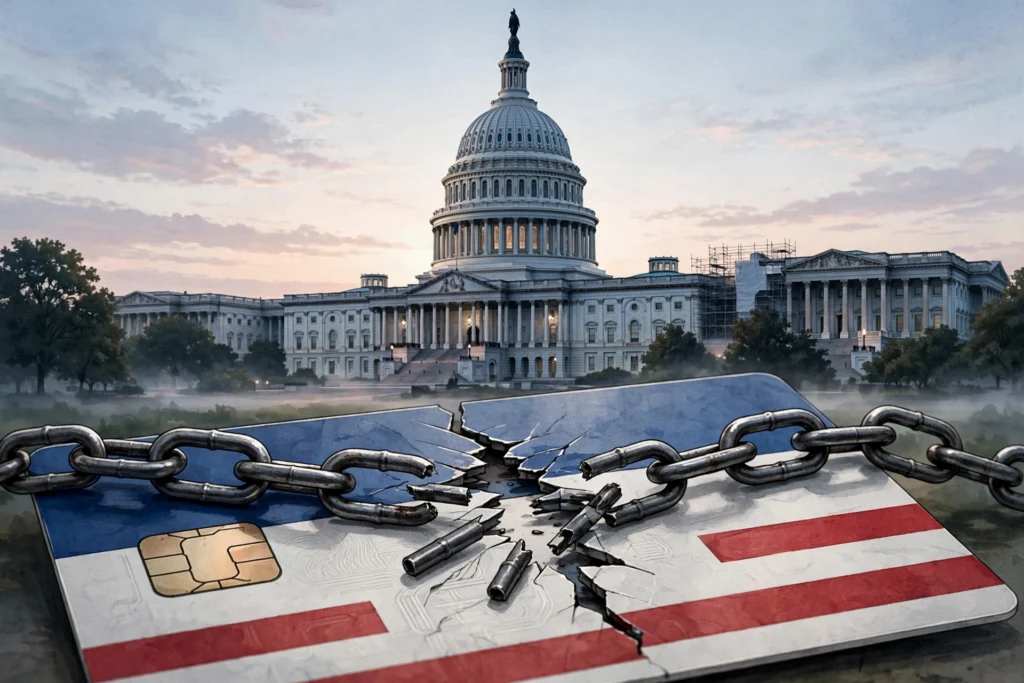
Trump News: Trump, Vance Renew Push for Swipe-Fee Bill
In the latest trump news with a direct line to American household budgets, President Donald Trump and Vice President JD Vance are mounting a fresh push to get Congress to pass the Credit Card Competition Act, a bipartisan bill aimed at the fees charged every time a shopper swipes a credit card. The convenience-store industry’s trade group, NACS, has been keeping a public tracker of the repeated endorsements from the two leaders, and the list keeps growing — with the most recent presidential statement landing earlier this month.
The legislation, known in Washington shorthand as the CCCA, would change how credit card transactions are processed in the United States. Supporters say it would break the dominance of Visa and Mastercard over the payment networks that quietly add to the price of nearly everything Americans buy. The White House has repeatedly urged Congress to put the bill on the president’s desk, and industry leaders say they believe the long-stalled measure finally has the momentum to become law.
What the Credit Card Competition Act Would Do
The Credit Card Competition Act would require the biggest banks that issue credit cards to enable those cards to be processed over at least two unaffiliated payment networks — Visa or Mastercard plus a competitor such as NYCE, Star, or Shazam. The requirement would apply to banks with at least $100 billion in assets, the institutions that issue the overwhelming majority of credit cards in the country.
The idea is straightforward: today, when a customer pays with a credit card, the merchant’s bank sends the transaction over the network chosen by the card issuer — almost always Visa or Mastercard. Because those two companies dominate both issuing and processing, there is little competition over the fees charged for each swipe. By forcing issuers to offer at least one alternative network, the bill’s backers say merchants would be able to choose the cheaper route, and the resulting competition would push fees down across the board.
NACS, the National Association of Convenience Stores, has championed the bill for years and estimates that the resulting competition could save retailers and customers as much as $17 billion each year. That figure captures the scale of what supporters call one of the most underappreciated costs in the American economy — a fee most consumers never see itemized but pay anyway in the form of higher prices.
A Timeline of Trump’s Repeated Endorsements
The donald trump latest news cycle has carried the swipe-fee fight repeatedly this year. According to NACS’ support tracker, the president’s public backing has come in waves, starting in January and continuing into October.
On January 13, 2026, Trump posted on social media in support of the bill, writing that everyone should support Senator Roger Marshall’s Credit Card Competition Act “in order to stop the out of control Swipe Fee ripoff.” The post came the same day the bill was reintroduced in Congress, a timing supporters read as a deliberate signal that the legislation had White House backing from day one.
On August 3, Trump again took to Truth Social to praise Marshall, writing that the Kansas senator was “working tirelessly to pass the Credit Card Competition Act, in order to stop the out of control Swipe Fee ripoff.” The truth social news post framed the bill as part of the administration’s broader affordability agenda.
The most detailed presidential pitch came on September 9, when Trump addressed the Republican Party’s 2026 midterm convention in Dallas. There, he promised to cut what he called out-of-control swipe fees, telling the crowd it would save the average family at least $1,200 per year. He also argued that Americans should not be paying seven to eight times more for those fees than people in other countries — a comparison to the much lower fee caps enforced by regulators abroad.
On September 18, in a recorded message, the president indicated the bill would be passed soon, calling it “a bill we’re going to pass as soon as possible” to eliminate out-of-control credit card swipe fees. And on October 12, in the most recent statement cataloged by the NACS tracker, Trump posted again on Truth Social, writing that Marshall “is working tirelessly to pass the Credit Card Competition Act, in order to stop the out of control Swipe Fee ripoff.”
JD Vance’s Long Running Swipe-Fee Fight
The vice president’s support for the bill runs deeper than a few soundbites. The jd vance news around the CCCA goes back to his time in the Senate, where Vance was a co-sponsor of the legislation alongside Marshall. The two served together in the upper chamber before Vance joined the national ticket.
On September 14, Vance used a visit to Kansas to spotlight Marshall’s leadership on the issue. “An issue that’s close to my heart, that Roger and I worked on when we were in the Senate together: He has been the leader in the fight against Wall Street to bring down out-of-control credit card swipe fees, which is going to make life affordable for everyday Kansans and everyday Americans,” Vance said, according to the NACS tracker.
The personal history matters for the bill’s prospects. Having the vice president as a former Senate co-sponsor — and the president as a vocal public backer — gives the legislation a level of White House sponsorship that most bills never enjoy. During NACS Show 2026, the industry’s annual gathering, the White House again urged Congress during show week to send the measure to the president’s desk.
NACS President and CEO Frank Gleeson told attendees the organization sees the end of what he described as a two-decade struggle. “We’re working super hard on credit cards,” Gleeson said. “We’ve got the president on board, the vice president on board. We’ve broadly have a coalition across both parties. So we’re very optimistic that we’ll get it done for our retailers before the end of the year. It’s been a 20-year battle, but we think the end is in sight.”
The Numbers Behind the Swipe-Fee Battle
The core of the fight is a number most Americans have never heard but pay every day. Credit and debit card swipe fees reached a record $187.2 billion in 2024, according to figures cited by NACS — a total that has risen 70 percent since the pandemic. For most merchants, swipe fees are the highest operating cost after labor, and small businesses feel the pressure most because the fees are too large to simply absorb.
The costs flow directly to consumers. NACS estimates that swipe fees drive up the prices Americans pay by nearly $1,200 a year for the average family — the same figure Trump cited at the Dallas convention. In the fuel business alone, total credit card swipe fees for gas and diesel purchases exceed $60 million every single day.
The United States is an outlier on the world stage. In Europe, regulators cap the fees on consumer credit cards at 0.30 percent per transaction, a fraction of what American merchants pay. Supporters of the CCCA argue there is no competitive reason for the gap — only the market power of two dominant networks.
“The president is right: Swipe fees are ripping off the American people and making almost everything we buy more expensive,” said Brennan Duckett, NACS’ director of regulatory and policy. “Visa and Mastercard have used their monopoly to make swipe fees in America the highest in the world. They are making everybody’s affordability problem worse.”
Bipartisan Backing Builds in Congress
The bill’s sponsors have been deliberately cultivating a cross-party coalition. In the senate, the measure — designated S. 3623 — was reintroduced in January by Marshall, a Kansas Republican, and Dick Durbin, an Illinois Democrat. In the House, the companion version, H.R. 7035, is led by Representative Lance Gooden, a Texas Republican.
That coalition has been growing. The Senate version recently added three new co-sponsors: Republican Senators Bernie Moreno of Ohio and Cynthia Lummis of Wyoming, along with Independent Senator Angus King of Maine. Moreno and Lummis sit on the Senate Banking, Housing and Urban Affairs Committee, which has jurisdiction over the legislation — a placement supporters consider strategically important. They join Marshall, Durbin, and Democratic Senator Peter Welch of Vermont.
NACS General Counsel Doug Kantor praised the additions, crediting the three senators with “standing up to Wall Street megabanks and global card networks.” The House version’s co-sponsors span both parties as well, including Democrats Zoe Lofgren of California, Derek Tran of California, Abraham Hamadeh of Arizona, Mark DeSaulnier of California, and James McGovern of Massachusetts, alongside Republicans Thomas Tiffany of Wisconsin and Jeff Van Drew of New Jersey.
Beyond Capitol Hill, the bill’s support includes almost 2,000 companies and nearly 300 trade associations, along with consumer, labor, and pro-competition organizations — a broad alliance that reflects how widely the fee burden is felt.
White House News: Why the Lame-Duck Session Matters
The trump administration’s strategy now turns on the congressional calendar. The Wall Street Journal has covered the president’s support for the CCCA, and many observers of Capitol Hill believe the bill is well positioned for the lame-duck session of Congress — the stretch between Election Day and the swearing-in of the next Congress in January 2027, when retiring and defeated lawmakers often vote differently and sitting presidents push to lock in legislative priorities.
That window is also shaped by the 2026 midterms, now just days away. A bill framed as saving families $1,200 a year carries obvious appeal in an election season dominated by affordability concerns. The White House has made lowering everyday costs a central theme of its midterm messaging, and the swipe-fee fight lets the administration argue it is taking on what it calls a Wall Street ripoff on behalf of Main Street.
Industry groups are mobilizing in parallel. NACS is urging everyone in the convenience and fuel retailing industry to contact their members of Congress through its Call to Action portal, arguing that the growing coalition makes this the moment to press for a vote. “The more industry voices that speak out on the issue, the higher the likelihood of getting a vote and winning that vote,” the association has said.
What Happens Next
The immediate question is whether congressional leadership will schedule the bill for a vote before the lame-duck window closes. The repeated presidential endorsements and the vice president’s personal investment have given the CCCA more executive-branch muscle than it has ever had, and the steady addition of co-sponsors suggests the vote-counting is moving in the right direction for supporters.
For American families, the stakes are concrete: the difference between the current system and one with competing networks is, by the industry’s math, about $1,200 a year in prices — money that currently flows to card networks and large banks through fees most shoppers never notice. Whether the bill clears Congress will depend on whether the White House’s repeated calls translate into floor time in a crowded legislative calendar, but after two decades of lobbying, the CCCA has never been closer to the president’s desk.
Source: NACS