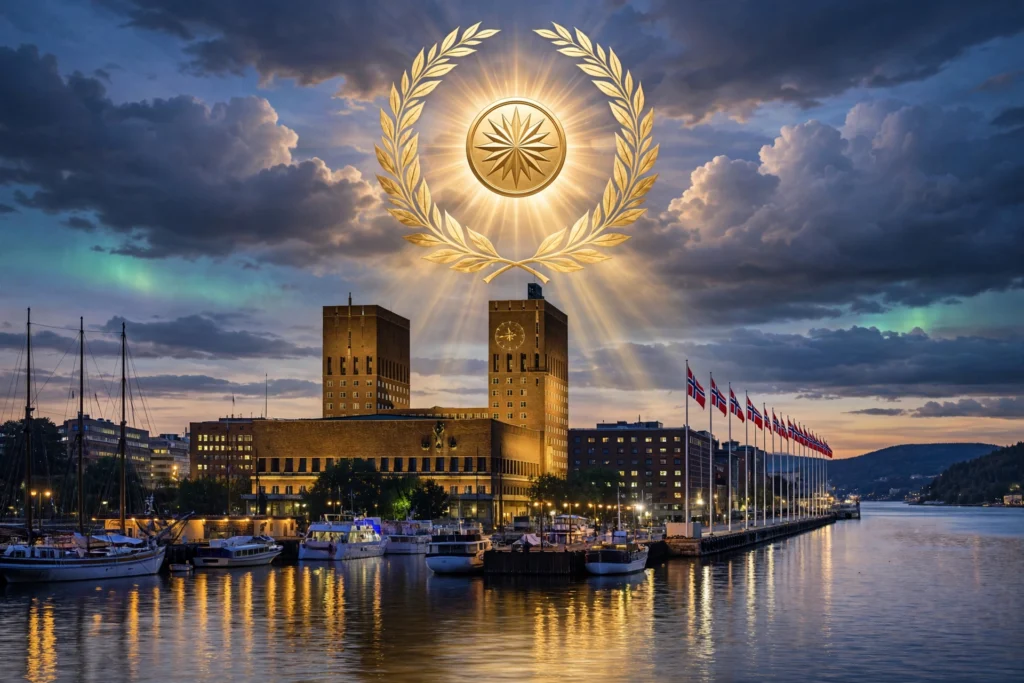
Trump News: Trump Slams Norway Over Nobel Snub
President Donald Trump turned a campaign rally in Michigan on Sunday into a fresh attack on Norway, declaring that he does not want immigrants from the country because the Norwegian Nobel Committee has refused to award him the Nobel Peace Prize. Speaking to supporters in Port Huron, Trump called Norway a “shithouse country” and tied the insult directly to the prize he has chased for years. “Because I didn’t get the Nobel Prize … So I don’t want anybody from Norway,” he told the crowd.
The remark, reported by Reuters on Monday, marked a sharp escalation in a feud that began when the Nobel committee chose South African jurist Navi Pillay as this year’s Peace Prize winner on October 9. The Port Huron comments went further than any of his earlier complaints, moving the grievance from the prize itself to the people of the country that awards it.
“Norway has become a shithouse country, actually,” Trump said, using a term he has previously applied to Haiti, Libya, Somalia and Yemen. “I’m not in love with Norway. Frankly, Norway sucks,” he told the rally. He also dismissed this year’s laureate as “a woman that nobody ever heard of.”
There was no indication the Trump administration was adopting new official policy on Norwegian immigrants. Norway’s Ministry of Foreign Affairs and a representative for the Norwegian Nobel Committee did not immediately return requests for comment outside regular office hours.
Trump Rally: A Midterm Stop in Port Huron
The comments came during a rally in Port Huron, a border city on the St. Clair River across the water from Sarnia, Ontario, where Trump was campaigning for Republican candidates a little more than a week before the midterm elections. About 3,000 people filled the venue. He was there to boost former Representative Mike Rogers, the Republican nominee for Michigan’s open Senate seat, and Representative John James, the Republican running for governor.
Michigan has emerged as one of the most important battlegrounds of the 2026 cycle. The open Senate seat could decide which party controls the chamber: Republicans hold a 53-47 majority, and Democrats need a net gain of four seats to take over. The Cook Political Report lists the race as a toss-up. In the RealClearPolitics polling average early on Sunday, Rogers was trailing the Democratic nominee, Abdul El-Sayed, by 1.9 percentage points, while James was trailing Michigan Secretary of State Jocelyn Benson by just over six points in the governor’s race.
Both Rogers and James spoke before Trump took the stage and returned to it during his address. Rogers, who spoke for about seven minutes, focused on El-Sayed, describing him as a dangerous radical and a liar. James, in particular, heaped praise on Trump. The president has repeatedly urged his supporters to vote in the midterms as if he himself were on the ballot, and he did so again on Sunday. The rally also featured rapper Nicki Minaj, making her first official campaign appearance alongside the president, and Trump took aim at Representative Alexandria Ocasio-Cortez and returned to his proposal that the United States should own Greenland.
The day before, former President Barack Obama had campaigned in Detroit for El-Sayed, setting up a direct contrast between the two parties’ closing messages. Trump has called El-Sayed a “jihadist,” a remark Democrats have condemned as an attack on his religion. If elected, El-Sayed would become the first Muslim to serve in the United States Senate. The election is on November 3.
Nobel Peace Prize: Two Years of Frustration With Oslo
Trump’s anger at Norway did not begin on Sunday. It traces back to the Nobel Peace Prize announcements of the past two years, both of which passed him over. This year’s prize went to Pillay, an 85-year-old South African lawyer who spent decades building the international system of justice. She headed the Rwanda genocide tribunal, served as a judge at the International Criminal Court, and was the United Nations high commissioner for human rights.
The Norwegian Nobel Committee, chaired by Jorgen Watne Frydnes, awarded Pillay the prize for her role as a driving force in the development of an international system of law and order, saying that a system in which war criminals are held to account is a precondition for a peaceful world. The prize carries a gold medal, a diploma and a sum of 12 million Swedish crowns, about 1.2 million dollars.
Trump’s reaction to the announcement on October 9 was immediate and furious. At a rally in Syracuse, New York, that evening, he called the choice “a disgraceful and embarrassing decision” and described Pillay as a “mystery person.” “I never heard of the person. Nobody did,” he said. “The United States of America, represented by me as your president, should have received the Nobel Peace Prize, but didn’t.” He called the snub “an indelible stain on the country of Norway” and declared that “the Nobel Peace Prize has been forever discredited by a handful of radical ideologues who are anti-democracy and really enemies of civilization. And we will not forget, Norway.”
Experts in Oslo had said before the announcement that Trump’s record worked against him: his war against Iran, his territorial ambitions in Greenland, his hard line on migrants, and his attacks on multilateral institutions and the media all counted against a candidacy the committee judges on contributions to peace.
Immigration News: What the Remark Does and Does Not Change
The most striking part of Sunday’s remarks was the link Trump drew between the prize and immigration. Attributing recent unrest in France to immigration, he said he would welcome immigrants from some countries but not from Norway, “because I didn’t get the Nobel Prize.” The statement stood in sharp contrast to what he had said only a day earlier.
At a rally in Perry, Georgia, on Saturday, Trump had named Norway, Sweden and Denmark among the countries whose immigrants he would prefer to welcome. By Sunday in Port Huron, Norway had moved from the preferred list to the excluded one, with the Nobel Prize as the stated reason. For all the force of the words, nothing in the reporting suggested they would become policy. Changing who may immigrate to the United States requires action by the administration and, in most cases, by Congress. The political effect is another matter: the remark was quickly picked up around the world, and it put a NATO ally in the position of absorbing a public insult from an American president over a prize decided by an independent committee.
NATO News: The Ally on the Receiving End
Norway is one of America’s oldest allies, a founding member of NATO whose northern coastline watches over the Arctic approaches to Europe. It is also, by the International Monetary Fund’s measure, among the highest-income countries in the world as measured by GDP per capita. Its sovereign wealth fund, built from North Sea oil revenues, posted a record profit of 1.75 trillion Norwegian crowns, about 184.3 billion dollars, for the first half of 2026 alone.
That record makes the insult land oddly. The countries Trump has previously described with the same term, Haiti, Libya, Somalia and Yemen, are among the poorest and most conflict-scarred in the world. Norway is among the richest and most stable, a country that hosts the Nobel Peace Prize ceremony each December and has built its international identity around peacemaking.
The Nobel Committee is independent of the Norwegian government: the five-member panel is appointed by the Norwegian parliament, but it makes its decisions on its own, and no government in Oslo can order it to choose a different laureate. Trump has nevertheless directed his anger at the country as a whole, describing the committee’s decision as a stain on Norway itself.
Midterm Elections 2026: The Rest of the Rally
The Norway remarks were only one part of a long rally speech that ranged across the issues dominating the final week of the campaign. Trump defended the ongoing war with Iran, telling the crowd that higher gas prices were “a small price to pay” for ensuring Iran does not have a nuclear weapon. “Short term, you’re taking a hit. It’s not a big hit. I thought gasoline would go up much more, to be honest,” he said. “The nastiest, the meanest, the No. 1 state sponsor of terror is Iran, by far,” Trump said. “And you had to make sure they didn’t have a nuclear weapon.”
He also repeated an earlier pledge to send 5,000-dollar checks to all American adults, but only if Republicans retain control of the House and Senate. And he told the border-city crowd that he expects the trade and tariff war with Canada to soon come to an end on terms favourable to the United States. “Canada has been ripping off the U.S. for years,” he said. “They’re willing to give us anything at this point.”
The pledges come as Trump campaigns with historically low approval ratings, amid high gas prices and continued inflation, along with the unpopular military conflict with Iran. Some Republican candidates have tried to distance themselves from him.
What Happens Next: Oslo’s Response and the Campaign Trail
The first question in the days ahead is whether Norway answers. The foreign ministry and the Nobel Committee were silent when the report was published, but a formal response from Oslo would not be surprising, and any statement from the committee would carry weight because it is the body Trump is actually angry with. A second question is whether the White House clarifies the immigration line, either by repeating it as policy or by letting it stand as rally rhetoric.
Back in the United States, the campaign moves on. Trump has spent virtually every day this month on the trail. The closing message he delivered in Port Huron, vote as if he were on the ballot, will be tested in the Senate and governor’s races he came to influence. Whether the Norway remarks help or hurt that effort is a question for the voters of Michigan, who will answer it at the ballot box.
Source: Reuters, Detroit Free Press, Washington Examiner, CNN, The Times, New York Post, AOL