Trump News: Four-Point Pact With Putin and Xi
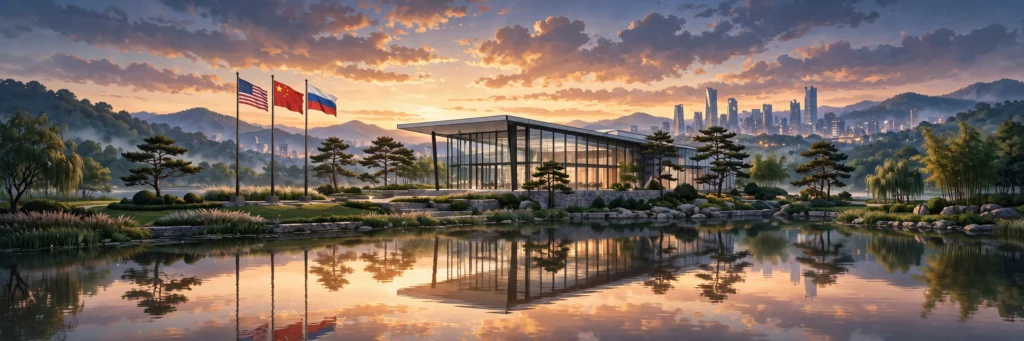
In the latest trump news, President Donald Trump, Chinese President Xi Jinping and Russian President Vladimir Putin have released a joint four-point agreement after their first-ever three-way summit, a document that pledges dialogue on nuclear risks, reform of the United Nations, higher production of refined fuel and a defence of the immunity of state officials. The agreement was unveiled on Thursday in Shenzhen, on the sidelines of the Asia-Pacific Economic Cooperation summit, hours after the three leaders sat down together at a lakeside resort known as Kylin Villa. It was an outcome almost nobody in Washington had predicted: American officials briefing reporters before the trip had cautioned that no agreement was expected from the encounter, and the White House had framed the session as the start of a conversation rather than a negotiation. The four-point text does not settle a single war, cap a single warhead or fix a single fuel price, but it is the first written statement the three leaders have ever produced together, and it puts their names to positions on the four subjects that have defined their rivalries for a decade.
The document itself is short, and its language is the careful language of communiques. First, the three countries, as permanent members of the United Nations Security Council, committed themselves to promoting reform of the United Nations so that it can respond more effectively to global challenges. Second, they said they plan to increase the production and supply of refined petroleum products for the benefit of all nations, and reaffirmed the importance of stable energy flows. Third, they recognised that the principle of national consent and respect for the immunity of state officials are of paramount importance, and agreed that the International Criminal Court and other similar bodies must not abuse their jurisdiction. Fourth, they reaffirmed that a nuclear war cannot be won and must not be fought, and said the three countries will engage in dialogue on reducing nuclear risks and preventing nuclear proliferation. None of the four points carries a deadline, a number or an enforcement mechanism. What the text does carry is the agreement, in public, of the leaders of the three largest nuclear arsenals on Earth that some of the rules of the postwar order still bind them all.
White House News: From No Agreement Expected to a Four-Point Text
The surprise is best measured against what was said before the meeting began. The Kremlin said no more than an hour had been set aside for the encounter, and American officials had been explicit that no agreement was expected. The White House had presented the session as an entry point to a longer process, a chance for the three leaders to begin talking about nuclear arms rather than to conclude anything. Trump himself opened the talks by telling the other two leaders that they were making history, and he made an early push for denuclearisation, the subject he had put at the centre of the meeting. He said the three countries are uniquely positioned to discuss how to reduce the number of nuclear weapons on Earth, and that the three leaders have a special responsibility to maintain open, respectful and productive dialogue on issues impacting not just their own people, but the entire planet.
The choreography around the meeting had already made headlines. Trump and Putin held a pull-aside before the three-way session, in which Trump called the Russian leader his friend and said a lot of wonderful things could come from the meeting. Trump later sat down with Xi for lunch at the five-star Kylin Villa after holding bilateral talks, and the two men discussed trade relations, Iran and fentanyl exports. The fact that a written agreement emerged at all is the story: the summit had been planned as a photograph and a first conversation, and the four-point text turns it into something that can be quoted, measured and, in time, tested. Its brevity is also its limit. On nuclear arms it promises talks, not cuts. On fuel it promises more production, not a volume. On the United Nations it promises reform, not a proposal. And on the immunity of officials it takes a position, not an action.
Ukraine War News: The Immunity Clause and Putin's Warrant
The third point of the agreement is the one that will draw the closest reading in Kyiv and in European capitals, because it speaks directly to the legal position of Vladimir Putin himself. The International Criminal Court has issued an arrest warrant for Putin over alleged war crimes in Ukraine, and the statement that the court must not abuse its jurisdiction will be read in Moscow as a vindication and in Kyiv as a warning. It is the only point in the four that touches, even indirectly, on the war in Ukraine, and it does so by taking the side of the leader under warrant rather than the country under attack. Putin himself underlined the point in his opening remarks, claiming that the three leaders have numerous shared interests in the settlement of regional conflicts, including the conflict in Ukraine.
The claim sits uneasily with the public record of the meeting. A senior American official who briefed reporters before the trip said Trump would discuss the war in Iran with Xi and Putin but would steer away from discussing Ukraine in the three-way session, while Trump himself said he intends to raise both wars. Trump did hold a separate meeting with Putin on Thursday before the trilateral session, a roughly 40-minute conversation in which the war in Ukraine was the main topic, according to the Kremlin, and the two presidents' first face-to-face talks since their summit in Alaska in August 2025. The four-point text says nothing about Ukraine by name, nothing about a ceasefire and nothing about the terms of any settlement, and that silence is itself a statement: the three leaders could agree on the immunity of officials and on the language of nuclear restraint, but not on a single word about the war that has dominated European security for nearly five years.
The reaction beyond the three capitals has been wary rather than welcoming, and the agreement is unlikely to calm it. European allies watched the preparations for the summit with open unease, fearing that decisions about Ukraine could be sketched out by a small group of great powers with Kyiv informed afterwards rather than consulted beforehand. The comparison drawn in advance to the Yalta Conference of 1945, when the leaders of the United States, Britain and the Soviet Union redrew the map of Europe, was dismissed by Kremlin spokesman Dmitry Peskov, who noted that any agreements reached in Shenzhen could not be enforced on others. That dismissal now reads differently: the Shenzhen text is not enforceable on anyone, but it does put the American president's name alongside the Russian president's on a document that questions the jurisdiction of the court that has indicted him.
Nuclear Arms: The Dialogue the Three Arsenals Could Not Avoid
The fourth point, on nuclear weapons, is the reason the meeting was called, and it is the one that carries the most weight and the least commitment at the same time. The three leaders reaffirmed that a nuclear war cannot be won and must not be fought, and said the three countries will engage in dialogue on reducing nuclear risks and preventing nuclear proliferation. The language echoes the joint statement issued by the five recognised nuclear powers in 2022, and it is deliberately unambitious: dialogue, not disarmament; risk reduction, not reductions. But the context gives it force. The last nuclear arms pact between Russia and the United States, known as New START, expired in February, removing caps on the two largest atomic arsenals for the first time in more than half a century. When the treaty expired, Trump rejected a call by Russia to extend the two-country deal for another year and called instead for a new, improved and modernized deal that includes China. The Shenzhen meeting was presented as the entry point to that longer process, and the agreement is the first written evidence that the process has begun.
The obstacle is arithmetic. Beijing's stockpile of more than 600 warheads, according to Pentagon estimates, is far smaller than the inventories held by the United States and Russia, each estimated to have more than 5,000 warheads. China has repeatedly rejected American attempts to include it in trilateral arms control talks, and the official who briefed reporters before the trip characterised the meeting as the moment for China to step up to the adult table. The four-point text does not resolve that asymmetry, and it does not say when the dialogue will start, who will conduct it or what it will cover. What it does do is put Xi's name to a document that commits China to engage in dialogue on reducing nuclear risks, which is further than Beijing has gone before in a trilateral format. The United Nations Secretary-General, Antonio Guterres, said before the meeting that a commitment by the three countries to meaningful denuclearisation would be a greater achievement for the world. The Shenzhen text is not that commitment, but it is the first step towards it.
Trump Administration: The Fuel Pledge and the Strait of Hormuz
The second point of the agreement, on refined fuel, is the most immediately practical and the most entangled with the wars. The three countries said they plan to increase the production and supply of refined petroleum products for the benefit of all nations, and reaffirmed the importance of stable energy flows. The pledge comes in the middle of a global fuel crisis brought on by the struggle between the United States and Iran over control of the Strait of Hormuz, the narrow waterway through which a large share of the world's oil and gas passes, and it comes despite the sanctions on Russian fuel sales that Washington and its allies have maintained since the invasion of Ukraine. Trump recently struck a diesel deal with Russia, waiving sanctions to allow the sale of millions of tons of the fuel, and the agreement's language on increasing refined fuel production sits comfortably with that deal.
The fuel pledge also has a domestic audience in the United States, where energy prices have been a persistent political issue. But like the other three points, it contains no numbers: no volume, no timetable, no mechanism. Whether it means anything will be measured in the months ahead, in refinery output, in export figures and in the price of diesel and gasoline. The same is true of the first point, on United Nations reform, which commits the three permanent members of the Security Council to promoting reform so that the organisation can respond more effectively to global challenges. The United Nations has been the subject of reform proposals for decades, and a commitment to promote reform, without a proposal attached, is a statement of intent, not a plan.
What Happens Next
The first test of the agreement will be whether the dialogue it promises actually begins. If the White House, Beijing and the Kremlin all describe a commitment to continue the nuclear conversation, with a date or a format for follow-up talks, the Shenzhen session will have done the one thing its organisers hoped for: turned a photograph into a process. The second test will be the fuel pledge, which can be measured in barrels and prices rather than in words. The third will be the United Nations, where the reform commitment will be tested against the reality of a Security Council divided by the wars in Ukraine and Iran. And the fourth will be the immunity clause, which will be tested the next time the International Criminal Court, or a national court, seeks to exercise jurisdiction over a serving head of state.
The APEC summit itself closes on Thursday, and the three leaders will return to capitals that face very different pressures. Trump returns to Washington after his first major foreign journey since Republicans lost control of both chambers of Congress in the midterm elections on November 3, carrying a document that his administration will present as proof that personal diplomacy can produce results. Xi returns to Beijing having hosted a meeting that displayed China's growing clout and prestige. Putin returns to Moscow with a document that questions the jurisdiction of the court that indicted him, and with the signal that he is once again treated as a superpower on par with Washington and Beijing. Whether the nuclear conversation they started in Shenzhen survives contact with the wars in Ukraine and Iran will be decided in the weeks that follow, and the four-point text will be the measure against which that survival is judged.
Source: Associated Press