Trump News: Farmers Get $8 Billion After Funding Cuts
Meta description: Trump announced $8 billion in harvest fuel relief for farmers before the midterms, after USDA cancelled over $1 billion in local food support.
President Donald Trump has promised American farmers $8 billion in new relief in the final fortnight before the midterm elections, a striking intervention in a harvest season defined by soaring diesel prices and by the administration’s own earlier decisions to withdraw support from other parts of the farm economy. The announcement, made at a campaign rally in Kansas on October 19, created the Harvest Fuel Relief programme, a one-time payment scheme intended to offset part of the fuel costs that producers have faced during the 2026 harvest. It arrived only days before voters go to the polls on November 3, and it has been presented by the administration as evidence that the president is standing behind rural America. For many farmers, however, the new money sits alongside a longer record in which funding for local food markets, rural energy projects and other programmes was cancelled, restricted or proposed for deep cuts, leaving a more complicated picture than a single announcement can capture.
The contrast at the heart of the story is not simply between generosity and restraint. It is between two different kinds of government action, aimed at different farmers, through different mechanisms, and on different timetables. The cancelled programmes were largely concerned with building local markets, helping schools and food banks buy from nearby producers, and supporting smaller farms and food businesses as they tried to reach customers. The new relief, by contrast, is a formula payment tied to acreage and modelled fuel costs, aimed principally at the large commodity producers who grow corn, soybeans, wheat and similar crops. Both stories are true at the same time, and understanding the farm economy in the autumn of 2026 means holding them together, rather than treating either one as the whole account.
Trump News: What the $8 Billion Programme Promises
The Harvest Fuel Relief programme will be administered by the Farm Service Agency, part of the United States Department of Agriculture, and funded through the Commodity Credit Corporation, the department’s line of credit at the Treasury that allows it to support farm programmes without a fresh vote in Congress. Agriculture Secretary Brooke Rollins announced the programme alongside the president, describing it as an $8 billion investment intended to give farmers certainty during harvest so that they can continue to feed the nation. The department said the payments would be simple and proportional, using a uniform formula to cover a portion of modelled losses during the 2026 crop year, based on reported planted acreage, production-cost estimates, crop yields and market prices.
Farmers will not need to hold crop insurance to qualify, a point the department has emphasised, and the money is described as one-time relief for temporary market disruption and increased input costs, rather than a permanent change to farm support. Commodity-specific payment rates for Title I crops, the major programme crops that include corn, soybeans and wheat, are due to be released in November. The payment method for other eligible commodities, including specialty crops and commercial fishermen, will be announced later, and the department has asked specialty-crop growers and fishermen to submit fuel-cost data while that method is being worked out. Pre-filled applications are expected to go live online in January 2027, according to farm reporting of the department’s timetable.
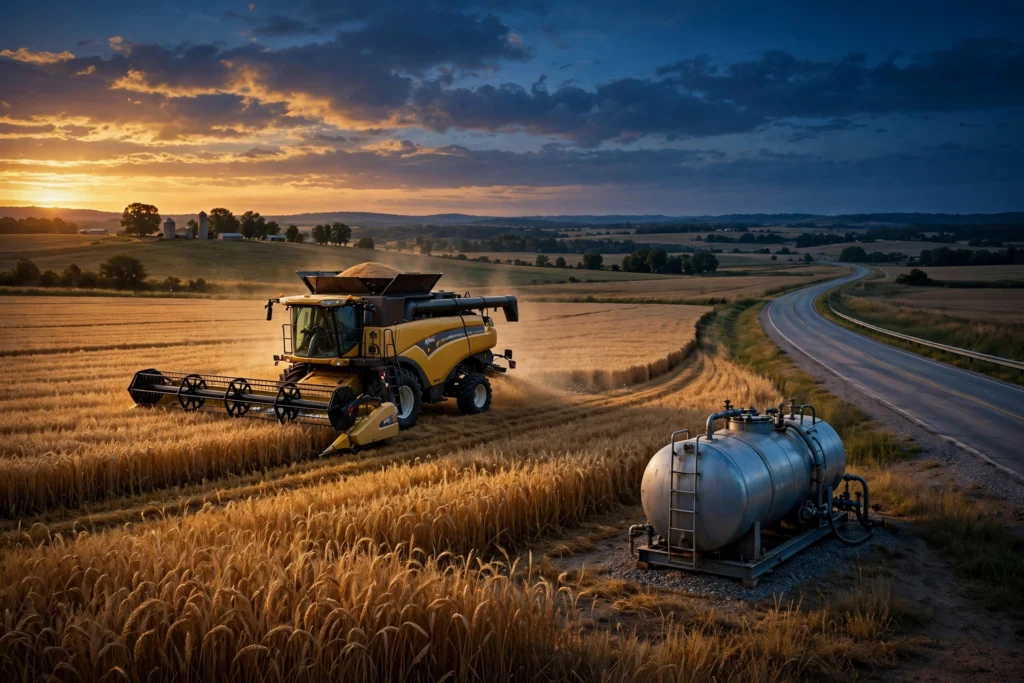
The immediate problem the programme is meant to address is diesel. Combines, tractors and trucks run on diesel, and diesel prices have climbed to levels that have eaten directly into harvest margins. Reuters reported that the weekly average diesel price stood at $6.28 a gallon, up nearly ten cents on the week, citing Energy Information Administration figures, and that the department’s Economic Research Service had projected farmers would spend nearly $5 billion more on fuel than last year. In that context, $8 billion is a large sum, but it is designed to cover only a portion of modelled losses, not the whole fuel bill, and what any individual farmer receives will depend on the per-acre rates set in November and on the acreage and crop mix they reported.
The Timing: Announced Before the Election, Paid After It
The timing of the announcement has drawn as much attention as the sum itself. Trump unveiled the programme at a rally in Park City, Kansas, where he was campaigning for Senator Roger Marshall, whose re-election race has been rated a toss-up by the Cook Political Report. The rally setting, days before an election in which farm-state Senate races in Iowa, Kansas, Nebraska and other states have become unexpectedly competitive, meant the announcement was heard first as a campaign promise as much as an administrative decision. Polling cited in recent commentary, including an October survey by the New York Times and Siena, has shown the president’s approval well underwater nationally, adding to the sense among farm-state Republicans that rural votes could decide close races.
What the announcement did not do was put money in farmers’ hands before they vote. The department has been clear that commodity-specific rates will not be set until November, so no payments can be calculated, let alone issued, before election day. A senior department official, Under Secretary for Farm Production and Conservation Richard Fordyce, told Reuters on October 23 that disbursement would come after the November 3 election and that the exact timing was still to be determined, adding that his guess was that it would be close to the end of the year. That sequence matters for how the programme should be judged. It is a commitment made before the election and a payment delivered after it, and farmers deciding how to vote will have the promise, but not the cheque, in front of them.
The delay is mechanical as well as political. Without November rates, the formula cannot produce individual payment amounts, and without a method for specialty crops, a large part of the farm sector cannot be included at all. The department has said it feels confident in the $8 billion figure, while acknowledging that work remains to pin down the specific numbers. Critics have seized on that uncertainty, arguing that a programme whose rates are not yet set cannot be evaluated as relief, while supporters reply that announcing the total and the formula in advance gives farmers something concrete to plan around, even if the individual amounts follow later.
The Cuts That Came First
To understand why the new programme has been received with scepticism in some farm circles, it is necessary to look at what was withdrawn earlier. According to an assessment published on October 27 by Farm Action, a farmer-led advocacy group, the department cancelled more than $1 billion in planned local food purchasing funding, including roughly $660 million intended for schools and child care facilities. Those programmes helped schools and food banks buy from nearby farmers, creating dependable markets for local producers and bringing fresh food into institutions. The same assessment says the department terminated the Regional Food Business Centers programme, which helped farmers and small food businesses develop markets and get their products to buyers, although some existing grants were preserved.
The assessment also notes later Farm to School grants and school kitchen investments, but argues that the amounts announced are far smaller than the purchasing funds cancelled, and that kitchen funding does not replace money to buy food. That distinction is important for diversified and smaller farms, which often depend on institutional buyers and local markets more than on commodity payments. For a vegetable grower selling to a school district, a cancelled purchasing contract is a lost customer, not an abstract budget line, and a later formula payment based on commodity acreage may offer little compensation. The administration’s broader record, as described in that assessment, also includes support for commodity subsidies without correcting an imbalance that favours corn and soybeans over fruits and vegetables, and moves to repeal protections against meatpacker abuse and to back limits on farmers’ lawsuits over weedkiller.
Other restrictions have followed a similar pattern. In October, the department tightened access to the Rural Energy for America Program, a scheme that has provided more than $4.8 billion in grants and loan guarantees for rural energy projects over the past decade. Under rules effective October 16, applicants must complete projects and demonstrate a full year of energy savings before applying for grants, a requirement that critics say will make it far harder for farmers without upfront capital to take part. The department had already suspended applications under the programme earlier in the year while rewriting its regulations, and restricted solar eligibility the previous year. Earlier still, the administration’s budget proposal for fiscal 2026 sought to cut department spending by more than $5 billion, or over 18 percent of discretionary funding, including agricultural research, conservation technical assistance and rural development, although Congress has historically resisted such proposals and the proposal itself was not enacted in that form.
Diesel, Fertilisers and a Pattern of Election-Season Aid
The fuel relief programme is not the administration’s only recent farm intervention, and the pattern of the others helps explain the political argument around it. On October 5, Trump signed an executive order waiving the restriction that limited red-dyed diesel, the tax-exempt fuel normally reserved for farm equipment, to off-road use, allowing it on highways, and deferring the federal diesel excise tax of 24.4 cents a gallon on that fuel, with no interest or penalties, through December 31. Secretary Rollins put the combined savings from that order at an estimated $640 million across roughly 225 million harvested acres. Three days after the Kansas announcement, Vice President JD Vance travelled to Nebraska to unveil more than $573 million in grants intended to subsidise domestic fertiliser production and lower fertiliser prices, which have been pushed up by both the war with Iran and by tariffs.
Those steps, taken together, form a coherent response to a genuine cost squeeze. Fertiliser, fuel and other input costs have risen sharply, the department has projected that fertiliser, lime and soil conditioner expenses would climb by more than 15 percent in 2026, adding roughly $5.3 billion in costs, and net farm income was projected to decline even as production costs rose. The administration has also exempted various farm inputs, including fertilisers, machinery and packaging materials, from tariffs, and suspended trade remedy duties on Moroccan phosphate. For farmers facing a harvest in which every input costs more, any of those measures, taken on its own, is welcome.
The political argument is about why the squeeze exists and who pays for the response. The Cato Institute, in commentary published on October 30, tallied roughly $46 billion in emergency aid directed to farmers since 2018 through the Commodity Credit Corporation to offset costs linked to the administration’s own policies, including tariffs and the war with Iran, on top of tens of billions in farm subsidies approved by Congress. The same commentary noted that total direct government payments to farmers were on track to reach a record $55.4 billion in 2026, about 30 percent of total farm income, once the diesel aid is included, exceeding the previous high of $45 billion in 2020, when farmers received pandemic assistance. A Nebraska Farmers Union leader, John Hansen, was quoted in that commentary describing the latest payments as election candy, a phrase that has since been widely repeated. Supporters of the programme reject that characterisation, arguing that the aid addresses real costs caused in part by global energy disruption, not merely by domestic policy, and that farmers should not be left to absorb a war-driven fuel spike alone.
What Happens Next for Farmers
The next milestones are administrative, and they will determine whether the programme lives up to its announcement. In November, the department is due to publish commodity-specific payment rates for Title I crops, which will allow farmers to estimate what they might receive. After that, it must publish a method for specialty crops and fishermen, and then open pre-filled applications, expected in January 2027. Only then will the timing Fordyce described, close to the end of the year for the first payments, be tested against reality. If rates are generous and applications are simple, the programme could deliver meaningful relief before the next planting season. If rates are thin, or if the specialty-crop method drags, the gap between the $8 billion headline and the money that reaches individual farms will become the story.
The political milestones run in parallel. On November 3, voters in farm states will decide Senate races that the administration has plainly had in mind, and the result will shape how the aid is remembered, whether as a fulfilled promise or as a campaign gesture. Beyond the election, Congress will face the question that has shadowed the programme from the start: whether emergency aid channelled through the Commodity Credit Corporation should continue to substitute for a farm bill and for appropriated support, or whether the scale of 2026 payments, a record in nominal terms, demands a more durable and more transparent farm policy. A separate $11.1 billion farm-aid request sent to Congress in June has still not passed, which is one reason the administration routed this money through the corporation instead.
For farmers themselves, the practical advice in the meantime is unglamorous but important: keep acreage reports accurate, watch for the November rates, and do not assume a payment amount until the formula is published. The $8 billion is real as a commitment, and the earlier cuts are real as a record, and the harvest of 2026 will be judged, in farm country, by what actually arrives in bank accounts, and when, rather than by what was announced on a rally stage in Kansas.
Source: Grist