Trump News: F-16s Intercept Plane Over Cincinnati
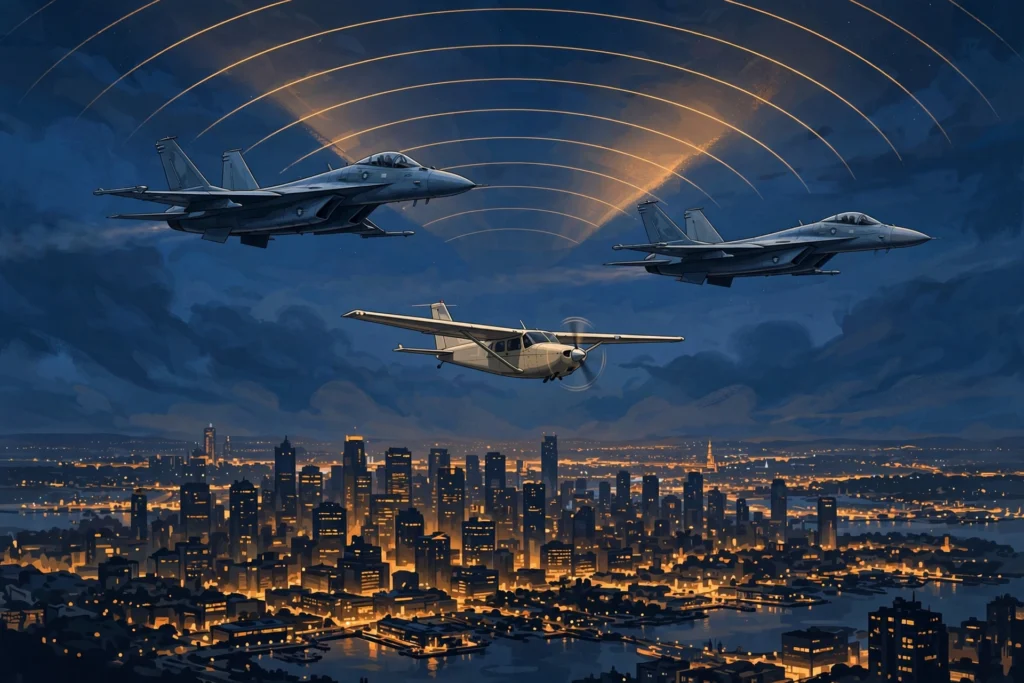
The latest Trump news from the campaign trail arrived with a military escort. Fighter jets scrambled over Ohio on Saturday afternoon after a small private aircraft drifted into restricted airspace while President Donald Trump was addressing a rally just across the river in Kentucky. The North American Aerospace Defense Command said its F-16 fighter aircraft intercepted the general aviation plane over Cincinnati at about 3 p.m. Central time on October 17 and safely guided it out of the area, ending the episode without injuries or further disruption to the president’s schedule.
The interception is one of several airspace incidents to punctuate the Donald Trump latest news cycle this year, a string of similar encounters that military officials say almost always come down to a pilot who failed to check the day’s flight restrictions. It drew a fresh reminder from the Air Force to private pilots the following day: check the airspace before you take off.
What Happened Over Cincinnati on Saturday
According to the official release from NORAD’s Continental U.S. region, headquartered at Tyndall Air Force Base in Florida, F-16 fighter aircraft intercepted a general aviation aircraft over Cincinnati, Ohio, on Saturday, October 17, at approximately 3:00 p.m. Central time. The small plane had entered a temporary flight restriction zone that was in place around presidential movement in the area. Military aircraft established contact with the pilot and escorted the plane safely out of the restricted zone.
The command said the pilot cooperated fully once intercepted, and no injuries or further disruption were reported. The interception took place in the skies over Cincinnati while Trump spoke to supporters at a rally at Northern Kentucky University in Highland Heights, Kentucky, just across the Ohio River from the city.
NORAD did not disclose the specific reason this particular restriction was imposed. CBS News, reporting on the incident, noted that the military did not say why the temporary flight restriction was in place, but that the Federal Aviation Administration routinely issues such restrictions around high-profile events, particularly those attended by political figures. A separate account of the episode described the restriction as having been put in place around the presidential movement itself.
For the pilots and controllers involved, the sequence was textbook. When NORAD aircraft intercept a general aviation aircraft, the command’s standing guidance tells the pilot to come up immediately on emergency frequencies 121.5 or 243.0 megahertz and to turn around and reverse course until receiving further instructions. That is what happened over Cincinnati: contact, compliance, and a guided exit from the restricted airspace.
The Trump Rally at Northern Kentucky University
The Trump rally at the center of the airspace alert was held Saturday afternoon at Northern Kentucky University’s campus in Highland Heights, just south of Cincinnati across the state line. Trump addressed supporters at the university while the interception unfolded overhead, and the rally itself was not disrupted.
Temporary flight restrictions are a routine feature of presidential travel. Whenever the president moves — to a rally, a fundraiser, a visit — the FAA publishes a temporary restriction that carves out a block of protected airspace around the location, and military aircraft stand ready under NORAD’s air-defense protocols to meet any aircraft that strays inside. The Cincinnati episode is a reminder of how wide that security footprint stretches: the restricted zone covered airspace over the Ohio city even though the rally was taking place in Kentucky.
The October calendar has kept that footprint busy. The president has been moving through a string of campaign-season appearances in the closing weeks before the November 3 midterm elections, and each stop brings its own published restrictions and its own scramble risk for general aviation pilots operating nearby. For anyone following White House news through the fall, the pattern is familiar: the travel schedule grows, the airspace notices multiply, and sooner or later a private pilot misses one.
How NORAD Handles Restricted-Airspace Violations
The Cincinnati intercept followed the standard playbook for a domestic air-defense response, a mission that has been running continuously for decades. NORAD — the joint U.S.-Canadian command responsible for aerospace warning and control — keeps fighter aircraft on alert to respond to aircraft that enter restricted airspace without authorization. The Continental U.S. NORAD Region, operating out of Tyndall Air Force Base in Florida, is the operational lead for missions like the one over Cincinnati.
When a violation is detected, the sequence moves quickly. Radar tracks the intruding aircraft, fighters are scrambled to intercept, and the military pilots establish visual and radio contact. The intercepted pilot is instructed to switch to one of the international emergency frequencies and reverse course out of the restricted area. In the Cincinnati case, that is exactly what happened: the F-16s made contact, the private pilot complied, and the aircraft was escorted clear.
The command’s public statement also carried its standard warning for general aviation. Pilots who violate temporary flight restriction airspace, NORAD said, may be met by federal authorities upon landing and can be subject to interview or further enforcement action. It is a warning designed less to threaten than to educate — the overwhelming majority of these violations, officials say, are inadvertent, the product of a pilot who did not check the day’s notices before departing.
That educational push continued the next day. On Sunday, U.S. Air Force officials issued a fresh reminder to general-aviation pilots to be aware of airspace restrictions while planning a flight and before taking off, urging them to consult the FAA’s Notices to Airmen — the regularly updated bulletins, known as NOTAMs, through which the FAA distributes information about airspace limitations. The reminder was a direct response to the Cincinnati incident, but its message applies every weekend the president travels.
2026 Midterms: A Campaign Season of Repeated Intercepts
The Cincinnati episode did not happen in isolation. With the 2026 midterms approaching on November 3 and the president holding rallies across the country, 2026 has produced a steady drumbeat of similar interceptions — a pattern that underscores how often campaign-season airspace restrictions and weekend general aviation traffic collide.
In September, F-16s intercepted 15 aircraft near Chicago in connection with another Trump appearance, the largest cluster of the year. In August, fighter jets intercepted a small plane over Geneva, New York. In July, another aircraft was turned away near East Rutherford, New Jersey, close to a venue for the football World Cup final. A separate August interception was reported near Bedminster, New Jersey. In each case, the aircraft were safely escorted away, and in each case the story ended the same way it did over Cincinnati: no injuries, no disruption, and a pilot facing questions about a missed notice.
Officials say most of these violations are inadvertent, caused by pilots failing to check updated restriction notices before flying. The mechanics are easy to understand. A temporary flight restriction can be published with relatively short notice around a presidential visit, and a private pilot planning a routine weekend flight may simply not think to check whether the airspace along the route has changed since the last flight. The result is a small aircraft drifting into protected airspace and a pair of fighter jets arriving to explain the situation.
The concentration of incidents around presidential travel is not new, but the 2026 campaign calendar has made it especially visible. Each rally brings a published restriction, each restriction brings a scramble risk, and the sheer number of campaign-season stops this fall has multiplied the opportunities for an encounter. The Cincinnati intercept, coming two and a half weeks before Election Day, fits the pattern exactly.
What Pilots Face After Violating a TFR
For the pilot of the Cincinnati aircraft, the military portion of the episode ended the moment the plane was escorted clear. The administrative portion is just beginning. NORAD’s statement was explicit: pilots who violate temporary flight restriction airspace may be met by federal authorities upon landing and subjected to interview or further enforcement action.
The Federal Aviation Administration is expected to review the violation. Accounts of the incident note that such reviews can result in licence action against pilots who stray into restricted zones — a consequence that ranges from warning letters to certificate suspensions depending on the circumstances. The fact that the Cincinnati pilot cooperated fully once intercepted, as NORAD’s account indicates, is the kind of mitigating detail that typically matters in how these cases are resolved.
The broader lesson, and the one the Air Force chose to emphasize on Sunday, is procedural. Before every flight, pilots are expected to check the Notices to Airmen for temporary restrictions along their route, particularly around high-profile events and protected locations. The NOTAM system is the FAA’s official channel for airspace limitations, and it is updated regularly — including, crucially, in the hours before a presidential visit. The Sunday reminder urged pilots to consult those official notices both while planning flights and again before taking off, a belt-and-suspenders approach designed to catch restrictions published after the initial flight planning.
Aviation safety advocates make the same point after every one of these incidents: the information is available, it is free, and checking it takes minutes. The cost of skipping it can be an encounter with armed fighter jets and a federal enforcement file.
Pentagon News: The Standing Air-Defense Mission
In Pentagon news terms, the Cincinnati intercept was unremarkable — and that is precisely the point. The air-defense mission over the continental United States runs around the clock, and scrambles to meet aircraft in restricted airspace are a routine, if infrequent, part of it. What made Saturday’s episode newsworthy was not the military procedure but the context: the restricted airspace, the presidential rally across the river, and the political calendar.
NORAD’s public affairs handling of the incident reflected that routine character. The release was brief and factual: the time, the place, the aircraft types, the outcome, the standing guidance for intercepted pilots, and the warning about enforcement. There was no alarm in it, because from the command’s perspective there was nothing alarming — the system worked as designed, detecting an unauthorized aircraft in protected airspace and resolving the situation safely within minutes.
That is the standard the command applies to every such encounter, whether the protected airspace surrounds a presidential rally in Kentucky, a World Cup venue in New Jersey, or any other temporary restriction. The fighters launch, contact is made, the aircraft leaves, and the incident is logged. The political significance belongs to the news cycle; the military significance is nil.
Still, the episode offers a small window into the scale of the security operation that travels with the presidency. A rally at a university in northern Kentucky draws a restricted zone over a major Ohio city, fighter aircraft on alert, federal coordination across agencies, and a public communications apparatus ready to explain it all — all for a Saturday afternoon campaign stop. It is a reminder, visible in the sky over Cincinnati, of how much machinery sits behind every presidential movement.
What Happens Next
In the near term, the next chapter of the Cincinnati episode belongs to the FAA. The agency is expected to review the violation, interview the pilot, and determine whether enforcement action — up to and including licence action — is warranted. Those reviews typically take weeks, and their outcomes are rarely announced publicly unless the penalty is severe.
For general aviation in the region, the practical effect is the Sunday reminder: check the NOTAMs, check them again before takeoff, and give published restrictions a wide berth. With the midterm campaign in its final two and a half weeks, more presidential travel is expected, which means more temporary flight restrictions around more cities — and, if the 2026 pattern holds, quite possibly more interceptions before Election Day.
For the broader Trump news cycle, the incident will likely remain what it is: a footnote to a busy October of campaign travel, notable less for what happened — a safe, routine intercept — than for what it illustrates about the intersection of presidential politics and the national airspace system. The rally went on, the plane went home, and the fighters went back on alert.
*Source: NORAD / CBS News / Cincinnati Enquirer*