Trump News: Bolsonaro Lands in Miami After Fleeing Brazil
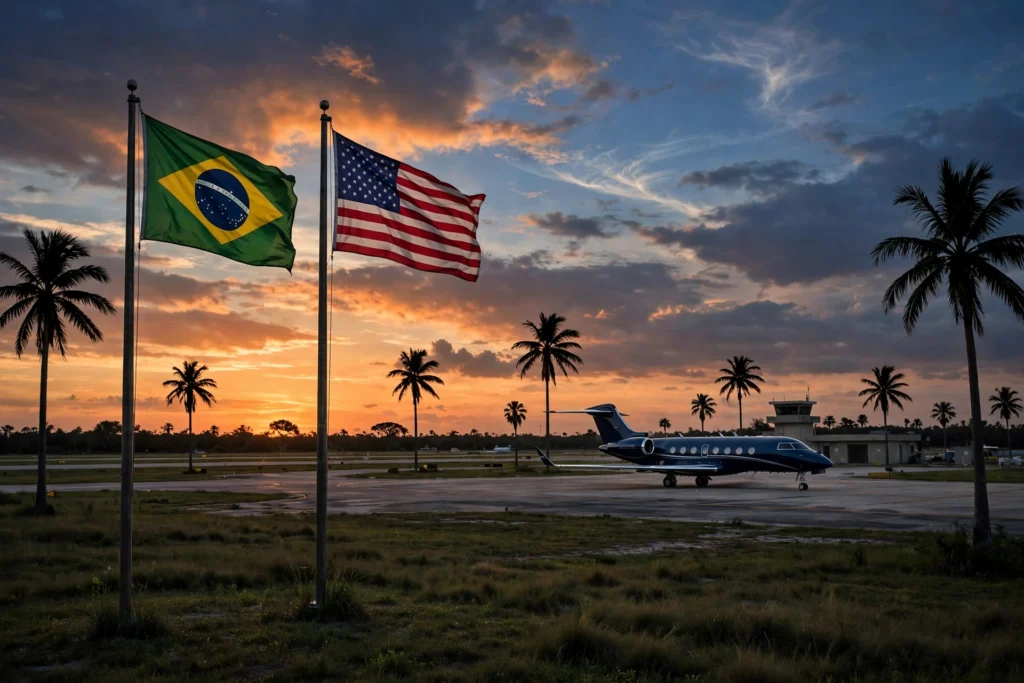
In the latest trump news, defeated Brazilian presidential candidate Flávio Bolsonaro landed in Miami on Wednesday after fleeing Brazil, ending two days of uncertainty about his whereabouts and opening a new diplomatic rift between Washington and Brasília. Television footage showed Bolsonaro stepping off a private jet at Miami’s Opa-locka Executive Airport with his wife and two daughters, the family shielding themselves from cameras under umbrellas. The arrival came a day after the Trump administration said it would issue visas to Bolsonaro and his family and allow them to enter the United States, a decision President Donald Trump publicly endorsed.
The flight capped a secretive journey across three countries. Bolsonaro crossed from Brazil into Argentina late on Tuesday night, boarded a private aircraft bound for Ecuador, and then continued on to Florida. He left behind a Brazilian Supreme Court order to surrender his passports, a criminal investigation into alleged corruption and money laundering, and a presidential election result he has refused to accept.
Election Results: A Runoff Upset in Brazil
Bolsonaro lost Sunday’s presidential runoff to Lula, the leftist incumbent, in a result that surprised many observers. Bolsonaro, a 45-year-old senator and the son of former president Jair Bolsonaro, had emerged as the leading candidate in the first round of voting and was widely favoured to defeat Lula. Instead, Lula won the second round by what the Wall Street Journal described as a close but convincing margin, securing another term and handing the Bolsonaro family its second presidential defeat in four years.
Bolsonaro has refused to concede. He has refused to recognise the result, and he threatened in the hours after the vote to attempt to annul the outcome. Trump backed him. Speaking to reporters on Monday, the president said the race looked “rigged,” echoing Bolsonaro’s own claims about the election. The two men have been close allies for years: Bolsonaro visited the White House in May, and Trump campaigned openly for the family’s return to power in Brazil.
The defeat was a bitter reversal for a political dynasty that has dominated Brazil’s right for a decade. Jair Bolsonaro, the former president, also fled to Florida after losing the 2022 presidential election to Lula, staying there for three months before returning to Brazil. His son’s flight follows the same route, but with a difference: the younger Bolsonaro left while under direct orders from Brazil’s highest court, and with the explicit help of the United States government.
Lula’s victory confirmed his hold on a deeply divided country. His supporters celebrated the result as a defence of Brazilian democracy. His critics, including the Bolsonaros, have spent the campaign arguing that the country’s institutions are stacked against them. The election was fought against that backdrop of mutual distrust, and the aftermath has now spilled across borders.
Immigration News: The Court Order and the Secret Flight
The immediate trigger for Bolsonaro’s flight was a court order. Brazil’s Supreme Court is investigating him for alleged corruption, money laundering and tax evasion in two cases. Shortly after the election result, the court ordered him to hand over his regular and diplomatic passports by noon on Tuesday and to remain in the country while the investigation proceeds. Bolsonaro denies wrongdoing and says he and his family are the victims of a witch hunt by the court. He did not surrender the passports, and Brazil’s Federal Police cancelled them after he failed to comply.
For much of Tuesday, his whereabouts were unclear. Then Argentina’s migration department issued a statement that filled in the first leg of the journey. Bolsonaro, his wife Fernanda and his daughters Carolina and Luiza had crossed into Argentina at 10:50 p.m. local time on Tuesday through the Tancredo Neves International Bridge, the border crossing in the north-eastern province of Misiones, where the borders of Brazil, Argentina and Paraguay meet. The department said the family presented valid travel documents and faced no legal restrictions on entering the country. Allies said late on Tuesday that Bolsonaro also holds an Italian passport, which may explain how he travelled after his Brazilian documents were cancelled.
Forty minutes later, at 11:30 p.m., the family boarded a private aircraft operated by the charter company Baires Fly. According to Argentina’s presidential spokesman, the flight was registered as LV-JQW, a Gulfstream G400, with the Ecuadorean city of Guayaquil listed as its destination on the flight plan. From Guayaquil, the family continued on to Miami.
The secrecy of the route was part of the story. The family travelled at night, through a remote border crossing, on a private jet, with a flight plan that listed a destination short of their final one. By the time Brazilian authorities and reporters pieced it together, Bolsonaro was already in the air.
Trump Administration: Visas and a “Rigged” Claim
The American end of the journey was arranged in advance. On Tuesday, the State Department said it would issue visas to Bolsonaro and his family and allow them to enter the United States. A Trump adviser told CNN that the president had approved allowing Bolsonaro entry into the country following his election loss, and that administration officials had known since Monday that Bolsonaro had roughly 24 hours to surrender his passport. The message to the defeated candidate was clear: he would be allowed into the United States.
Trump confirmed the decision himself. Speaking to reporters on Wednesday, he said he would approve of Bolsonaro coming to the United States. “Well, I would approve. I think they’re fine people. The election was very strange, and I thought it was terrible,” he said. It was not clear whether Trump and Bolsonaro had spoken directly by phone before the departure. The State Department did not immediately respond to a request for comment on the details of the visa arrangement.
The decision fits a pattern of open American support for the Bolsonaro family. Ahead of Sunday’s election, Reuters reported on a United States State Department campaign to restore the Bolsonaros to office, and Trump made little secret of his preference during the race. His claim that the election looked “rigged” gave Bolsonaro’s refusal to concede a powerful endorsement from the White House, and the visa offer that followed turned rhetorical support into practical help.
The episode also shows how immigration policy and foreign policy have blurred under this administration. The visa decision was not a routine consular matter: it was made at the highest level, announced by the State Department, and confirmed by the president himself. Bolsonaro’s case is the most dramatic example yet of visas being used as an instrument of foreign policy, and it is likely to be cited by both sides in the debate over how the president uses American power.
World News: A Rift Between Washington and Brasília
Bolsonaro’s departure threatens to deepen a rift between the two most populous nations in the Americas. Lula has accused Washington of colluding with the Bolsonaro family to help return them to power, and the visa decision gives that accusation fresh force. From Brasília’s point of view, the United States has now helped a man under criminal investigation evade a court order and escape the country days after losing an election. From Washington’s point of view, it has offered refuge to a democratic ally facing a politicised judiciary. The two accounts cannot both be true, and the gap between them will shape the relationship for months.
Argentina’s role adds a second diplomatic fault line. President Javier Milei has been one of Bolsonaro’s most fervent supporters, and he travelled to Brazil to take part in the campaign. The fact that Bolsonaro’s escape route ran through Argentine territory, with Argentine migration officials confirming the crossing and a private Argentine charter carrying him onward, is almost certain to strain relations between Lula and Milei.
The regional implications reach further. Brazil is the largest economy in South America and a central player in global climate negotiations and trade talks. A prolonged standoff between its government and Washington would complicate cooperation on all of those fronts, and it would test the region’s other leaders, who must decide whether to treat Bolsonaro as a fugitive from justice or as a political exile. Ecuador, whose territory the flight passed through, has said nothing.
There is also a domestic American dimension. The decision to admit Bolsonaro will be debated in Washington, where Democrats are likely to frame it as the president sheltering an ally who defied a court, and Republicans as a stand against the persecution of conservatives abroad. The argument will play out ahead of the midterm elections on November 3, and Bolsonaro’s arrival in Florida, a state with a large Brazilian community, guarantees the story will stay in the news.
What Happens Next: Exile, Investigations and an Uncertain Stay
The most immediate question is how long Bolsonaro and his family intend to stay in the United States. It was not immediately clear at the airport whether they planned to remain in Florida or to move on. The visas the State Department promised would allow them legal entry, but their duration and conditions have not been made public, and neither Bolsonaro nor the administration has said what comes next. His father’s precedent suggests one path: Jair Bolsonaro spent three months in Florida after his own defeat before returning to Brazil to face the legal consequences. His son may follow the same course, or he may try to build a longer exile.
The investigations in Brazil will continue whether he is there or not. The Supreme Court cases into alleged corruption, money laundering and tax evasion do not disappear because the defendant has left the country, and the cancellation of his passports means he cannot travel on Brazilian documents. Whether Brasília seeks his return through formal channels, and whether Washington would cooperate, are questions that will test the relationship further.
Bolsonaro himself will also have to decide how public to be. His refusal to concede, and his threat to challenge the election result, suggest he does not intend to go quiet. Speaking from the United States, with the president’s backing, he could become a rallying point for Brazil’s right and a constant irritant to Lula’s government. Or he could find, as his father did, that exile dulls a politician’s edge and that the audience at home moves on.
For the Trump administration, the test is whether the visa decision brings blowback that outweighs the loyalty it demonstrated. The president has shown no sign of second-guessing the move, and his public comments suggest he regards it as straightforward. But the diplomatic costs are real, and they will accumulate if Lula’s government responds with formal protests or a cooling of cooperation. The story that began with a late-night border crossing and a private jet is now a matter of statecraft.
Source: Fortune