Trump News: Arch Won’t Finish Before Term Ends
Meta description: The Justice Department said Trump’s proposed 250-foot triumphal arch in Washington would not be completed until after his second term ends.
The latest trump news about one of the president’s most personal building projects arrived on Tuesday in the form of a timetable that undercuts its own symbolism. The Justice Department told a court that President Donald Trump’s proposed 250-foot triumphal arch in Washington would not be completed until after the end of his second term, even though the project is presented as a monument to the nation’s 250th anniversary and has been pursued with unusual speed. The admission, reported by Reuters on November 3, sets out a construction schedule that stretches well beyond the president’s remaining time in office: six to eight months of work below ground, above-ground construction not beginning until May at the earliest, and a total building period of 33 to 39 months. On even the shortest of those estimates, the arch would still be unfinished when a successor takes office in January 2029, and on the longest it would run for more than a year into the next presidency.
The timing of the statement matters because the project is on the verge of a decisive week. The arch is set to be approved as soon as Thursday, when the National Capital Planning Commission is scheduled to consider the National Park Service proposal, and the administration has previously said construction could commence as early as November 5, 2026, once final approvals are in place from the planning commission, the Park Service and the Interior Department. Several legal challenges are now asking a federal judge to block the project before that approval can take effect, and the Justice Department’s timetable was filed in the context of those challenges. In other words, the government was not volunteering a political embarrassment. It was answering a court, in a case where the pace of construction is itself part of the argument: the challengers say the administration is trying to move so fast that judicial review will be overtaken by events, while the government is now on record saying that the most visible part of the building will not even begin for months.
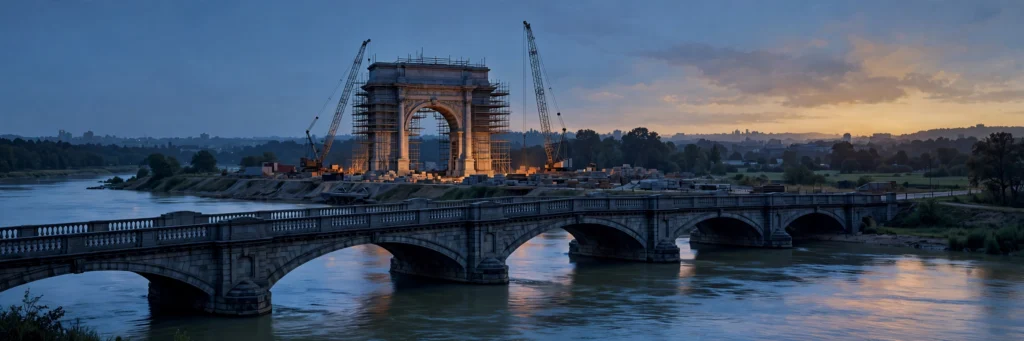
The arch itself is, by any measure, an extraordinary proposal for the centre of Washington. At 250 feet, or about 76 metres, it would stand in Memorial Circle, on the banks of the Potomac River, at the foot of Arlington Memorial Bridge, between the Lincoln Memorial and Arlington National Cemetery. It would eclipse the Capitol, the Lincoln Memorial and the White House in height, and it would be taller than the Arc de Triomphe in Paris that it is said to resemble, with gilded statues and an observation deck among its planned features. The Park Service has described it as a concrete structure clad in granite or marble veneer, topped by a central winged figure and two statues, and has said it would honour the 250th anniversary of the signing of the Declaration of Independence. It would also, according to the Park Service’s own estimates cited in court filings, attract between 2,000 and 22,000 visitors a day. That is a major new monument, in one of the most sensitive and heavily trafficked ceremonial landscapes in the United States, and it is being advanced on a timetable that its opponents say has left proper scrutiny behind.
DOJ News: A Schedule That Runs Past the Presidency
The doj news at the heart of Tuesday’s report is the breakdown of that timetable, and it deserves to be read in full because it reframes the whole project. The Justice Department said the first phase of construction would last six to eight months and would be focused exclusively on below-grade excavation and foundation work. Above-ground construction, the part of the project that the public would actually see rising over Memorial Circle, would not be expected to begin until May at the earliest. Total construction is anticipated to take 33 to 39 months. Put together, those figures mean that for the first half-year or more after any ground-breaking, there would be little to show above the surface except excavation, and that the arch itself would be a construction site through the next presidential election cycle and beyond. For a monument intended to celebrate a national anniversary, that is a striking mismatch between ambition and calendar: the anniversary it commemorates is in 2026, but the monument to it would not be finished until well after the anniversary year has passed, and after the president who proposed it has left office.
The schedule also matters to the legal argument. If construction were genuinely about to produce a finished monument within weeks, a court might feel pressure to act immediately or not at all. A schedule measured in years, with months of invisible underground work first, gives a court more room to consider the challenges on their merits before the most irreversible steps are taken, although the challengers argue that even excavation and foundation work would cause harm that could not easily be undone. The Justice Department’s filing therefore cuts both ways. It reassures a judge that there is time for review, because the arch will not appear overnight, but it also confirms that the project, if it proceeds, will be a multi-year undertaking that will bind a future administration to a monument it did not choose, on a site it did not select, at a cost that has not been clearly stated. The White House has said the project will likely rely on both private and public funds, according to reporting in The New York Times, and the National Endowment for the Humanities has set aside 15 million dollars, but no firm total cost has been published. A project whose price is uncertain, whose completion date falls in someone else’s presidency, and whose legal basis is disputed is, by definition, a project whose future is not secure.
White House News: Three Lawsuits and a Claim of Illegality
The white house news around the arch is now dominated by litigation, and the most consequential case arrived on Saturday, October 31, when Washington, D.C., and Virginia sued to block construction. Their 46-page complaint, filed in the United States District Court for the District of Columbia, calls the project flagrantly unlawful and asks a judge to act before work can begin, which the two governments say could happen as early as Wednesday, November 5. The case was brought by District Attorney General Brian Schwalb and Virginia Attorney General Jay Jones, and it names the National Park Service, the Interior Department, Interior Secretary Doug Burgum and Jessica Bowron, the Park Service comptroller exercising the authority of the director. It has since been consolidated by United States District Judge Tanya Chutkan with an earlier challenge to the arch, on the grounds that the cases share common legal questions, and the two governments have also asked for a temporary restraining order to pause construction until the court can rule on a preliminary injunction.
The legal claims in the new lawsuit go to the foundations of the project, not merely to its details. First, the complaint argues that the Commemorative Works Act and a separate federal law, 40 U.S.C. 8106, require specific authorisation from Congress before a monument is built on federal land in the District, and that the administration has obtained none. Second, it cites the Height of Buildings Act, which the complaint says bars any building in the District taller than 130 feet, with limited exceptions, so that a 250-foot arch would nearly double the statutory limit. Third, it argues that the Park Service did not properly weigh alternatives, costs and consultation under the National Environmental Policy Act, the National Historic Preservation Act and the Administrative Procedure Act, and that the agency did not begin its historic-preservation review until June 5, 2026, nearly eight months after the initial announcement, according to the complaint. The governments also warn of practical harm, including increased traffic congestion and pollution over an estimated three-year construction period, and they cite figures showing that more than 27,000 vehicles, 1,100 cyclists and 1,200 pedestrians pass through Memorial Circle each day, with construction expected to close the south side of the circle and reduce lanes on Memorial Bridge, and to run for about 20 hours a day.
Those claims are not the only ones before the courts. A separate lawsuit brought by three Vietnam War veterans and an architectural historian argues that the monument lacks the required congressional approval and would obstruct views of Arlington National Cemetery, the final resting place for hundreds of thousands of American service members and their families. Judge Chutkan held a hearing on October 30 on a request to pause the project in that earlier case. Arlington County’s board filed a further challenge on October 8, focused on traffic, public safety and historic preservation, and pending in federal court in Alexandria. The Associated Press has reported that the District and Virginia case is the third lawsuit seeking to halt the arch, and none of the challenges has yet produced a final ruling on the project’s legality. Taken together, they represent a broad front of opposition, from two governments, a county, veterans and preservationists, all converging on the same central argument: that a monument of this scale, on this site, cannot lawfully proceed without Congress and without the reviews that Congress required.
Trump Administration: A Monument With a Military Argument
The trump administration’s defence of the arch has taken an unusual turn, and it is one of the more revealing parts of the court record. In filings submitted to a federal court on October 28, Defense Secretary Pete Hegseth and Homeland Security Secretary Markwayne Mullin said the arch could serve a dual purpose, as a major national monument that also incorporates military utility, including counter-sniper personnel, drones and ammunition. That argument, if accepted, would recast the arch from a purely commemorative structure into a piece of security infrastructure, and it has been noted with some surprise by the challengers, who argue that it does not cure the absence of congressional authorisation and that it sits uneasily with the arch’s presentation as a celebration of the nation’s founding. The administration has also defended the arch in simpler terms, as a fitting tribute for the 250th anniversary, and has said it could break ground in less than a week once approvals are complete. The two arguments together, commemoration and military utility, suggest a project that is being justified on more than one ground at once, perhaps because no single ground is thought sufficient on its own.
The visual impact of the arch is another point on which the government’s own material has supplied the challengers with arguments. According to material cited in the complaint, the Park Service has acknowledged that the arch would occupy the centre of the vista between the Lincoln Memorial and Arlington National Cemetery, obstructing the reciprocal view and impairing the clarity of that sightline, and that it would introduce a competing illuminated vertical element affecting the Washington Monument’s traditional visual prominence. Those are not the words of opponents. They are the government’s own findings about what its monument would do to a landscape that was deliberately designed as a sequence of views and memorials, and they help explain why the veterans’ lawsuit, in particular, has resonated. For veterans and their families, Arlington is not a backdrop. It is a cemetery, and a monument that blocks the view between the Lincoln Memorial and Arlington, or that competes with the Washington Monument for the eye, is not a neutral addition to that landscape. It changes the meaning of the place, and it does so permanently.
The Commission of Fine Arts gave its final approval to the project on May 21, 2026, according to the complaint, and the Park Service has asked the National Capital Planning Commission for final approval at its meeting on November 5. The District and Virginia governments say the government told the court on October 21 that it may begin construction the same day it receives that approval, and they argue that the administration has made clear it will attempt to outrun judicial review, and that once construction begins it will argue that halting it would irreparably harm the federal government. That is a familiar pattern in litigation over fast-moving government projects, and it is why the request for a temporary restraining order is so important to the challengers. If the court does not act before November 5, they argue, the government will be able to present the court with a construction site and argue that the harm of stopping it outweighs the harm of letting it continue. If the court does act, the project will be paused while its legality is tested, and the timetable set out by the Justice Department on Tuesday suggests that a pause of weeks or months would not, on its own, change the completion date by much, since the project is already measured in years.
What Happens Next for the Triumphal Arch
What happens next will be decided, in the first instance, on Thursday, when the National Capital Planning Commission meets, and in the courtroom, where Judge Chutkan is now handling the consolidated challenges. If the commission grants final approval and no court order intervenes, construction could begin as early as November 5, starting with the months of excavation and foundation work described by the Justice Department. If a temporary restraining order is granted, construction will be paused until the court can consider a preliminary injunction, and the arch will remain a proposal rather than a building site while the legal questions are argued. Either way, the Justice Department’s timetable has changed the political conversation around the project. A monument that will not be finished until after the president leaves office cannot be presented, without qualification, as his monument in the same way as a building completed during his tenure. It will be completed, if it is completed at all, under a successor who may have different priorities, and who will inherit both the construction site and the legal disputes that come with it.
That inheritance is worth dwelling on, because it is the most durable consequence of Tuesday’s filing. Monuments are meant to outlast presidencies, and in that sense an arch completed in 2029 or 2030 would still be a monument to the 250th anniversary, even if it missed the anniversary itself. But the political meaning of a monument depends in part on who builds it and when, and a project that runs past the end of a term invites a question that its supporters have not yet answered: what happens if the next administration, or the next Congress, decides that the arch should not be finished at all? The legal challenges give that question a concrete form, because a court could still rule that the project was never lawfully authorised, even after construction has begun, and a future government could decide not to defend it. The cost, the traffic disruption, the altered sightlines and the years of construction would then have been incurred for a monument that was never completed, or that was completed only to stand as a reminder of a contested decision.
For now, the arch remains a proposal with approvals pending, lawsuits pending and a timetable that stretches beyond the presidency that proposed it. The Justice Department’s statement on Tuesday did not kill the project, and it did not save it. It simply put a date on the calendar that everyone involved will now have to reckon with: a completion date that falls after the end of the second term, for a monument to an anniversary that will already have passed, on a site where the law, the landscape and the courts all have a say. Whether that date becomes a reason to pause, a reason to press ahead, or simply a fact of life for a long construction project will be decided in the coming days, first by the planning commission, then by Judge Chutkan, and ultimately by the courts and governments that will still be dealing with the arch long after its proposer has left the White House.
Source: The Guardian