Trump Netanyahu News: Kushner Gaza Rebuild Plan
In the latest trump netanyahu news, Jared Kushner, President Donald Trump's son-in-law and his special envoy for peace, has set off a furious argument about the future of Gaza by describing the destruction of the territory as an opening to rebuild it entirely differently. Speaking in an interview recorded on Wednesday, Kushner said the war that has flattened much of Gaza also created the chance to build something new in its place, rather than restoring what stood there before. The remark landed at a moment when the ceasefire in Gaza is under severe strain, when Israel's defence minister is threatening a new offensive, and when the American-led body meant to govern Gaza's transition is publicly accusing the Israeli government of blocking its work.
Kushner's words were blunt, and they were deliberate. "The bad thing about the war is that it was horrific. It caused a lot of suffering," he said. "The good thing about the war is that Gaza does need to be built. So why build it into what it was?" The sentence, reported by Al Jazeera and widely shared in clips of the interview, was immediately seized on by critics who said no good could be found in a war that has killed tens of thousands of people and left more than two million living in tents and makeshift shelters. Supporters of the administration's plan heard something else: a statement of the plan's central idea, that Gaza should not be rebuilt as it was, but remade as a place with a different government, different rules and a different economy.
Kushner gave the interview to Mathias Dopfner, the chief executive of Axel Springer, the German media group that owns Politico, for Dopfner's MD Meets podcast. The conversation, recorded on November 25, ranged across the whole of the administration's Gaza plan: the ceasefire, the disarmament of Hamas, the international force meant to take over security, and the reconstruction that is supposed to follow. But it was the passage about rebuilding that travelled furthest, because it put a positive frame on destruction that most of the world has watched with horror.
"The good thing about the war is that Gaza does need to be built," Kushner said, according to Al Jazeera's report of the interview. "So why build it into what it was? Let's build it into something new." The line was clipped and shared within hours on social media, where the Middle East Eye posted extended excerpts and the footage drew hundreds of thousands of views. Commenters on the clips called the framing callous and accused Kushner of treating devastated land as a development opportunity, while others questioned whether the footage was genuine at all, a sign of how little trust now surrounds public statements about Gaza.
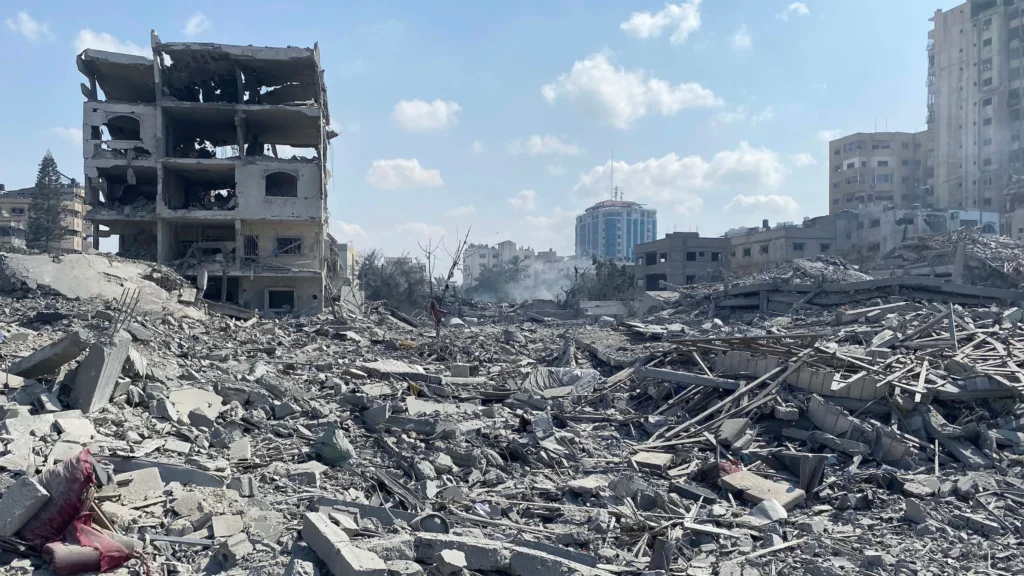
The scale of what would need to be built is enormous. According to figures cited by Al Jazeera, at least 74,700 Palestinians have been killed since the war began in October 2023, and much of the territory lies in ruins, forcing about 2.1 million people to live in tents and makeshift shelters. The Israeli military says it currently controls about 60 percent of the land. Israel's defence minister, Israel Katz, put the destruction even higher on Thursday, saying that 70 percent of Gaza has been destroyed and is controlled by the Israeli army, including the Philadelphi corridor along the Egyptian border.
At the centre of Kushner's remarks sits the Board of Peace, the international body created to govern Gaza's transition. The board was established by the Trump administration and endorsed by the United Nations Security Council in Resolution 2803, passed on November 17, 2025, with thirteen votes in favour and two abstentions, from Russia and China. The resolution endorsed President Trump's twenty-point plan for Gaza and called for two transitional bodies: the Board of Peace, tasked with overseeing aid delivery, reconstruction and day-to-day administration, and the International Stabilization Force, mandated to take over security and disarm Hamas until the Palestinian Authority has undergone reforms the plan deems satisfactory. Trump designated himself as the board's chair. Notably, no Palestinian representative sits on the board, a choice that has drawn criticism from Palestinian officials and analysts who argue that decisions about Gaza's future are being made without Gazans at the table.
The board's most important task is disarmament, and Kushner used the interview to claim progress on it. He said Hamas has signed an agreement to give up its weapons, and he described the work now under way to move from signing to actual collection through an International Stabilisation Force led by a commander he identified as General Jeffers. He acknowledged that the task is difficult, even close to impossible, but argued that removing the weapons, establishing a new government, and putting in place new rules and laws that attract capital will make Gaza free and give its people a chance. "Make it free, that gives the people a chance," he said, in the account published by the Middle East Eye.
The claim has a history. In July 2026, Hamas said it accepted a Board of Peace roadmap under which it would hand over its weapons gradually as Israeli forces withdraw from the territory. On July 30, 2026, Trump announced that Hamas and the international body had reached what he called a historic agreement for the complete disarmament of Hamas and all other armed groups in Gaza. According to details reported at the time by CBS News, Al Jazeera, CNN and other outlets, the plan calls for Hamas and allied factions to dismantle their heavy and light weapons, tunnel networks, weapons depots and production facilities over an eight-month, multi-phase process. Earlier in July, Hamas had announced that it would dissolve its formal governing body in Gaza, though the central question of disarmament remained unresolved.
Netanyahu's government has disputed that the board's proposal meets Israel's demands. His office has argued that Hamas must completely disarm before Israeli troops conduct any withdrawals, rejecting the phased approach in which weapons are handed over gradually as Israeli forces pull back. That disagreement is now the central obstacle to the plan, because it determines the order of events: Washington and the board want withdrawal and disarmament to proceed together, while Jerusalem wants disarmament first and withdrawal second. Kushner's interview was, in part, an attempt to break that deadlock in public, by presenting the phased approach as already agreed and already moving.
The board also controls the money. It has complete authority over the distribution of humanitarian aid in Gaza, and it is responsible for overseeing reconstruction. But statements from American officials, including Vice President JD Vance, have indicated that reconstruction will be permitted only in areas where Hamas is not operating, which in practice confines rebuilding to areas under the control of the international force. That condition matters enormously for the two million people living in tents, because it means that where they can go home depends not only on whether the fighting stops, but on who controls the ground they are standing on.
US Politics: Kushner's Warning That Israel Risks Becoming a Pariah
The podcast interview was Kushner's second striking intervention in three days, and the first was arguably sharper. In an extensive interview with New York magazine, published on Monday, he warned that Israel was increasingly becoming globally isolated. "I feel like the fork in the road is Israel could rise from the tragedy of October 7, (and) be much more secure and much more integrated in the world, or they can go on the current trajectory, which is to trend toward global pariah status," he said. The phrase "global pariah" was the headline, and it was understood in Jerusalem as a warning from the administration that has been Israel's closest ally: change course, or lose the standing that the Abraham Accords and American backing were meant to secure.
In the Dopfner interview, Kushner delivered his sharpest rebuke of Israel's broader posture, arguing that it should drop its constant wartime mindset and embrace economic diplomacy the way the Gulf Arab states do. He called Netanyahu someone who "doesn't always make it easy" to make progress in the Trump administration's Gaza plan, and he said Israel "needs to get out of the constant wartime mindset and focus on economic diplomacy." He praised Morocco, Bahrain and the United Arab Emirates as incredible partners, and he suggested regional projects such as building data centres and energy infrastructure in the Sinai Peninsula with Egypt, to create what he called a warm peace with economic benefits.
The rebuke is striking because of who is delivering it: Trump's son-in-law, the architect of the Board of Peace and a key broker of the Abraham Accords. When he says Netanyahu "doesn't always make it easy," it is the administration's own envoy saying, in public, that the Israeli prime minister is the obstacle to its plan. The board has begun intensifying its public messaging against Israel, accusing Netanyahu's government of blocking its disarmament plan and failing to allow sufficient aid into the territory. A senior adviser to the board, Josh Gruenbaum, gave several interviews over the weekend arguing that Israeli intransigence was blocking the American-controlled panel from even testing whether Hamas would keep its commitments. The board held off exerting more pressure on Israel in the lead-up to the October 27 election. Netanyahu remains the caretaker prime minister, with his approach toward Gaza unchanged, and the board's patience appears to have run out.
Trump Administration: A Ceasefire Under Strain
Kushner's remarks landed on a day when the ceasefire itself looked fragile. The ceasefire took effect on October 10, 2025, and the plan built on it stalled within weeks of its implementation. More than a year later, much of Gaza remains in ruins, and the killing has not stopped. According to Gaza's health ministry, 1,679 Palestinians have been killed since the ceasefire began. Netanyahu and Katz have said about 80 Hamas members have been killed in the past month. The numbers tell the story of a truce that holds on paper and frays on the ground, with each side accusing the other of breaking it.
On Thursday, Israel's defence minister, Israel Katz, told Hamas it must disarm under Trump's Gaza plan or face a new offensive that would push about one million Palestinians to the south of the territory. Writing in Hebrew on social media on Thursday morning, Katz set out two options. "Either they will disarm voluntarily and Gaza will be demilitarized in accordance with President Trump's plan, or the IDF will disarm them as part of Operation Gideon's Chariots II," he wrote, adding that the second option would mean another evacuation of one million Gaza residents southward. Last week, Katz said Israel "will not withdraw from the current lines of the security zones" until Hamas is "dismantled." Netanyahu has refused to make progress on the twenty-point plan until Hamas is completely disarmed.
Hamas, for its part, has refused to disarm unilaterally, saying it would only do so alongside a staged Israeli withdrawal from Gaza. The group has blamed both Israel and the American-backed Board of Peace for the ongoing attacks, saying the board "bears political and moral responsibility for the continuation of these crimes as a result of its silence and failure to halt the aggression." In a written statement on Thursday, Hamas condemned the killing of a member of its political bureau and senior education official, calling the policy of targeted assassinations a flagrant breach of the ceasefire agreement in force in Gaza.
Israel has intensified its campaign of targeted assassinations in Gaza in recent days, striking and killing Hamas commanders and political leaders, even as the Trump administration urges Netanyahu to proceed with the American-brokered ceasefire plan. CNN reported on Thursday that the assassinations are continuing while Washington presses Jerusalem to carry out its obligations under the plan, which would require Israel to stop striking Gaza and begin withdrawing forces that occupy more than half of the enclave's territory. The telephone call between Netanyahu and Kushner on Tuesday was part of the effort to close that gap. An Israeli official told the Times of Israel that the two men discussed the humanitarian situation in Gaza and agreed to continue working together. According to Axios, Kushner urged Netanyahu during the call to carry out Israel's obligations under the ceasefire plan.
Politics News: The Reaction to the "Good Thing" Remark
Reaction to Kushner's remark was swift, and it was overwhelmingly hostile in the places where the clip circulated. On the Middle East Eye's posts of the interview, the comment sections were dominated by anger and condemnation, with viewers rejecting his characterisation of the war's devastation as an opportunity and calling it evidence of callousness. Many accused him of seeking profit from Palestinian land, and of planning luxury developments on ground where tens of thousands of people have been killed. Others said the rebuilding of Gaza should be decided by Palestinians alone, not by Americans or Israelis, and called the plan colonial. A smaller thread questioned whether the video was generated by artificial intelligence, reflecting the distrust that now surrounds footage of public figures speaking about Gaza. Supportive comments were virtually absent.
Kushner's claim that Hamas has signed an agreement to give up its weapons is contested, not because no agreement exists, but because what was agreed in July was a roadmap for gradual disarmament tied to Israeli withdrawal, not the immediate and complete disarmament that Netanyahu demands. Netanyahu's office disputed that the board's fifteen-point disarmament proposal meets Israel's own demands for what it calls the complete demilitarisation of Gaza. The difference between a roadmap and a surrender is the difference between a negotiation and a defeat, and both sides are describing the same document in different terms. Kushner's interview presented the roadmap as a settled agreement. Netanyahu's government presents it as insufficient. Hamas presents it as conditional on withdrawal. All three cannot be right at the same time, and the International Stabilisation Force, which is supposed to collect the weapons, cannot begin its work until the disagreement is resolved.
What Happens Next: Disarmament, Withdrawal and Reconstruction
The immediate question is whether the disarmament roadmap moves from paper to practice. The July agreement set a fourteen-day deadline for negotiators to produce a precise, detailed roadmap, and the plan calls for the dismantling of heavy and light weapons, tunnel networks, weapons depots and production facilities over an eight-month, multi-phase process. The International Stabilisation Force is supposed to collect the weapons, under the commander Kushner named in the interview. But the force cannot deploy in strength while Israel and Hamas disagree about the sequence, and while Israeli strikes continue and Hamas refuses to hand over weapons before withdrawal begins. The test of the roadmap will be the first handover of weapons under international supervision, and there is no date for it yet.
The second question is whether Israel withdraws. The ceasefire plan requires Israel to stop striking Gaza and to begin withdrawing forces that occupy more than half of the territory. Katz's statement on Thursday pointed in the opposite direction, threatening a new offensive and a further displacement of a million people. The board, for its part, has accused the Israeli government of blocking it from operationalising the governing and security agencies that are supposed to replace Hamas in Gaza, effectively keeping the group in control of half of the enclave. Until one side moves, the other has a reason not to, and the stalemate that has held since the plan stalled within weeks of its implementation will continue.
The third question is reconstruction, and it is the one that matters most to the two million people living in tents. The board has authority over aid and reconstruction, but reconstruction is permitted, in the administration's account, only in areas where Hamas is not operating. That means rebuilding will begin, if it begins at all, in the parts of Gaza under the control of the international force, and will spread only as the force's writ spreads. Kushner's vision of data centres and energy projects in the Sinai depends on the same sequence: first disarmament, then a new government, then rules and laws that attract capital, then investment. Each step depends on the one before it, and the first step has not yet been taken. What the interview has made unmistakable is the administration's position: Gaza is not to be rebuilt as it was, and the argument now is about who decides what the new Gaza will be.
Source: Al Jazeera