Trump Administration Sued Over Slavery Exhibit
The trump administration is facing a new federal lawsuit over the future of a slavery exhibit in Philadelphia, the latest court fight in a year-long battle over how the United States tells the story of enslaved people at the site of the nation's first presidential home. The lawsuit, filed on Monday in federal court in Pennsylvania, argues that the administration's removal and replacement of the exhibit at the President's House amounts to a whitewashed account of slavery and violates the Constitution and federal law.
The plaintiffs are the Avenging the Ancestors Coalition, the Philadelphia group that campaigned for the memorial's creation, and The Black Journey Walking Tour, a Black-owned tour company that leads visitors through the city's African American history. They are asking a federal judge to order the memorial restored to its original form and to block the administration from enforcing the executive order that set the changes in motion.
The Lawsuit Filed on Monday
The complaint was filed on Monday, November 23, in the United States District Court for the Eastern District of Pennsylvania. The case is Avenging the Ancestors Coalition v. Burgum, No. 2:26-cv-08904, and it names the Department of the Interior, Interior Secretary Doug Burgum, the National Park Service, and the service's acting director, Jessica Bowron, as defendants.
The suit challenges the removal of an exhibit documenting the lives of nine people enslaved by George Washington at the President's House in Philadelphia, and the installation of replacement panels that the plaintiffs say dilute and de-emphasize the original meaning of the memorial. The plaintiffs argue that the changes violate the Equal Protection component of the Fifth Amendment and the Administrative Procedure Act, the federal law that allows courts to set aside agency action that is arbitrary, capricious, an abuse of discretion, or otherwise not in accordance with law.
The plaintiffs are represented by the NAACP Legal Defense and Educational Fund, the Advocacy for Racial and Civil Justice Clinic at the University of Pennsylvania's law school, and the law firm WilmerHale. The Legal Defense Fund said the lawsuit seeks to protect the public's access to what it called critical history and to prevent the federal government from erasing the experiences of enslaved and free Black people from the nation's historical record.
"The erasure of Black history is an inexcusable violation of the guarantee of Equal Protection afforded by the United States Constitution," the Avenging the Ancestors Coalition said in a statement. The group added that the current depiction at the site "fails to recognize the horrific realities of slavery" and the contributions of the nine enslaved men, women, and children honored there.
What the President's House Exhibit Tells
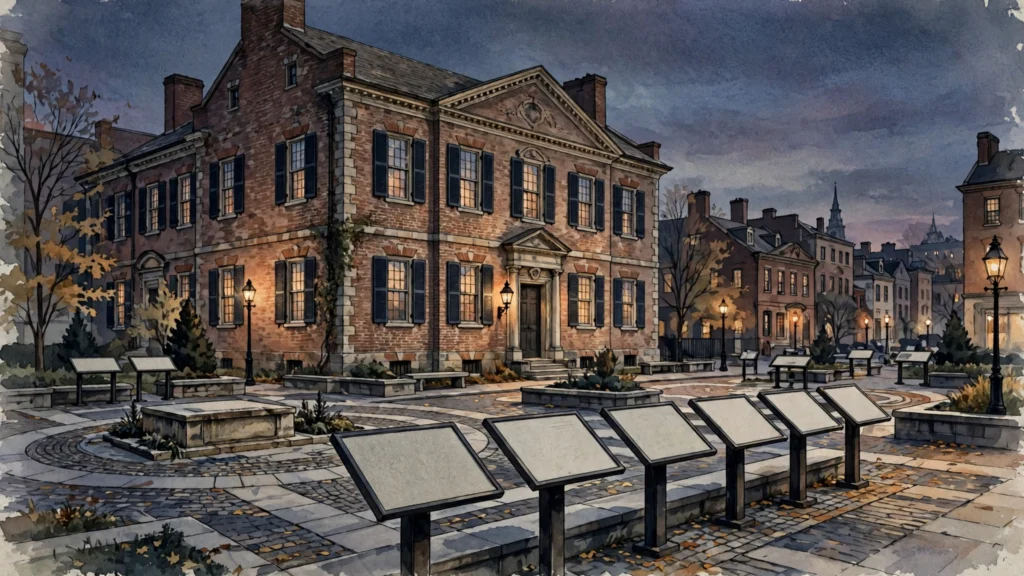
The President's House stands at Sixth and Market streets in Philadelphia, on the site of the nation's first executive mansion, where George and Martha Washington lived in the 1790s, when Philadelphia was briefly the nation's capital. The open-air memorial and its exhibit, "President's House: Freedom and Slavery in the Making of a New Nation," opened in 2010 and confronts the contradiction between the nation's founding ideals of liberty and freedom and the reality of slavery.
The exhibit told the stories of nine people enslaved by the Washington family: Austin, Christopher, Giles, Hercules, Joe, Moll, Ona Judge, Paris, and Richmond. Its glass panels and motion-activated videos described their lives, their work in the presidential household, and the hardships they faced, including the physical and sexual violence inflicted on enslaved people. The memorial was the product of years of advocacy by the Avenging the Ancestors Coalition, which pushed for the site to be marked and helped create the exhibit.
According to the coalition, the President's House is the only place in Philadelphia where Black people were enslaved on government property, which is why the group says the completeness of the exhibit matters so much. For visitors, the site is one of the few places in the city's historic district where the story of the founding is told alongside the story of the people who were enslaved while it happened, in the very house where the first president lived.
A Year of Removals and Court Rulings
The dispute began on January 22, 2026, when the National Park Service dismantled portions of the exhibit, removing educational and interpretive panels and shutting off interactive displays. In all, the administration removed 34 panels from the Old City site without warning, according to local reporting, and the motion-activated videos that had told visitors the stories of the nine enslaved people went dark.
The City of Philadelphia challenged the removal in a lawsuit filed in January, and a federal judge issued a preliminary injunction in February ordering the administration to restore the exhibits. For a time, that order halted the changes. But in June, the United States Court of Appeals for the Third Circuit vacated the injunction and allowed the administration to install new educational panels, and on July 3 a federal judge ruled that the Park Service could proceed with the new displays. The 11 new panels went up overnight on July 14.
The city's case is still pending in the district court, and the new lawsuit is separate from it. Where the city challenged the removal itself, the advocacy groups are now challenging the replacement exhibit as well, arguing that the new panels are not a restoration of the memorial but a rewrite of it. The distinction matters because the appeals court's ruling addressed whether the original panels had to be put back, not whether the new ones tell the story accurately or lawfully.
The Trump Administration's Executive Order
At the center of the case is an executive order signed by President Donald Trump in March 2025, titled "Restoring Truth and Sanity to American History." The order directed Interior Secretary Doug Burgum to evaluate whether monuments and memorials portray a "false reconstruction of American history" or include "improper partisan ideology," and it called for federally owned or controlled historic sites to stop displaying information that would "disparage Americans past or living" and to focus instead on "the greatness of the achievements and progress of the American people."
The lawsuit describes the order as part of a broader effort by the trump administration to censor, erase, destroy, and rewrite certain aspects of American history, especially with respect to Black people in the United States. The complaint alleges that the administration has targeted historical and cultural sites that contain information about Black people, slavery, and the civil rights movement, while leaving untouched monuments and displays that detail the contributions of White people.
That broader pattern is part of the public record. The administration's executive orders have led to pressure on museums, the dismantling of slavery exhibits, and the restoration of Confederate statues, among other moves, and the President's House is only one of the sites where the new approach to federal history has been put into practice. The lawsuit argues that the pattern itself is evidence of the administration's intent, and that the changes at the President's House cannot be understood as a neutral curatorial decision.
What the New Panels Leave Out
The heart of the complaint is a detailed comparison between what the exhibit used to say and what it says now. The new exhibits diminish the harms of enslavement, the plaintiffs allege, by prefacing the biographies of Washington's slaves with a sanitized version of how the former president treated them. The majority of the information removed or altered by the administration detailed the harms of slavery, and the new exhibits omit any reference to the physical and sexual violence Washington's slaves were subjected to.
The original exhibit featured descriptions of those hardships as a central part of the story, not as a footnote. The lawsuit claims that the replacement panels watered down or completely omitted those descriptions, leaving visitors with an account in which the violence of slavery is softened out of the picture. The new panels, the complaint says, dilute and de-emphasize the original meaning of the exhibit, replacing a frank account of enslavement with a gentler narrative.
The Legal Arguments
The lawsuit rests on two main legal claims, and both go beyond the question of whether the new panels are accurate. The first is that the administration's actions violate the Administrative Procedure Act, which requires federal agencies to act on a reasoned basis and within the bounds of the law. The plaintiffs argue that the removal and replacement of the exhibit conflicts with Congress's mandate that national monuments and similar sites promote and protect their natural, historic, and cultural resources, and that the Interior Department acted arbitrarily and capriciously in dismantling a congressionally recognized memorial without a lawful basis.
The second claim is constitutional. The plaintiffs argue that the changes violate the Equal Protection component of the Fifth Amendment, which bars the federal government from denying any person the equal protection of the laws. Their argument is that the selective removal of Black history from a federal historic site, while displays honoring White Americans are left alone, amounts to a denial of equal treatment, and that the erasure of Black history from the public record is itself a constitutional injury.
The two claims work together. The administrative claim asks the court to judge the process: whether the agency followed the law, explained its decision, and respected the mandate Congress set for the site. The constitutional claim asks the court to judge the pattern: whether the administration is singling out Black history for removal in a way the Constitution forbids. If the court accepts either argument, it could set aside the Interior Department's actions and order the memorial restored.
What Happens Next
The case is now before the United States District Court for the Eastern District of Pennsylvania, where it will proceed alongside the city's earlier lawsuit, which remains pending. The complaint was filed on Monday, and the court's next steps, including any schedule for briefings or a hearing, have not yet been set out in public filings. The plaintiffs have asked for the Interior Department's actions to be set aside and for the administration to be barred from enforcing the executive order, relief that, if granted, would return the memorial to its original condition.
For now, the replacement panels remain in place, the original glass panels remain unrestored, and the videos remain off. Visitors to the President's House this week will see the exhibit as the administration left it, and the question of whether that exhibit is lawful will be decided in the months ahead. The outcome will determine not only what the memorial says about the nine people enslaved by the Washingtons, but how much of American history the federal government is allowed to rewrite at the sites where that history happened.
Source: Associated Press