Trump Administration Offshore Wind Crackdown Hits Ports
The trump news today from the New England coast is a story about a boom that ran out of road. In New London, Connecticut, the trump administration’s campaign against offshore wind has collided with a port city that bet heavily on the industry. Connecticut borrowed more than $211 million to rebuild its state-owned pier for offshore wind turbines, and Orsted put in another $100 million with the local utility Eversource — more than $300 million in all. Today, the last project is due to finish next year, no tenant is lined up to replace it, and the workers who found good pay on the docks are scattering to other jobs.
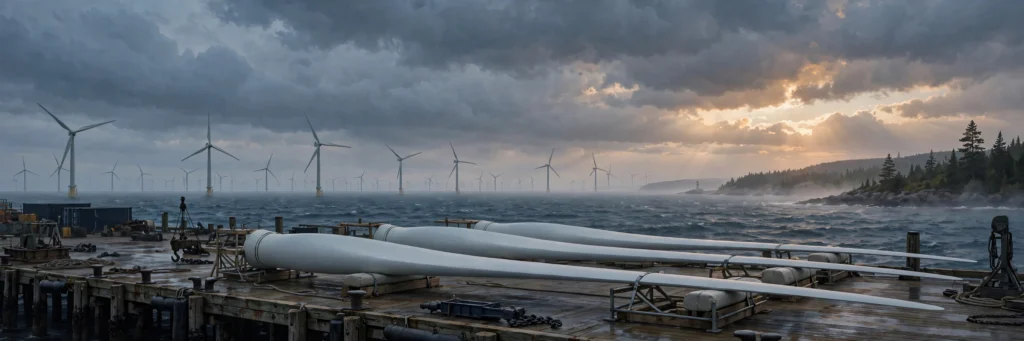
For four years, ships carried turbine blades as long as a football field into New London, where hundreds of workers loaded and unloaded equipment bound for Orsted projects. The port handled three consecutive Orsted projects, and the final one is expected to be completed next year. After that, the work simply stops. New London’s mayor, Michael Passero, once said the future of the port looked limitless. Before the wind work, the city had struggled to attract business to a pier competing with much larger ports in New York and Boston, and the dock was often used to store road salt. The city may now have to go back to chasing cargo business.
White House news: the crackdown that stalled an industry
The reversal did not happen by accident. Within days of returning to office in January 2025, President Donald Trump moved to halt offshore wind work, temporarily ordering five projects to stop construction. Federal courts later allowed the developers to resume, but the administration has kept up the pressure: it has frozen future offshore wind development, blocked or sought reviews of permits, and is paying some developers billions of dollars to give up their leases. The Interior Department recently asked a court for permission to reconsider a key permit for Revolution Wind, one of the projects previously ordered to stop — even though the farm is already operating.
The administration has defended its approach, with the Interior Department describing offshore wind as an expensive and unreliable source of energy, and saying the previous administration encouraged companies with the promise of taxpayer subsidies.
The industry was already under strain before Trump returned to office. Developers were contending with rising construction costs, supply chain shortages, and opposition from coastal communities worried about marine ecosystems and sea views. In 2023, Orsted pulled out of two projects off New Jersey, citing rising interest rates and supply problems. The Trump administration’s actions landed on an industry that was already fragile. The previous administration had set a goal of deploying 30 gigawatts of offshore wind power by 2030, and the ports of New England were built up to deliver it.
Trump news: the projects that survived — and the ones that did not
Orsted’s South Fork Wind, the first of the big projects, began sending power to the grid in 2023. Two of the five major projects that Trump tried to stop have now reached full commercial operation. On October 29, the $4 billion, 800-megawatt Vineyard Wind project, some 15 miles off Martha’s Vineyard, became fully operational. On November 5, the 704-megawatt Revolution Wind project followed, sending power to Rhode Island and Connecticut. Together, Revolution Wind and Sunrise Wind are being built to power about one million homes across Rhode Island, Connecticut and New York.
Vineyard Wind was the first large offshore wind farm fully permitted by the federal government, and its developer said the project directly employed more than 3,700 full- and part-time workers, most of them from Massachusetts, over eight years of development and construction. At the height of construction, as many as 300 union members worked onshore in southeastern Massachusetts. Still under construction, and due to reach commercial operation in 2027, are the 924-megawatt Sunrise Wind project and the two-gigawatt Empire Wind project off New York, and the 2.6-gigawatt Coastal Virginia Offshore Wind project.
The administration has frozen future development, including proposed projects that could power as many as 1.7 million New England homes. The work now under way is the tail end of a wave approved years ago, and when the current projects are finished there is little behind them. That is the crux of the problem for the ports: the piers, factories and trained workforces were built for a pipeline the administration is determined to close off.
Donald Trump latest news: “I will not approve wind turbines”
The latest Donald Trump news on energy came at a press conference, where the president said he supported a bipartisan bill to speed up energy development — but not if it helped wind power. Asked whether he was comfortable with the bill applying to wind projects, he said he would not approve wind turbines, adding that wind turbines are a major loser. The remark captured the administration’s position: even legislation meant to accelerate American energy projects will not get his backing if it leaves room for offshore wind.
The bill in question is the Bipartisan American Affordability and Jobs Act, a 494-page measure that would streamline federal permitting for energy and infrastructure projects. The Senate took a small bipartisan step toward passing it on November 11, and the president’s comments have complicated its path. Trump has made clear he wants the legislation to forbid wind power in the United States, something its supporters say will not happen. The result is a standoff: a permitting bill the president says he supports in principle, held up by his insistence that it exclude an entire industry.
The episode shows how far the politics of wind power have travelled. What was once a bipartisan infrastructure story — ports, factories and union jobs in coastal states — has become a fault line in US politics, with the president openly campaigning against the turbines themselves. Two of the five projects he tried to kill have now entered full commercial operation. The administration points to the empty factories and quiet piers as proof the industry cannot survive without the subsidies and approvals it is withholding.
Congress: a permitting bill caught in the middle
Congress now holds the next move. The permitting bill’s backers in the Senate want a final vote, and the president’s demand that wind be written out of it is the main obstacle. If the bill passes with wind included, Trump must choose between signing legislation that helps an industry he has vowed to stop and vetoing a measure his own party’s energy agenda depends on. The same rules govern transmission lines, pipelines and power plants, and supporters say the delays cost jobs and raise energy prices. Whatever Congress does with the bill, the administration’s freeze on future offshore wind development remains in place, and the Interior Department’s request to revisit Revolution Wind’s permit shows it is still looking for ways to claw back ground even on projects that are already operating.
Trump administration crackdown: the workers left behind
The human cost of the slowdown is clearest in the port cities. In New Bedford, Massachusetts, a historic whaling and textile centre, the state spent $140 million on an offshore wind pier. As recently as last winter, hotels, offices and piers were busy with offshore wind workers. Local businesses won contracts serving the industry, and longshoremen found work handling barges and turbine components. Now the terminal that employed workers assembling turbine components is quiet, and the next developer expected to use the pier has delayed its project indefinitely.
For longshoreman Onix Vazquez, the work brought a substantial increase in pay. He had struggled to find steady, well-paid work before the project began hiring through his union. His hourly wage rose to $50, nearly double what he had earned unloading occasional shipments of tangerines and juice concentrate. But the wind work has ended, and Vazquez now has a seasonal job in the cranberry industry, earning less than he did at the port. He said the politicians who decided the industry’s fate do not see that it affects the people who work the projects. Kevin Rose, president of the city’s longshoremen union, said most of the members have to get other jobs for now or collect unemployment. About two dozen union members worked on the project.
The slowdown has also reached the region’s fishermen, whose relationship with offshore wind is complicated. Many in New Bedford’s fishing industry oppose wind development because they fear it will disrupt fishing grounds. At the same time, catch limits can keep boats tied up for much of the year, and offshore wind work has offered some crews another source of income. Over several years of construction, Vineyard Wind paid about $11 million to 55 fishing vessels from New England and an estimated 60 to 70 fishermen, for work supporting the construction. Patrick Walsh, a fifth-generation fisherman, said the scallop boats need the extra revenue, and that the worst thing for a boat is to sit idle. Walsh said wind work helped him buy his first house, and he plans to return to his father’s fishing business when the offshore work ends.
The same pattern is visible elsewhere along the coast. In Providence, Rhode Island, a recently built factory for wind turbine foundations sits empty. In Somerset, Massachusetts, the story is older. In July 2022, then-President Joe Biden stood at the ruins of a coal-fired power plant at Brayton Point and praised Italian cable manufacturer Prysmian’s plan to build a factory there. The project was expected to create 250 jobs making undersea power cables. Four years later, the factory has not been built. Tall grass and weeds cover the lot where Biden spoke, and Prysmian has abandoned its plans, citing long-term trends in the American market.
What happens next for offshore wind
For the communities that invested in ports, factories and training, the question is whether offshore wind will return at a scale that can sustain the jobs built around it. For the moment, empty terminals, idle factories and unfilled waterfront sites stand where officials once anticipated years of construction and employment. New London’s pier will finish its last project next year, and the city has no tenant lined up to replace it.
What happens next depends on three things. The first is the courts: the Interior Department’s request to reconsider Revolution Wind’s permit will test whether the administration can unwind approvals for projects that are already operating. The second is Congress: the permitting bill’s fate will show whether lawmakers can separate faster energy approvals from the president’s opposition to wind. The third is time: the projects now under construction will be finished by 2027, and after that there will be almost nothing left to build unless the freeze is lifted. Until one of those three things changes, the ports of New England will keep waiting — and the workers who built the wind farms will keep finding other work.
Source: Rhode Island Current