Trump Administration Expands Anti-Cartel Campaign
The trump administration is widening its military campaign against Latin American drug cartels even as the legal challenges to that campaign keep mounting. On Saturday, November 21, President Donald Trump gathered a dozen Latin American and Caribbean leaders at his golf resort in Doral, Florida, to launch a new regional security alliance aimed at the cartels, urging the governments in the room to use military force against trafficking groups and pledging American firepower to back them up. The summit was the diplomatic face of a campaign that has already killed more than 240 people in over 70 strikes on suspected drug boats since September 2025, according to an Associated Press tally in late October — and that is now being tested in a Boston courtroom, in the Senate, by the Pentagon's watchdog, and by United Nations experts who call the strikes unlawful killings.
The expansion and the pushback are moving in parallel. In the same weeks that the White House has built a 17-country military coalition and talked openly about taking the fight from the sea to land targets, the families of two men killed in an October strike have filed the first wrongful-death lawsuit against the campaign, senators from both parties have tried to force a vote on the war powers question, and the administration has sanctioned the entire International Criminal Court. What began as boat strikes in the Caribbean is now a hemispheric campaign with no declared end point and no congressional authorization.
Pentagon News: The Shield of the Americas Summit
The clearest sign of the expansion came at Trump National Doral Miami on November 21, where Trump opened the first Shield of the Americas summit with the leaders of Argentina, Bolivia, Chile, Costa Rica, the Dominican Republic, Ecuador, El Salvador, Guyana, Honduras, Panama, Paraguay and Trinidad and Tobago. The gathering was designed to show that the White House still sees Latin America as a strategic priority even while a war with Iran — joined with Israel about a week earlier — dominates American foreign policy. After speaking at Doral, Trump flew to Dover Air Force Base in Delaware for the dignified transfer of six American troops killed in a drone strike in Kuwait, one day after the Iran campaign began.
At Doral, the main thrust was a harder anti-cartel line. Trump encouraged the regional leaders to take military action against drug trafficking cartels and transnational gangs that he says pose an unacceptable threat to the hemisphere's security, and the White House released a proclamation tying the event to a new Americas Counter Cartel Coalition, which it said includes military representatives from 17 countries. Trump told the gathering the heart of the agreement was a commitment to using lethal military force against the cartels, and said the United States would deploy precision missiles if partner nations asked.
The summit also produced news on two other fronts. On Cuba, Trump said the island's government was very much at the end of the line, that Havana wanted to negotiate with Washington, and that great change will soon be coming to Cuba, adding that his administration would turn its attention to the island after the war with Iran. On Venezuela, Trump said his administration had formally recognized the interim government of Delcy Rodriguez, after a United States operation earlier this year captured Venezuela's then-president, Nicolas Maduro, and flew him to the United States to face drug conspiracy charges.
White House News: From Sea Strikes to Land Operations
The coalition is the latest stage of a campaign that began at sea. On September 2, 2025, the United States military carried out its first lethal strike on a vessel the administration said was a drug-carrying speedboat from Venezuela, killing 11 people on board in the Caribbean. Since then, American forces have struck suspected smuggling boats across the Caribbean Sea and the eastern Pacific in a campaign the administration calls Operation Southern Spear. An Associated Press tally in late October put the death toll at at least 240 people in more than 70 strikes, and the attacks have continued since, expanding from the Caribbean into the eastern Pacific as traffickers shifted routes.
The administration has framed every strike in the same language. Southern Command announces each operation as a lethal kinetic strike, says intelligence confirmed the vessel was engaged in drug smuggling, and describes those killed as narco-terrorists. The Pentagon typically releases a short video of the boat being destroyed but does not disclose the identities of those killed, the vessel's flag, or the intelligence behind the targeting. Two survivors of earlier strikes were repatriated to Ecuador and Colombia without being charged, according to Reuters — a detail that feeds the central question over the campaign: how does the government know, before it fires, that the people on a small boat are traffickers rather than fishermen going home?
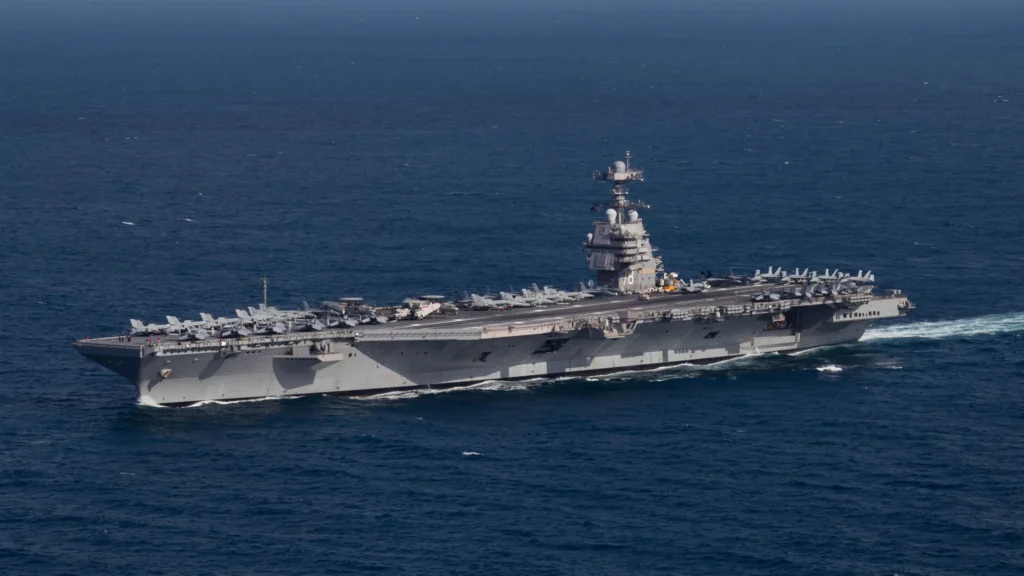
Trump has now signalled that the sea campaign is only the first phase. In a recent interview on Fox Business, he said naval operations had already reduced drug flows by 33 percent and announced plans for expanded land-based strikes against the cartels, telling the interviewer that if you hit them on land, they go to the boats, and now we are going to hit them on land, very hard. Defense Secretary Pete Hegseth has confirmed that Washington is exploring ground operations in Latin America, and the administration has not provided a timeline, although Trump has previously suggested the operations could extend into Mexico, where the cartels operate with near impunity. The military buildup behind the threat is already visible: the USS Gerald R. Ford carrier strike group has been deployed to the Caribbean, accompanied by B-1 bombers, F/A-18 fighter jets and missile-equipped destroyers, and the administration has also sent F-35 fighter jets to Puerto Rico.
Trump Executive Orders: The Legal Framework Behind the Strikes
The legal foundation for the campaign was laid on the first day of Trump's second term, when he issued Executive Order 14157 designating major Latin American cartels as Foreign Terrorist Organizations, reclassifying them from criminal enterprises to national security threats. On February 5, 2025, Attorney General Pam Bondi followed with a memorandum titled Total Elimination of Cartels and Transnational Criminal Organizations, directing the Justice Department to reorient its charging priorities and expand its cartel task forces. The Justice Department has since widened the law-enforcement side of the fight, probing banks over cartel ties and charging five senior United Cartels leaders in August 2025 under the terrorist designation, the first such prosecution.
The most consequential legal step came in an October 2, 2025 notice to Congress, in which the administration said it had designated Venezuelan drug cartels as terrorist organizations and determined that their actions constitute an armed attack against the United States. In a memorandum obtained by the Associated Press, the administration declared that the United States is in a non-international armed conflict with the cartels, labelled alleged smugglers unlawful combatants, and argued that cartel trafficking amounts to an armed attack justifying lethal force in self-defense. Pentagon officials notified Congress but could not provide lawmakers with a list of the designated organizations, a gap that frustrated the senators briefed. The memo's reasoning is the hinge of the entire campaign: if the United States is legally at war with the cartels, then cartel members can be targeted like enemy soldiers, without arrest, charge or trial. If it is not, then the strikes are killings outside any armed conflict, governed by law enforcement rules that require evidence and due process.
That distinction is why the administration's refusal to share its full legal reasoning has become a fight in itself: lawmakers have pressed the White House to produce the classified legal opinion behind the strikes, and a bipartisan Senate briefing was abruptly cancelled, then rescheduled, leaving many questions unanswered. Secretary of State Marco Rubio defended the strikes during a Senate hearing in June, saying the Defense Department had determined their legality. But the administration has not sought formal congressional authorization, has not defined the campaign's scope, duration or rules of engagement, and has not explained how far the armed-conflict theory extends.
Congress: The War Powers Fight
Congress has not accepted the administration's legal theory quietly, and the fight over war powers is now one of the central political battles of the campaign. In October, Senate Republicans blocked a Democratic effort, joined by two Republican senators, to stop the president from launching additional strikes on boats in the Caribbean. Republican Senators Rand Paul of Kentucky and Lisa Murkowski of Alaska joined all but one Democrat in voting to invoke the War Powers Resolution of 1973, the Vietnam War-era law meant to rein in a president's ability to launch attacks without congressional approval. The resolution failed, and the strikes continued, but the vote exposed a split inside the Republican Party over a president whose America First agenda promised to keep the United States out of foreign entanglements.
Paul has been the most outspoken Republican critic, saying the United States cannot simply kill people without having some kind of process. Vance has defended the strikes in blunt terms, posting that killing cartel members who poison our fellow citizens is the highest and best use of our military, and replying to a commenter who raised war crimes concerns that he did not care what you call it. Representative Michael Baumgartner, a Republican on the House Foreign Affairs Committee, has said there has to be congressional oversight and authorization in major foreign policy actions. Representative Adam Smith of Washington, the top Democrat on the House Armed Services Committee, called the attacks an abuse of presidential authority that risks dragging the country into another endless war.
The Wrongful-Death Lawsuit: Legal Challenges Mount
The most direct legal challenge arrived in a federal courtroom in Boston on Tuesday, January 27, 2026, when the families of two Trinidadian men killed in an October strike sued the United States government for wrongful death and extrajudicial killings — the first such lawsuit against the campaign, and the first time a judge will test whether the strikes have any lawful basis at all.
The two men were Chad Joseph, 26, and Rishi Samaroo, 41, killed on October 14 when an American missile struck their boat as they travelled from Venezuela to Trinidad. Their families say the men had been fishing off the Venezuelan coast and working on farms there, and were returning home to Las Cuevas in Trinidad and Tobago. Neither family was notified of the deaths, and both held memorial services only after the men failed to return. Joseph's mother, Lenore Burnley, and Samaroo's sister, Sallycar Korasingh, are suing on behalf of the surviving family members.
The lawsuit was filed by lawyers from the American Civil Liberties Union, the Center for Constitutional Rights, and Seton Hall Law School professor Jonathan Hafetz, along with the ACLU of Massachusetts. It argues that the October 14 strike violated two federal statutes: the Death on the High Seas Act, which allows family members to sue over wrongful deaths that occur more than three nautical miles from the United States, and the Alien Tort Statute, a 1789 law that allows foreign nationals to sue in American courts over violations of international law. The complaint calls the killings premeditated and intentional, says they lack any plausible legal justification, and argues they were simply murders ordered at the highest levels of government, carried out without congressional authorization and with no military conflict that could justify them under the laws of war. The suit seeks damages, not an injunction, but its lawyers say it also aims to prevent more strikes by persuading a court to reject the administration's claims about its authority. A Pentagon spokesperson said the department does not comment on ongoing litigation, and the White House said the October 14 strike was conducted against designated narcoterrorists bringing deadly poison to American shores. At the time the lawsuit was filed, the death toll from the strikes stood at at least 126 people in 36 strikes since September, a figure that has since nearly doubled.
Beyond the Boston case, Human Rights Watch, Amnesty International and independent United Nations experts have called the strikes unlawful extrajudicial killings, and the UN Special Rapporteur Ben Saul has said there are reasonable grounds to believe the pattern of attacks could constitute crimes against humanity — a legal assessment, not a court judgment. The administration has also sanctioned the entire International Criminal Court, after legal experts warned the strikes may fall under its jurisdiction. A second episode has become a focal point for critics: according to reports about the first strike on September 2, 2025, two men who survived the attack that killed nine others were allegedly killed by a second strike while clinging to the wreckage. The White House defended the follow-up strike as self-defense. The Pentagon's own watchdog is now reviewing the targeting procedures used in the operations.
What Happens Next
The immediate question is whether the campaign moves from the sea to the land, and on what legal basis. Trump has said the land strikes are coming, Hegseth has confirmed they are being explored, and the Doral coalition gives the administration partner governments that could host or support them. But strikes on targets inside another country's territory, without its consent or congressional authorization, would test the armed-conflict theory far more severely. Mexico has opposed American military intervention on sovereignty grounds, and Colombia's president has condemned the boat strikes as illegal and ineffective. In Ecuador, where American forces train local troops, the administration has suspended joint operations while it investigates whether Ecuadoran forces committed abuses during a September 23 raid.
The courts will also have their say. The Boston lawsuit will move through discovery in the coming months, and it could force the government to produce, in court, the legal justification it has declined to share with Congress. And Congress itself is about to change hands: Democrats, who won control of both chambers in the midterms, take over on January 3, 2027, with subpoena power and a majority on the committees that oversee the Pentagon.
For now, the campaign continues on both tracks at once: the strikes go on, the coalition grows, and the talk of land operations gets louder, while the lawsuits, the war powers fight, the watchdog review and the international criticism accumulate. Trump calls his approach a modern version of the Monroe Doctrine, a doctrine he proudly calls the Donroe Doctrine. Whether the courts, Congress and the country's partners accept that doctrine — or whether the campaign's expansion is checked by the legal challenges mounting against it — will define the next phase of the war on the cartels.
Source: Associated Press