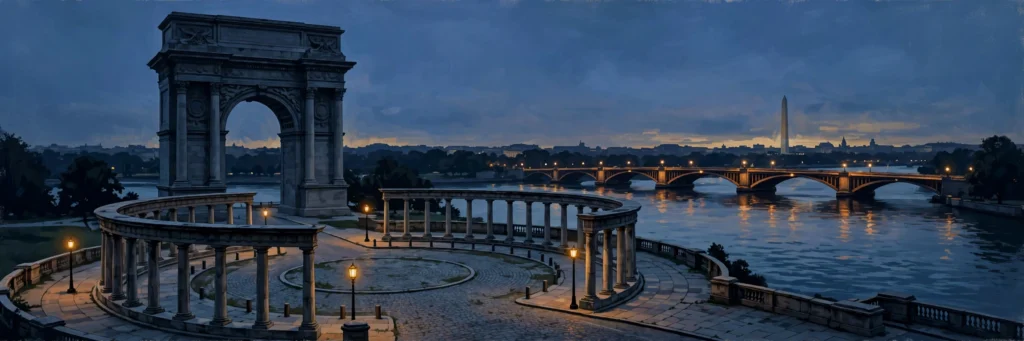
Trump Administration Arch Faces Court Halt Threat
A federal judge in Washington has signalled that she may stop the trump administration from starting work on a planned 250-foot triumphal arch on the banks of the Potomac River, turning one of President Donald Trump’s most personal building projects into a test of presidential power. United States District Judge Tanya Chutkan heard arguments on Friday, October 30, on a request for a preliminary injunction that would bar any construction steps at Memorial Circle until the underlying lawsuit is decided. The hearing came less than a week before the date on which the government says work could begin. In us politics, where disputes over executive authority have become a recurring feature of this presidency, the arch case is distinctive because it is not about a policy or a spending decision. It is about a monument: a stone structure, 100 feet taller than the Statue of Liberty measured from its base to the top of its torch, proposed for the western end of the Arlington Memorial Bridge, between Arlington National Cemetery and the Lincoln Memorial.
The plaintiffs are three Vietnam War veterans, Jon Gundersen, Michael Lemmon and Shaun Byrnes, together with a retired architectural historian, Calder Loth. Their argument is that the arch cannot lawfully be built without the approval of Congress. The government disagrees, and the disagreement goes to who gets to decide what is built on federal land that carries national memory, and whether a president can reshape the ceremonial landscape of the capital on his own authority. That is why Friday’s hearing drew attention well beyond the small group of plaintiffs, and why the judge’s sceptical questioning was reported as a signal, even though no ruling had been issued when the hearing ended. A signal is not a decision, and it would be wrong to report it as one. But where construction could start within days, the tone of the hearing matters, and both sides left knowing that the next move belongs to the judge.
Trump Administration: What Judge Chutkan Signalled
The hearing was about an injunction, not a final verdict. The plaintiffs asked Judge Chutkan to prohibit the administration and the National Park Service from taking any steps to construct, or to direct or facilitate construction of, any structure in Memorial Circle, absent congressional authorisation, while the litigation continues. An injunction of that kind would not decide the case for good. It would freeze the position until the court can rule on the competing claims in full. The plaintiffs’ case for urgency rests on a practical point: once a foundation is dug and stone is raised, a later court victory may come too late to matter. In their filing, they argued that the public interest leans heavily against allowing the defendants to blaze ahead, so the project does not become a fait accompli before the court has made a final determination. A monument is not like a regulation that can be withdrawn with a signature. Once built, it tends to stay.
Judge Chutkan pressed the government’s lawyer, Robert Stander of the Justice Department, on the claim that the arch is necessary for national security. The claim has drawn attention because the president has previously described the arch as a project that might also include national security functions, such as drones and snipers. At the hearing, the judge questioned how a triumphal arch, a ceremonial structure, could be justified on security grounds. The plaintiffs’ position is that the security argument does not cure the absence of congressional approval, and that a court should not accept a label in place of a legal basis. The judge’s scepticism is the reason the Washington Post’s headline said she signalled she may halt construction. Scepticism is not a ruling, and she could still deny the injunction, grant it in full, or grant a narrower order. But a judge who is sceptical of the government’s central justification is taking the plaintiffs’ request seriously, and that alone changes the atmosphere around a project that had appeared to be moving steadily towards a start date.
The timetable added to the urgency. The National Park Service and the Executive Office of the President filed a notice saying they planned to possibly begin construction as early as November 5, pending approval by the National Capital Planning Commission, which meets that day to consider final approval of the site and building plans. Construction could begin once that approval was finished, the Interior Department issued a final decision authorising construction, and the proper notification was published. The plaintiffs’ filing, made the day after that notice, said the notification makes clear that the defendants have no intention of awaiting the court’s decision and have every intention of imminently beginning construction. That clash, a court case still undecided and a construction schedule already set, is precisely the situation in which courts are asked to grant preliminary injunctions.
Congress and the Authorisation Question
At the heart of the case is a legal dispute that is easy to state and hard to resolve. The plaintiffs contend that the project needs separate congressional authorisation under the Commemorative Works Act and under a federal statute governing the planning of the national capital, 40 U.S.C. section 8106. Those laws, in their reading, reserve decisions about new commemorative works on federal land in the capital to Congress, acting through a defined process of consultation, review, and approval. A triumphal arch at Memorial Circle, they argue, is exactly the kind of work those laws were written to govern. The Justice Department takes the opposite view. It argues that the plaintiffs lack standing to bring the case at all, and that a law from 1925 authorising the Arlington Memorial Bridge also supports the arch. On that reading, the arch is not a new, freestanding work requiring fresh approval, but a structure connected to an already authorised bridge and memorial complex. The court has not resolved those competing arguments, and Friday’s hearing did not produce a final answer. It produced a preview of how the judge is thinking about the balance of harms, which is what a preliminary injunction hearing is designed to do.
Congress, as an institution, has not voted to authorise this arch. The project has, however, received early approval from the United States Commission of Fine Arts, whose members were all appointed by President Donald Trump. That approval is a step in design review, but it is not a substitute for a congressional vote, and the plaintiffs’ case depends on keeping that distinction clear. Supporters of the project, including organisations that have filed briefs opposing the injunction, argue that the review process has been followed and that the arch should proceed. Opponents, including the American Institute of Architects and the National Trust for Historic Preservation, which have filed a brief supporting the injunction, argue that the National Park Service ignored federal law and public opposition. The Park Service’s own updated review, according to reporting on the case, identifies an adverse impact on at least one historic property, a finding the plaintiffs say strengthens their argument that the project has not been properly assessed.
There is also a second lawsuit. The Arlington County Board in Virginia filed a lawsuit earlier in October opposing the construction, becoming the first governmental body to take legal action against the planned monument. That case raises its own arguments about the project’s impact on the county and the region, and it runs alongside the veterans’ case rather than merging with it. The existence of two separate challenges suggests that opposition to the arch is not confined to a single interest group. It also means that even if one case were resolved in the government’s favour, the other could still delay or block the project.
Memorial Circle: A 250-Foot Project on a Sensitive Site
The physical facts help explain why the project has provoked such strong feeling. The arch is planned to be 250 feet tall, or about 76 metres. It would dominate Memorial Circle, a traffic circle at the gateway between Virginia and the District of Columbia. The site is not an empty plot. It sits between Arlington National Cemetery, where American service members are buried, and the Lincoln Memorial, one of the most visited monuments in the country. The plaintiffs, three of whom served in Vietnam, argue that an arch looming over the gravesites of Arlington would dishonour their service, a claim that goes beyond legal technicalities and touches the emotional meaning of the place. Supporters see it differently, as a fitting tribute and a landmark for the capital. The court, however, is not being asked to choose between those visions. It is being asked whether the law permits the project to proceed, and whether it should be allowed to proceed before that legal question is answered.
The construction timetable, as described by the government, is long, which cuts both ways. The government says the first six to eight months would involve below-ground excavation and foundation work, that above-ground construction is not expected before May 2027, and that the projected total schedule is 33 to 39 months, with completion projected around 2030. Supporters could argue that there is no immediate emergency, because no arch will rise overnight, and a court ruling on the merits could still come in time to matter. The plaintiffs answer that excavation and foundation work are themselves construction, that they would alter the site irreversibly, and that once a foundation is in the ground, the pressure to finish the structure becomes overwhelming. The judge will have to decide which reading of the timetable is more persuasive, and whether the harm of delaying a lawful project outweighs the harm of allowing an unlawful one to take root.
The review history adds another layer. The National Capital Planning Commission approved preliminary plans in July and requested more information before final review. Its project page lists November 5 for consideration of the final plans, and shows no decision recorded as of the reporting before Friday’s hearing. That means the commission has not yet given the final go-ahead, even though the government has signalled that construction could start on the same day as the commission’s meeting, if the other conditions are met. Commission approval, Interior Department authorisation, and Park Service notification would all need to fall into place for work to begin on November 5. If any one of them is delayed, or if the court intervenes, the start date slips.
US Politics: Why the November 5 Date Matters
The arch case is unfolding in the final days before the midterm elections on Tuesday, November 3, when voters will decide control of Congress, and in the same federal courthouse where, on the same Friday, another case about the president’s plans for the capital was also being heard. That second case concerned a historic public golf course near the National Mall, which the administration wants to shut down and reconfigure, with construction expected to begin on November 15. In that case, Judge Ana Reyes said she would open a formal inquiry into whether administration attorneys had violated ethical boundaries. The two cases are legally separate, involving different judges, projects, and legal questions, and they should not be conflated. But together, as reported by the Associated Press, they reveal the breadth of the president’s attempts to reshape parts of the District of Columbia as he wishes, and the underlying claims about executive authority that lie beneath them.
The timing matters for a practical reason as well. November 5 is the date of the planning commission meeting, and it is the earliest date on which, under the government’s own notice, construction could begin. If the court grants an injunction before then, the project pauses, and the post-election period will begin with a legal freeze rather than a groundbreaking. If the court does not act, or denies the request, the project could begin while the underlying lawsuit is still pending, and the debate will shift from whether the arch should be built to whether a half-built arch can be stopped. That distinction is the whole point of Friday’s hearing, and it is why the judge’s signals, rather than only her eventual ruling, were reported so prominently. In a case where the next step is measured in days, not months, the direction of travel matters almost as much as the destination.
What Happens Next
The immediate next steps are clear, even if their outcomes are not. The National Capital Planning Commission is scheduled to consider final approval on November 5. The Interior Department would then need to issue a final decision authorising construction, and the National Park Service would need to publish the required notification. In parallel, Judge Chutkan must decide whether to grant the preliminary injunction. She could rule before November 5, which would settle the immediate question of whether work can start on that date, or she could rule after, in which case the commission’s decision and the court’s decision could arrive in either order. If she grants the injunction, construction steps at Memorial Circle would be barred for the duration of the litigation, and the case would proceed to a fuller hearing on the authorisation question. If she denies it, the government could proceed, subject to the planning and departmental approvals, while the lawsuit continues, and the plaintiffs could appeal the denial.
For now, the facts are these. A 250-foot arch is proposed for Memorial Circle, at the western end of the Arlington Memorial Bridge. Three Vietnam veterans and a retired architectural historian have sued, arguing that Congress must authorise it. The government argues that existing law already supports it and that the plaintiffs lack standing. A federal judge heard an injunction request on Friday, October 30, pressed the government on its national security claim, and signalled that she may halt construction. The planning commission meets on November 5, the earliest date on which the government says work could begin. Everything else, for the moment, is argument, and the court will have the next word.
Source: The Washington Post