Senate Confirmation Hearings: Cornyn Blocks Trump Pick
In the latest senate confirmation hearings news, a Republican senator stopped one of President Donald Trump's judicial nominees from advancing on Wednesday, using a long-standing Senate custom to block a lifetime appointment in his own home state. Senator John Cornyn of Texas declined to return the blue slip for T. Elliot Gaiser, the Justice Department official nominated to a federal judgeship in Dallas, which meant Gaiser could not appear at the Senate Judiciary Committee hearing scheduled to take up his nomination. Cornyn, who is in the final weeks of his Senate career after losing his primary earlier this year, said the White House had chosen a nominee with no real ties to Texas and had skipped the vetting process Texas senators have traditionally run. The standoff is the latest sign that the president's rush to fill the federal bench before Democrats take control of the Senate in January is meeting resistance from inside his own party.
The dispute is about more than one seat. With the Senate changing hands on January 3, the White House has been working through the lame-duck session to confirm as many judges as possible, and every vacancy left unfilled will fall to the incoming Democratic majority to shape instead. Cornyn's decision leaves the Dallas seat in limbo, and it puts two Texas Republicans on opposite sides of the question: Cornyn insists the White House should have consulted the state's senators and picked a Texan, while his fellow senator Ted Cruz warns that blocking Gaiser now means losing the seat altogether. The White House, for its part, says it still expects all of the president's judicial nominees to be confirmed by the end of the year. The question is whether Cornyn will bend, the White House will withdraw the nomination, or the seat will simply stay empty until the new Senate takes over.
What the Blue Slip Is — and Why It Stopped Gaiser
The tool Cornyn used is one of the Senate's oldest unwritten rules. When a president nominates someone to a federal trial court, the Senate Judiciary Committee sends a form — printed on blue paper, which is where the name comes from — to the two senators from the nominee's home state, asking whether they approve. For district court seats, the committee's custom is that a nominee does not receive a hearing unless both home-state senators return the form with their approval. A senator who withholds it can therefore stop a nomination without ever casting a vote, and without the committee ever taking up the nominee's record.
That custom exists because senators have traditionally played a central role in choosing the judges for their own states. Presidents consult home-state senators, the senators run their own screening, and the nomination that reaches the committee usually carries both senators' blessing. The arrangement is not written into the Senate's formal rules, and a committee chairman can in theory move a nomination forward over a home-state senator's objection. In practice, chairmen have been reluctant to do so for trial court seats, because the blue slip is also a matter of senatorial courtesy: every senator knows that one day they may be the home-state senator whose views are being ignored.
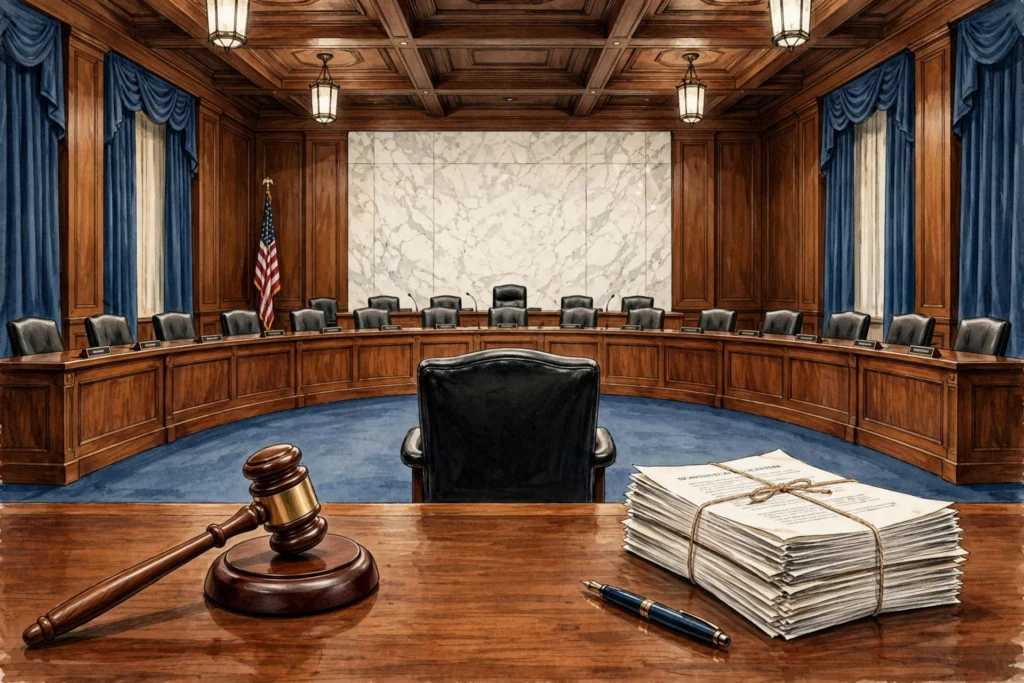
Cornyn's move fits that pattern exactly. Gaiser was nominated after the midterm election to a seat on the United States District Court for the Northern District of Texas, the court that sits in Dallas. He is 37 years old, a former Ohio solicitor general who clerked for conservative Supreme Court Justice Samuel Alito, and he currently leads the Justice Department's Office of Legal Counsel, the unit that signs off on the legality of the administration's actions. His nomination was listed for Wednesday's Judiciary Committee hearing, but because Cornyn never returned his blue slip, Gaiser did not appear. The hearing went ahead with the other nominees, and Gaiser's chair stayed empty.
The episode also underlines how much of the confirmation process depends on norms rather than laws. Nothing in the Constitution requires a president to consult home-state senators, and nothing in the Senate's standing rules requires a blue slip at all. The system works only as long as presidents and committee chairmen respect it. When a White House decides to move quickly, as this one has in the weeks since the election, the blue slip becomes the last place where a senator can insist on being heard — and Cornyn, with nothing left to lose politically, used it.
Cornyn's Case: No Texas Roots, No Vetting, No Trial Experience
Cornyn made his objections public on Tuesday, the day before the hearing, and he did not soften them on Wednesday. Speaking to reporters and to the Associated Press, he said the problem with Gaiser was simple: the nominee is not from Texas, he was never screened by the body Texas senators use to vet candidates, and the White House tried to push him through without the consultation the process requires. "He's not from Texas. He hasn't been vetted. And this is a lifetime job, and there's better qualified people to hold that job," Cornyn said. In a separate conversation with Reuters, he added that Gaiser had no trial experience and that the White House had been trying to force the nomination through without adequate vetting for a lifetime appointment.
The vetting point matters to Cornyn because Texas has its own machinery for this. The state's senators have long relied on the Texas Federal Judicial Evaluation Committee, a bipartisan panel that screens candidates for federal judgeships in the state before a nomination is made. Gaiser never went through that committee, and Cornyn has said that is a basic failure of the process, not a technicality. A federal judgeship is a lifetime appointment, and the committee exists precisely so that a nominee's record, experience and ties to the state are examined before the president's choice becomes final. Cornyn's argument is that the White House skipped that step and expected the Senate to ratify the result.
Cornyn has also said he believes Gaiser himself has been badly treated by the process. He told reporters that the nominee had been used, in his words, basically as a pawn, caught between a White House in a hurry and senators who were never consulted. That framing is notable, because it separates the nominee's personal qualities from the way he was chosen: Cornyn has not attacked Gaiser's legal ability, and he has praised other Trump nominees. His complaint is with the selection, not the man, and he has made clear that he wants the White House to pick someone else for the seat.
The alternative Cornyn has in mind is Steve Fahey, a Fort Worth lawyer and former federal prosecutor who spent nearly two decades in the United States Attorney's office for the Northern District of Texas. Cornyn has been recommending Fahey to the White House, and he said on Wednesday that the administration has requested information about him, though he does not know whether Gaiser's nomination will be withdrawn. Fahey fits the profile Cornyn says the seat requires: a Texan, with trial experience, who has already been through the state's screening process. The question now is whether the White House will accept the swap or hold its ground.
Cornyn's willingness to defy the White House is shaped by his own political position. He is a member of the Senate Judiciary Committee, and he lost his Republican primary earlier this year to a challenger backed by President Trump, Texas Attorney General Ken Paxton. He will leave the Senate in January, when he is due to be replaced by Senator-elect James Talarico, a Democrat. Speaking at an event hosted by The Atlantic on Tuesday, Cornyn said the Senate was not supposed to be a rubber stamp, adding that it had been one too often. With no election ahead of him, he has little reason to defer to a White House that backed his opponent — and every reason to insist on the Senate's prerogatives in his final weeks.
Cruz Warns the Seat Could Be Lost for Good
If Cornyn is unmoved, his fellow Texas senator is alarmed. Senator Ted Cruz warned on Tuesday that blocking Gaiser now would likely mean losing the seat entirely, because there would not be enough time for President Trump to get another nominee through the Senate before control changes hands on January 3. Cruz said it would be a tragedy not to confirm Gaiser, and that the people of Texas would pay the price, because the vacancy would effectively be handed to the Democrats, who he said would keep it unfilled indefinitely.
Cruz's argument rests on the calendar. A new nominee would need to complete an FBI background check, go through committee vetting and a hearing, and then win a floor vote, all before the Senate adjourns for the year. Cruz said the White House has been explicit that a brand-new nominee could not complete the background check fast enough to be confirmed in the time remaining. Gaiser, by contrast, already has that check complete, because he is a sitting senior Justice Department official. In Cruz's telling, he is the only candidate who could make it through in the time left, and blocking him means the seat stays open into the new Congress.
The split between the two senators was visible at Wednesday's hearing itself. Cornyn did not address Gaiser's nomination during the session, even though he sits on the committee. He did, however, speak warmly about the president's other pick for a vacant Texas judgeship: James Sullivan, the outgoing Texas Supreme Court justice who was defeated by a Democrat in the recent election and has now been nominated to a federal judgeship. Sullivan appeared at Wednesday's hearing, and Cornyn praised him for his strong Texas roots — a contrast with Gaiser that nobody in the room could have missed.
The White House has not publicly criticised Cornyn, and an administration official said in a statement that it expects all of the president's judicial nominees to be confirmed by the end of the year. That confidence may be tested in the coming days. The administration must decide whether to withdraw Gaiser and nominate Fahey, which would require Cornyn's blessing and a fresh round of vetting, or to press ahead and hope Cornyn relents. Neither path is quick, and the clock is the one thing neither side controls.
A Pattern Across the Lame-Duck Session
Gaiser is not the first of the president's late judicial picks to run into trouble with Republican senators from the nominee's home state, and the pattern is now clear enough that it looks like a deliberate message from senators who feel the White House has stopped consulting them. In Arkansas, the state's two Republican senators opposed the president's choice for a vacancy on the United States Court of Appeals for the Eighth Circuit, and the White House withdrew the nomination on November 10. The original nominee, United States District Judge Lee Rudofsky, was replaced by Arkansas Supreme Court Justice J. Cody Hiland, the candidate the two senators preferred. Hiland appeared at Wednesday's Judiciary Committee hearing alongside the other nominees.
Oklahoma has produced a similar standoff. Senator Alan Armstrong, a Republican, initially signed off on two nominees for judicial vacancies in his state — Trevor Pemberton for the Northern District of Oklahoma and Zachary West for the Eastern District — and then revoked his support for West. The reversal held up both nominations, and Senate Judiciary Committee Chairman Chuck Grassley postponed a committee vote on the two nominees that had been scheduled for Tuesday, pushing it to next Tuesday. Armstrong's hold is expected to expire when he leaves office later this month, and he is due to be replaced by Senator-elect Kevin Hern on November 30, which means the fate of the two nominations will likely rest with his successor.
The broader picture is a confirmation drive that has moved quickly but is now meeting friction at exactly the point where the Senate's traditions give individual senators leverage. The Senate confirmed its 58th judicial nominee of the president's second term on Monday evening, when Daniel Domenico was confirmed to the Tenth Circuit by a vote of 51 to 46, and more than 20 nominations are still pending. The White House's goal is to lock in as many lifetime appointments as possible before the Democratic majority takes over, when the party will control the committee, the floor schedule and the pace of confirmations. Each blue slip withheld, each vote postponed, eats into the days remaining, and the three states where Republican senators have pushed back — Texas, Arkansas and Oklahoma — are a reminder that the president's own party is not a rubber stamp either.
The dynamic also reflects the unusual politics of a lame-duck session in which many of the senators involved are leaving. Cornyn lost his primary. Armstrong is leaving at the end of the month. Other Republican senators who have raised concerns about the pace of confirmations are retiring or lost their re-election bids. Senators with nothing left to lose are often the ones most willing to assert the institution's prerogatives, and the White House's rush to fill the bench has given them a reason to do so.
What Happens Next for the Dallas Seat
Three paths are open, and none of them is straightforward. The first is that Cornyn relents and returns his blue slip, allowing Gaiser to appear at a rescheduled hearing and move to a floor vote before the session ends. That would require Cornyn to accept a nominee he has publicly described as unvetted and unconnected to Texas, and there is no sign he is willing to do so. The second is that the White House withdraws Gaiser and nominates Fahey, or another candidate Cornyn supports, and tries to move that person through the remaining days. That would satisfy Cornyn, but it would run straight into the background-check problem Cruz identified, and it would require the White House to admit that its first choice was a mistake. The third is that nothing happens, the nomination lapses when the session ends, and the Dallas seat falls to the incoming Democratic Senate to fill on its own terms.
Which path is taken will say a good deal about how the final weeks of this Congress are going to work. If the White House withdraws Gaiser, it will confirm that home-state senators still hold a veto over trial court picks, even in a lame-duck session, and other senators with objections may follow Cornyn's example. If Cornyn backs down, it will show that the pressure to fill seats before January outweighs the Senate's traditions, and the White House will have a freer hand with its remaining nominees. And if the seat simply stays empty, it will be an early sign of the stalemate to come: a Democratic Senate, a Republican White House, and a federal bench that neither side can fill without the other's cooperation.
For now, Gaiser remains the nominee, Fahey remains the alternative, and the Dallas seat remains vacant. The hearing that was supposed to advance Gaiser's nomination came and went without him, and the next move belongs to a White House that has said it expects all of its nominees to be confirmed by the end of the year. Cornyn, in his final weeks in the Senate, has made clear that he does not share that expectation — and that he is prepared to use the Senate's oldest customs to make his point.
Source: Reuters