Science News Today: Supermoon Meets Seven Sisters
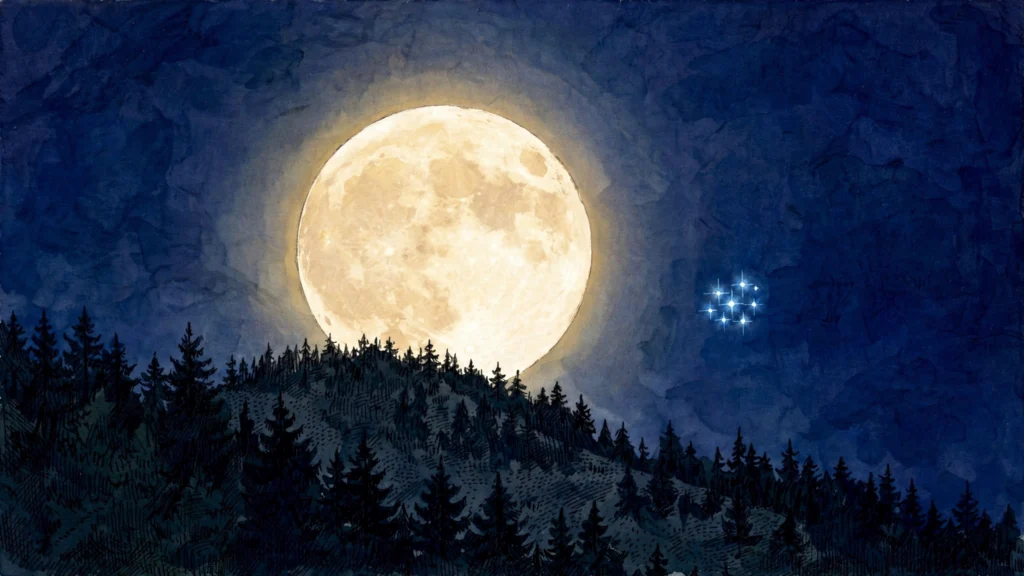
In the latest science news today, the night sky is offering a double show that will not come around again this year. The full Beaver Moon, the biggest and brightest full moon of the season, reaches its peak on Tuesday morning, November 24, and as it does, it will slide past the Pleiades, the glittering star cluster better known as the Seven Sisters. The two will be at their closest a few hours before dawn on Tuesday, when the moon passes within less than a degree of the cluster in the western sky. For skywatchers willing to step outside in the cold November air, it is the kind of pairing that makes a late-autumn night feel like an event.
The moon will be at its fullest at about 9:53 in the morning Eastern time on Tuesday, November 24, which is 14:54 UTC. At that moment, the moon will be below the horizon for viewers in the United States, so nobody in America will see the exact instant of fullness. That hardly matters. The moon will look full, or nearly full, on the nights of both Monday, November 23, and Tuesday, November 24, glowing high in the south near midnight and dropping low in the west near sunrise. The best time to catch it is around moonrise on Tuesday evening, when it climbs above the eastern horizon against the fading late-fall sky. Moonrise on Tuesday lands in the late afternoon across the country: around 4:17 p.m. in New York, 4:09 p.m. in Chicago, 4:29 p.m. in Denver, and 4:44 p.m. in Los Angeles, with slightly earlier times on Monday.
What makes this full moon special is that it is also a supermoon. The moon travels around the Earth in a slightly oval orbit, not a perfect circle, which means its distance from us changes through the month. At its closest point, called perigee, it is about 223,374 miles away. At its farthest, it is about 238,855 miles away. This month, perigee falls about 30 hours after the full phase, at 9 p.m. UTC on Wednesday, November 25, when the moon is below the horizon for central North America. Because the full moon arrives so close to perigee, it counts as a supermoon, a full moon that looks slightly larger and shines slightly brighter than an ordinary full moon. The difference is subtle to the eye, a few percent in size and brightness, but it is most noticeable when the moon is low on the horizon, where the landscape gives the eye something to compare it against, and where the moon can look enormous and turn orange or gold against the late-fall sky.
Science News Today: What Makes This Moon a Supermoon
The name Beaver Moon is the traditional name for November's full moon, one of the old monthly names that come down from the almanac tradition in North America. November is the month when beavers finish preparing their lodges for winter and trappers once set their traps before the waters froze. The name has stuck, and it now belongs to a full moon that arrives right on time for Thanksgiving week, two days before the holiday itself. On Thanksgiving night, Thursday, November 26, the moon will still be roughly 98 percent illuminated, so the holiday weekend will have a nearly full moon of its own.
The supermoon is the first in a run of consecutive supermoons stretching into early 2027. The next one, the Cold Moon, arrives on December 23 at 8:28 p.m. Eastern time, and it will be even closer to Earth than this month's, at roughly 221,667 miles away. After that comes the Wolf Moon on January 22, 2027, at 7:17 a.m. Eastern time. A run of supermoons like this happens when the timing of the full moon and the timing of perigee stay close together for several months in a row, and it gives skywatchers a season of bright moons rather than a single night.
The other half of this week's show is the company the moon keeps. This month's full moon falls in Taurus, the Bull, one of the constellations of the zodiac, and it travels across the sky near two of the most beautiful star clusters in the heavens. The first is the Pleiades, also called the Seven Sisters, a tight knot of young, hot, blue-white stars about 440 light-years away. The second is the Hyades, the V-shaped cluster that forms the face of the bull. On the evening of Monday, November 23, the bright waxing gibbous moon, only a few hours away from full, will shine near Aldebaran, the brightest star in Taurus, with the Pleiades nearby. On Tuesday, the pairing reaches its closest point.
Weather News Today: Clear Skies and the Best Viewing Times
The closest approach between the moon and the Seven Sisters comes a few hours before dawn on Tuesday, November 24, when the moon will pass just 0.9 degrees from the cluster in the western sky. That is less than the width of two full moons placed side by side, close enough that the moon will hide several of the cluster's bright stars from parts of North America as it glides through. The best moment is that pre-dawn window, not the evening, because by the time the moon is exactly full in the morning it has set for American viewers, and when it rises again at dusk on Tuesday evening it will have moved on, sitting about eleven degrees from the cluster, having been about six degrees away on Monday evening.
There is a catch, and it is the same one that comes with every supermoon. The moon's glare washes out faint stars, and the Pleiades, for all their beauty, are delicate. Under normal conditions, the stars of the cluster that can be seen with the unaided eye are Alcyone, the brightest, along with Electra, Atlas, Maia and Merope. With a nearly full supermoon sitting almost on top of them, the fainter members of the family will be hard to pick out, and the cluster may look like a small, hazy smudge rather than a jewel box. Binoculars or a small telescope make a real difference here. They cut through the glare, reveal the blue-white colour of the stars, and show the cluster's tight grouping in a way the naked eye cannot when the moon is so close. Scanning slightly away from the brightest edge of the moon also helps, because it keeps the glare out of the centre of your vision.
The weather will decide who gets to see any of it. A clear sky is the one thing no forecast can guarantee, and November weather across the United States is changeable. The good news is that the show lasts more than one night. The moon will appear nearly full on Monday and Tuesday, and it will still be bright and bold on Wednesday and Thursday, so a cloudy Tuesday does not mean a missed event. If the sky is overcast where you are, the moon will still be there the next evening, a little further from the Pleiades but still large, still bright, and still worth a look. Check the local forecast before heading out, dress warmly, and give your eyes ten or fifteen minutes to adjust to the dark before trying to find the fainter stars.
How to Find the Seven Sisters
Finding the Pleiades is easier than it sounds, and it starts with the most familiar constellation in the winter sky. Look first for Orion, the Hunter, with its three bright stars in a row forming the belt. Trace an imaginary line through the belt from left to right, and continue through Orion's bow, which will take you to Aldebaran, the orange-red eye of Taurus and the brightest star in that constellation. Keep going along the same path, and beyond Aldebaran you will find the Pleiades, a small, tight dipper-shaped cluster that looks like a tiny jewel box in the sky. On Monday and Tuesday nights, the moon will be sitting almost on top of them, so you can use the moon itself as the signpost: find the bright moon in Taurus, and the Seven Sisters will be right beside it.
The cluster has been known to every culture that has looked up. The Greeks called its stars the Seven Sisters, the daughters of Atlas and Pleione, and the name has survived for thousands of years. In Japan they are Subaru, the name now carried by the carmaker whose logo is a stylised version of the cluster. In Māori tradition they are Matariki, the stars whose rising marks the new year. The stars themselves are young by cosmic standards, only about 100 million years old, and they are surrounded by a faint blue reflection nebula, dust lit up by their light, that telescopes can capture as a soft glow around the cluster.
If you have binoculars, try sweeping the sky a little away from the moon to find the Hyades as well, the V-shaped cluster that forms the face of Taurus, with Aldebaran at one tip. The Hyades are older and more spread out than the Pleiades, but they are part of the same scene, and together the two clusters and the bright moon make Taurus the richest patch of sky this week. Later in the week, the planets join in: Mars, Uranus and Venus will be visible in the early morning hours, and Saturn will shine in the south-eastern sky after sunset.
What Happens Next: Cold Moon, Wolf Moon, and a Winter of Bright Nights
The Beaver Moon is only the beginning of the season. The Cold Moon on December 23 will be the closest supermoon of the run, and it will light up the longest nights of the year, arriving two days after the winter solstice. The Wolf Moon on January 22 will carry the sequence into the new year. Each one will be a little different in its timing and its distance, and each will offer its own reason to look up. The December moon will rise over a winter landscape, and the January moon will climb into a sky that, by then, belongs fully to winter.
For now, the moment belongs to Tuesday morning. Set an alarm for a few hours before dawn, if you can, and step outside to see the moon and the Seven Sisters at their closest. If the early hours are too much, the evening will do: the moon will rise in the east at dusk, big and gold and nearly full, with the Pleiades in its company. Either way, it is a reminder that the sky still puts on shows that need no ticket and no telescope, only a clear night and a willingness to look up. The moon will be there, the sisters will be beside it, and for a few hours on a cold November night, the oldest clock in the world will be running right on time.
Source: Forbes