Pentagon News: Air Defenses Deployed at Mar-a-Lago
Meta description: NORAD confirmed ground-based air defense systems at Mar-a-Lago and Palm Beach’s airport at the Secret Service’s request, as drone threats reshape protection.
Pentagon news rarely arrives in the form of missile launchers on a barge, but that is what residents of Palm Beach have been watching for the past week. The United States military has deployed ground-based air defense systems in and around President Donald Trump’s Mar-a-Lago estate in Florida, and a separate deployment has been reported near the Donald J. Trump International Airport, where Air Force One is stationed during the president’s visits to the state. The deployment was confirmed by the North American Aerospace Defense Command, known as NORAD, and by the Secret Service, which requested it. It is an unusual sight for a private presidential residence: a layer of ground-based air defense of the kind more often associated with the national capital or with military bases abroad, now sitting on the water beside a Florida resort.
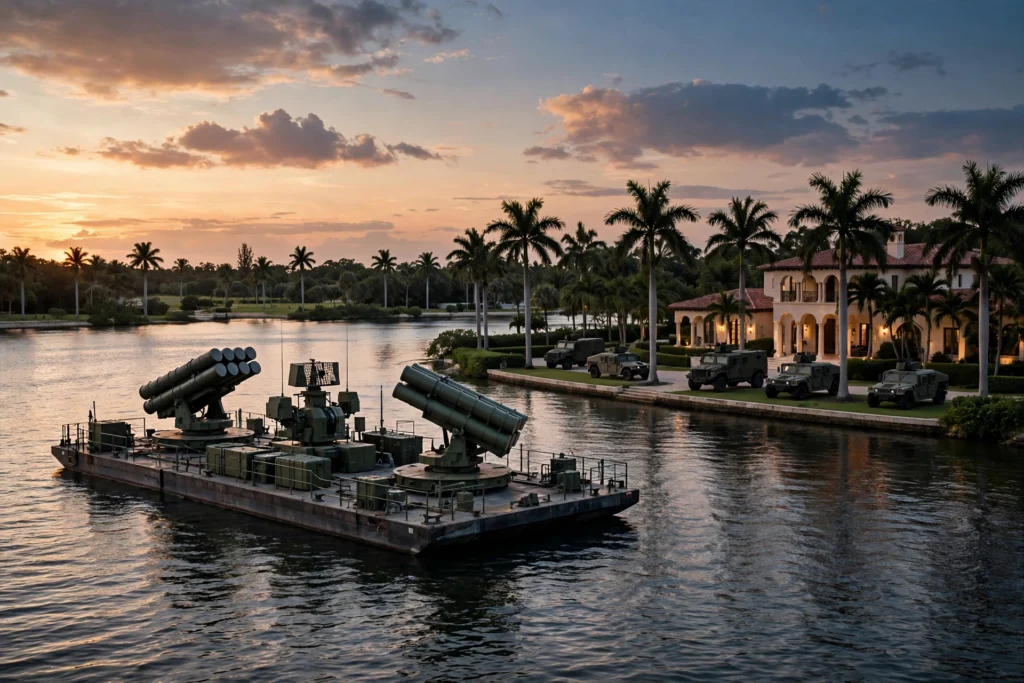
The story broke into public view through photographs rather than an announcement. Images of two Avenger air defense systems mounted on a floating barge in the Lake Worth Lagoon, on the western side of Trump’s 17-acre oceanfront property, were published by the Palm Beach Daily News on October 30. Photographs dated October 24 had already appeared in news-agency picture libraries, and local television stations in West Palm Beach captured footage of the launchers both on the barge and at the nearby airport. The Sun Sentinel reported the deployment as anti-missile defenses installed to enhance security at Mar-a-Lago and the airport, and the story was picked up by national and international outlets within hours.
Pentagon News: What Was Deployed at Mar-a-Lago
The systems photographed on the barge are AN/TWQ-1 Avengers, a short-range air defense platform built by Boeing and fielded by the United States Army since the late 1980s. Each Avenger mounts a gyro-stabilised turret on a Humvee chassis, carrying two pods of four FIM-92 Stinger infrared-guided missiles, eight in total, alongside a forward-looking infrared sensor, a laser rangefinder and an M3P .50 calibre machine gun. The Stinger’s effective range is around five kilometres, which makes the Avenger a last line of defense against low and slow targets rather than a shield against cruise or ballistic missiles. Those larger threats would require far bigger systems, such as the MIM-104 Patriot, the system the United States recently agreed to sell to Ukraine in a separate deal.
The identification of the launchers as Avengers was made by a former United States Navy fighter pilot, Matthew Buckley, who examined the photographs and said their main purpose was to counter small and medium drones, and particularly drone swarms. That assessment fits the official language used by the commands involved. NORAD and United States Northern Command said in a statement that they had deployed ground-based air defense assets and counter-unmanned aircraft system capabilities in and around Mar-a-Lago at the request of the Secret Service, under NORAD and Northern Command authorities. The statement added that the assets add a complementary layer of technology to enhance protection, and that due to operational security no further details could be provided. Neither command named the systems, said how many had been deployed, or said how long they would remain in place.
The Secret Service confirmed the arrangement in its own terms, saying that Northern Command was providing counter-small unmanned aircraft system capabilities, described as Fly-Away Kits, in support of its protective operations. The agency said it is operating in a heightened threat environment and continuously adapts its protective operations to incorporate cutting-edge tools, technology and methods to safeguard its protectees. That is the closest either institution has come to explaining the deployment: not a response to a single named threat, but an adaptation to a threat environment that has changed, in which small drones have become the most common aerial danger to fixed sites.
Trump Administration: Why the Secret Service Asked for Air Defenses
The request did not come out of nowhere. Mar-a-Lago has been one of the most heavily protected private properties in the country since Trump returned to office in January 2025, and its airspace has been a constant source of incidents. The Federal Aviation Administration maintains a temporary flight restriction around the estate around the clock, and NORAD has intercepted more than 60 aircraft near Mar-a-Lago since the start of the second term, most recently on October 24, when an F-16 fighter used a maneuver known as a headbutt, flying in front of a civilian aircraft to turn it away, after it entered the restricted zone.
The Secret Service has also said that threats against the people it protects have risen sharply, by about 40 percent compared with the same period last year. That figure covers threats against protected individuals generally, not a specific plot against Mar-a-Lago, and neither the Secret Service nor the military has cited a specific threat behind this deployment. The distinction matters, because the absence of a named threat has left room for speculation about the timing, which is addressed below. What is documented is the trend: more threats, more airspace violations, and a protective posture that has been tightening in stages. The deployment of ground-based air defense is the most visible stage yet.
There is also a precedent within the president’s own travel pattern. Similar systems were seen during Trump’s golf outing at his golf course in Bedminster, New Jersey, in August, suggesting that the air defense layer travels with the president’s itinerary rather than belonging to one property alone. Avenger units were also among the systems deployed to protect Washington after the September 11, 2001 attacks, and the type has since been adapted widely for the counter-drone role. What is new at Mar-a-Lago is not the technology but the location, and the visibility of a military air defense deployment at a private club where the president spends weekends.
White House News: A Heightened Threat Environment
The deployment comes days before the November 3 midterm elections, in a campaign season in which the president has been travelling heavily. Trump news in the closing days has been dominated by rallies, polling and the battle for control of Congress, and the appearance of missile launchers beside his Florida home adds a security dimension to that coverage. The White House has not itself issued a separate statement on the deployment; the public record rests on the NORAD and Secret Service statements, which frame it as a protective measure rather than a political one.
The estate itself, often called the Winter White House, is a working presidential residence as much as a private club. That is why the deployment has two reported locations rather than one: the barge on the water beside the estate, covering the approach from the lagoon, and the position near the southern side of the airport, close to where the president’s aircraft is parked. Together they describe a perimeter drawn around the president’s movements in Palm Beach, not a single installation at a single address.
For the agencies involved, the deployment also illustrates how presidential protection has evolved. The protective model that once relied on agents, fences and flight restrictions now includes counter-drone kits, ground-based launchers and the command structure of NORAD itself, supplied through Northern Command under authorities that allow domestic air defense at the request of the civilian protective agency.
Iran War News: Why the Timing Is Drawing Attention
The timing of the deployment has drawn attention because it coincides with reporting about the possibility of renewed United States military action against Iran after the midterm elections. Some coverage of the Mar-a-Lago deployment has linked the two, noting that the air defense layer appeared as Washington weighs its next steps in the Middle East. That link is reported speculation, not an official explanation: neither NORAD nor the Secret Service has connected the deployment to Iran, and the official statements describe it solely as a protective measure requested by the Secret Service. Readers should keep that distinction in mind, because the deployment is a confirmed fact while the reason for its timing remains a matter of interpretation.
The Iran context is nevertheless part of why the story has travelled so widely. Any visible military move near the president’s residence is bound to be read against that background, and the air defense deployment sits at the intersection of a domestic protective measure and a foreign policy under intense scrutiny. The responsible way to report it is to state what is confirmed, attribute what is speculated, and leave the gap between them open.
Timeline: From First Sighting to Confirmation
The sequence of events, as far as the public record establishes it, runs over roughly a week. Photographs of the barge-mounted launchers dated October 24 appeared in news-agency libraries, and the systems were first widely noticed on the water beside Mar-a-Lago around October 26. Local television stations in West Palm Beach filmed the launchers on the barge and at the airport, and the Palm Beach Daily News published its images on October 30. NORAD and Northern Command then confirmed the deployment in a statement, and the Secret Service confirmed its request for counter-drone support. The Sun Sentinel’s report, describing anti-missile defenses installed to enhance security at Mar-a-Lago and the airport, carried the story to a national audience on October 31.
That timeline is worth setting out because it shows how the story was established: not by a single announcement, but by photographs, local reporting and then official confirmation. The gap between the first sighting and the confirmation is also why early coverage varied in its description of the systems, with some reports calling them missile defenses in general terms and others identifying them specifically as Avenger short-range systems. The confirmed facts now support the specific description: short-range, Stinger-based air defense, designed for drones and low-flying aircraft, deployed at the Secret Service’s request.
What Happens Next: How Long the Systems Stay
What happens next is, for now, unannounced. Neither NORAD nor the Secret Service has said how long the Avenger systems will remain at Mar-a-Lago or at the airport, and the official statements leave open whether the deployment is tied to the president’s presence in Florida, to the election period, or to a longer-term change in the protective posture. The most likely course, based on how such deployments have worked before, is that the systems remain while the president is in residence and are repositioned as his itinerary changes, as the Bedminster sighting in August suggests. But that is an inference from past practice, not a statement from the commands involved, and it should be treated as such.
The deployment will also be watched for what it signals about the broader direction of presidential protection. If ground-based air defense becomes a routine part of the perimeter at Mar-a-Lago, it would mark a permanent escalation in the security of a private presidential residence. If it proves temporary, it will be remembered as a moment when the machinery of national air defense became briefly, visibly present in a resort town’s lagoon.
Either way, the photographs will remain the defining image of the episode: two launchers on a barge, pointed at the sky over Palm Beach, beside a property that has become one of the most recognizable addresses in American politics. The official explanation is spare, and deliberately so. The rest, including how long the systems stay and what prompted this particular week, is a question the agencies have chosen not to answer, and one that will only be resolved by watching what happens on the water in the days ahead.
Source: Sun Sentinel