Oil Prices Today: Trump Ends Methane Rules in Texas
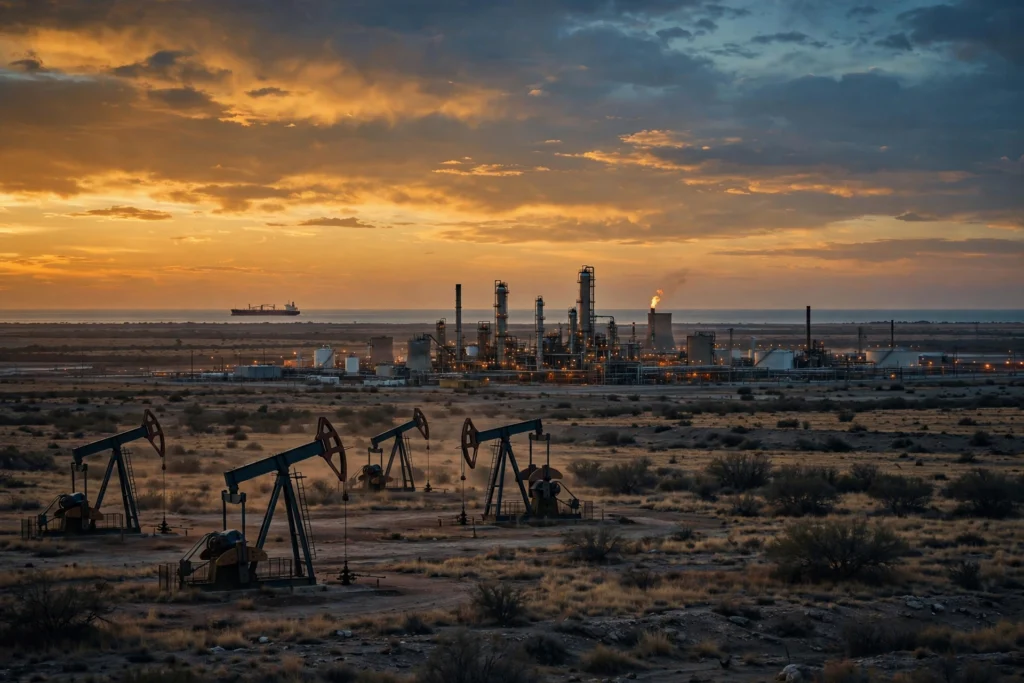
The oil prices today debate took centre stage in Texas on Tuesday, as President Donald Trump used a pair of campaign stops at opposite ends of the oil-producing state to announce the end of Biden-era methane rules for oil and gas producers — a move he cast as a $45 billion saving for consumers and energy companies, and a direct answer to the fuel prices that have become a political liability for Republicans a week before the midterm elections. Standing in Lubbock after an earlier appearance before a tanker loaded with Venezuelan crude in the Gulf of Mexico, Trump told the crowd he was officially terminating the regulations, promising to unlock vast quantities of Texas natural gas and produce 210 million barrels of oil.
The announcement was the policy centrepiece of a day of campaigning in a state that Republicans have long taken for granted and now find themselves fighting to hold. Trump was in Texas to boost United States Senate candidate Ken Paxton and other Republican candidates, and to fend off what could be the first statewide Democratic victory in 32 years. The trip was his third visit to Texas this month, and it came as polls show Democrats may retake control of one or both houses of Congress in the November 3 elections.
Oil Prices Today: Fuel Costs and the Midterm Stakes
The backdrop to the Texas trip is a fuel-price problem that has shadowed the Republican campaign for weeks. With high fuel prices weighing heavily on the campaign for the November 3 congressional elections, Trump scheduled a pair of stops at opposite ends of the oil-producing state, using each one to show voters he was working to bring down gasoline prices. The stakes are plain: losing control of either chamber of Congress would make it far harder for the president to advance his agenda during his final two years in office, and polls show the Democrats may retake one or both houses from the president’s Republicans.
The numbers explain the urgency. The United States Energy Information Administration reported that regular gasoline averaged $4.269 a gallon in the week of October 26, down 1.5 cents in a sixth straight weekly decline since September 21, when it averaged $4.478. Diesel moved the other way, rising 7.6 cents to $6.352 a gallon, its second straight weekly increase. Diesel is now $2.634 a gallon dearer than a year ago, and gasoline $1.234 dearer. The Financial Times has reported that diesel prices have risen about 70 percent over the past year, to $6.32 a gallon, presenting the increase as a driver of the inflation voters feel at every checkout.
Trump has taken a number of steps to address fuel prices, which have become a political liability for Republicans amid the United States’ war with Iran. The conflict, which began when the United States and Israel launched military strikes against Iran in February, sent fuel prices higher and disrupted global energy markets. Before the war, polling had shown voters favouring Republicans over Democrats as the party better equipped to manage the economy. The latest surveys show that advantage narrowing: in the most recent Reuters/Ipsos poll, 37 percent of voters viewed Democrats as having the better economic approach, compared with 33 percent who preferred Republicans, and 73 percent said the cost of living was moving in the wrong direction.
The Methane Rollback: What the EPA Proposal Changes
The substance of the announcement is an Environmental Protection Agency proposal to roll back Biden-era rules that required companies to fix leaky equipment and regularly check wells for escaping methane, a potent greenhouse gas. Trump framed it in the simplest terms: “Tonight, I’m officially terminating Biden’s expensive and unnecessary methane regulations to save consumers and energy producers $45 billion in costs, unlock vast quantities of Texas natural gas and produce 210 million barrels of oil.”
The EPA’s own projections put the scale of the change in concrete terms. The agency projects $45 billion in savings from the rollback, alongside additional production of 210 million barrels of oil and 1.41 trillion cubic feet of natural gas. The plan would give relief to small, low-output wells — the marginal wells that produce only a trickle of oil each day but number in the hundreds of thousands across the country — and end a programme that used outside groups to report large methane leaks. It would also ease rules aimed at phasing out the routine burning off of gas at oil wells, a practice known as flaring.
The administration is casting the rollback as a way to produce more energy and lower costs. The logic is straightforward: compliance with leak-detection and repair rules costs producers money, particularly the small operators who run marginal wells, and removing those costs makes it economic to keep wells pumping that might otherwise be shut down. More supply, in this telling, means lower prices — for the natural gas that heats homes and generates electricity, and for the oil that becomes gasoline and diesel.
Critics of the move will note what the announcement leaves out. Methane is a greenhouse gas far more potent than carbon dioxide in the short term, and the rules being rolled back were designed to stop it escaping from wells, pipelines and processing plants. The programme that used outside groups to report large leaks — the Super Emitter Program, which identified major methane releases — is to be eliminated, and the easing of flaring rules means more gas will be burned off at wellheads rather than captured. Environmental advocates argue that the savings claimed by the administration are dwarfed by the climate costs. The administration’s answer is that American energy production is itself a security good, and that the rules were an unnecessary burden on an industry the country depends on.
Corpus Christi: A Tanker of Venezuelan Crude
Before Lubbock, there was Corpus Christi — and a piece of stagecraft designed to make the energy message visible. The rally took place within view of an oil tanker, moored near the Port of Corpus Christi, that Trump said was loaded with the first oil received from Venezuela under a deal Washington made after deposing the country’s former leader. “We’re celebrating the greatest oil victory in history. To the victor belongs the spoils, right?” Trump said. Texas has long been one of the main refining centres for Venezuelan crude oil, and the Gulf Coast refineries were built to process exactly the heavy, sulphur-rich grades that Venezuela produces.
Trump announced in August an agreement that grants the United States access to a fifth of Venezuela’s crude reserves. The White House said in September that oil from the deal would probably hit United States reserves in November. The oil is slated to head to refineries owned by ExxonMobil and Citgo, a White House official told Reuters.
The Venezuelan thread runs through the administration’s wider energy strategy. The deal with Caracas, the diesel arrangement with Moscow, and the methane rollback at home are all presented as parts of the same policy: use every available source of supply, foreign and domestic, to bring fuel prices down before the midterms. The Texas trip tied the threads together in a single day: Venezuelan crude in the morning, deregulation in the evening, and a promise that both would mean cheaper fuel.
The Senate Race: Paxton, Talarico and a State in Play
The campaign purpose of the trip was never in doubt. Trump was in Texas to mobilise support for Paxton, who is locked in a close race with Democrat James Talarico, and a loss in Texas next Tuesday would complicate the Republican Party’s path to retaining its slim Senate majority. The trip marks Trump’s third visit to Texas this month to mobilise support for Paxton, and his October campaign blitz has also taken him to Oklahoma, Alabama, Nebraska, Iowa, Ohio, South Carolina and Mississippi — Republican-leaning states that were expected to be safely in hand but have instead become midterm battlegrounds.
Texas has consistently voted Republican for 30 years, but Democrats raised their hopes this year when Paxton won the Senate nomination with Trump’s backing. Paxton carries heavy baggage: he was indicted on securities-fraud charges in 2015 and impeached by the Texas House in 2023. The criminal case was dismissed in 2024 after an agreement with prosecutors, and the Texas Senate acquitted him in the impeachment trial. Trump has publicly criticised his longtime ally, calling him “a pain in the ass sometimes,” even as he campaigns for him — a measure of how much the race matters to the president’s party.
Trump also heavily criticised Talarico, whom he accused of opposing Texas values on issues such as oil production, immigration and transgender rights. Tech billionaire Elon Musk and other donors are pouring hundreds of millions into a late effort to rescue Paxton’s campaign. “Our policy has always been drill, baby, drill. And man, we are drilling now. But if Texas elects Communist James ‘Talafreako,’ that wealth will rapidly disappear,” Trump said, applying his preferred nickname to the Democratic candidate. Talarico has used the nickname as a fundraising tool, selling “I’m a Talafreako” T-shirts, while also responding: “We are a threat to their corrupt system.”
The race is a test of whether Texas is genuinely in play or whether the Democratic hopes are, as in past cycles, a mirage. A first statewide Democratic victory in 32 years would be a shock with consequences far beyond one Senate seat. That is why the president has now visited three times in a month, and why the energy message was delivered with such force.
What Happens Next: Prices, Permits and November 3
What happens next will be decided in two places: the regulatory process and the ballot box. The methane rollback is, for now, a proposal — an EPA plan announced at a rally, which must go through the formal rulemaking process before it takes effect. That process takes time, invites legal challenge, and may not be complete before the next administration’s priorities change. The $45 billion in savings and the 210 million barrels of additional oil are projections, not results.
The more immediate verdict comes on Tuesday, November 3, when voters decide control of Congress. The Texas Senate race will be one of the night’s headline results, and the fuel-price argument will be tested in every state where gasoline and diesel prices have risen. If Republicans hold their majorities, the administration will claim the energy message worked, and the rollback will proceed with political momentum behind it. If Democrats win one or both chambers, the proposal will face congressional scrutiny, and the president’s ability to advance his energy agenda in his final two years will narrow sharply.
For voters in Texas, the choice is framed in the starkest terms by the president himself: more drilling and lower prices under Republican rule, or, in his telling, a Democratic victory that would make the state’s energy wealth disappear. The polls suggest the race is close, the money pouring in suggests both sides believe it, and the president’s three visits in a month suggest that the White House knows what is at stake. The methane rules may be the policy, but the election is the test — and the answer arrives in a week.
Source: Reuters