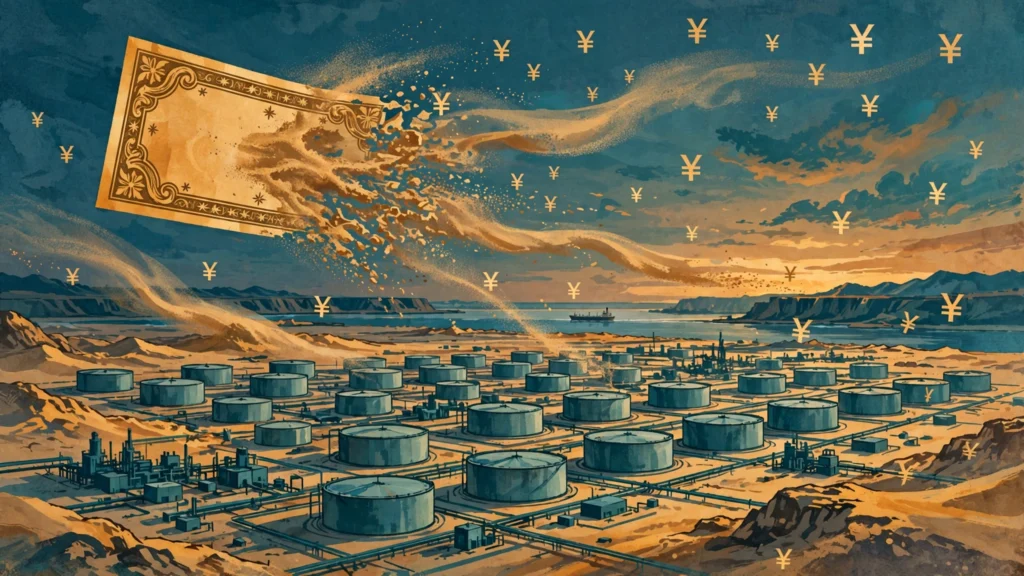
Oil Prices Today: Iran War Strains the Petrodollar System
For anyone watching oil prices today, the war in Iran is about more than barrels and shipping lanes. It is the first major test of a financial arrangement that has quietly shaped the world economy for half a century: the petrodollar system, the understanding under which the global oil trade runs on US dollars. That system was already fraying before the first missiles flew. Now, with Iran having shut the Strait of Hormuz and some tankers reportedly paying in Chinese yuan to get through, economists say the cracks are widening in plain sight. The dollar is not about to lose its crown overnight; most Saudi oil is still sold in dollars. But the war has forced a question Washington spent decades avoiding into the open: what happens to American power if the world stops needing dollars to buy its oil?
When oil is priced in dollars, every buyer must first hold dollars, and that constant demand has helped keep US borrowing costs lower and the dollar at the centre of world trade. Gulf states have parked their oil earnings in US government bonds for generations. If it fades, the effects would eventually show up in interest rates, import prices and the cost of filling a tank. That is why a story that sounds abstract — the currency of oil invoicing — is now watched as closely as the fighting, from the White House to Wall Street.
Oil Prices Today: How the Petrodollar Wired the World Economy
The system was born in the turmoil of the early 1970s. The United States had abandoned the gold standard in 1971, and the 1973 oil crisis had shown how vulnerable the American economy was to the decisions of oil producers. In 1974, the US government, with then-Secretary of State Henry Kissinger playing a central role, reached an understanding with Saudi Arabia: the kingdom would sell its oil exclusively in US dollars, and in return Washington would provide military assistance and security guarantees. The deal was secretive and historians still debate its terms, but its effect was unmistakable: oil became the anchor that replaced gold.
The logic was simple. Because nearly every country needs oil, and oil could only be bought in dollars, every central bank and major importer needed a stockpile of dollars. That steady demand underpinned the dollar's role as the world's reserve currency. Oil exporters recycled earnings into US Treasury bonds, helping finance American borrowing at lower rates and keeping Treasury yields down. It gave the United States an extraordinary privilege: it could borrow in its own currency and impose sanctions that bit hard, because cutting a country off from dollars meant cutting it off from oil.
The Gulf monarchies built their financial architecture around the dollar. Saudi Arabia, Qatar, Oman, Bahrain and the United Arab Emirates all peg their currencies to it, and together they hold an estimated 800 billion dollars in supporting reserves. The sovereign wealth funds of the Gulf Cooperation Council states hold more than two trillion dollars in US assets. For fifty years, this was the wiring of the world economy: oil flowed one way, dollars the other, and Washington sat at the centre of both.
The Cracks Were Showing Before the War
The system did not collapse in a single moment; it eroded slowly over years, visibly, well before the Iran war began. In 2024, Saudi Arabia did not formally renew its practice of pricing oil solely in dollars. The kingdom has announced no break with the dollar, and most of its oil is still sold in greenbacks, but the decision not to reaffirm the arrangement was read across the energy world as a signal. The 1974 understanding was never a formal treaty obligation, so there is no single document binding Riyadh to dollar-only pricing — the petrodollar was always as much habit as contract, and habits change when interests do.
Saudi interests have been shifting for years. China has displaced the United States as the kingdom's largest oil customer, and the economic gravity of that relationship now points toward the yuan. In 2023, Riyadh signed a currency swap agreement with China worth seven billion dollars, and it has joined mBridge, a blockchain-based platform built for direct cross-border currency exchanges that bypass the dollar altogether. None of these steps ended dollar pricing, but each made it easier to imagine oil priced in more than one currency.
The numbers tell the same story of slow drift. The dollar's share of global foreign exchange reserves has fallen from 71 percent in 1999 to about 57 percent today, a 25-year low. Dollar invoicing still covers over 90 percent of trade in the Americas, but only about 70 percent in Asia-Pacific and 20 percent in Europe. American sanctions policy has accelerated the trend. After the United States imposed restrictions on Russia following its annexation of Crimea, Moscow began reducing its dollar exposure and arranged a currency swap with China worth about 150 billion yuan. The shift deepened after the 2022 invasion, when Ukraine war news dominated the sanctions debate and Moscow was cut off from much of the dollar system. Each time Washington has used the dollar as a weapon, economists note, it has given other governments a reason to look for an alternative.
Iran War News: The Strait of Hormuz Test
The war in Iran turned a slow drift into a live stress test. After the first US-Israeli strike, Iran effectively closed the Strait of Hormuz, the narrow waterway through which about 20 percent of the world's traded oil passes. Industry experts reported that some ships were able to pass through the choke point by paying in Chinese yuan, a detail that captured the new reality in a single image.
US forces have since helped restore more transits, and flows have recovered to about 80 percent of pre-war levels, suggesting Iran's grip may be slipping, at least for now. But the episode exposed a vulnerability that had been theoretical until the shooting started: the petrodollar assumes oil flows freely and is paid for in dollars. A war in the Gulf breaks both halves of that assumption at once: it interrupts the flows, and it creates the conditions in which buyers and sellers reach for whatever currency will get the cargo moving.
Iran has lived outside the dollar system for years. Long under US sanctions, Tehran now sends about 90 percent of its oil exports to China, much of it reportedly settled in yuan. As historian David Wight of the University of North Carolina at Greensboro told Fortune, the war has drawn renewed attention to the fact that Iran has sold much of its oil in yuan for years to avoid being tied to the dollar system. What was once a sanctions workaround has become, in wartime, a working model for how oil can trade without the greenback.
China's Petroyuan Play
China has spent years preparing for this moment. It is the world's largest oil importer, consuming roughly 15 to 16.6 million barrels a day, about 15 to 16 percent of everything the world burns. In 2018, Beijing launched the Shanghai International Energy Exchange, giving international investors a pricing mechanism for oil outside the US petrodollar system. Chinese officials have signalled to Gulf states that Beijing can offer both a currency alternative and a security umbrella in times of geopolitical stress — a pitch that lands differently while American security guarantees are being tested by war.
The mBridge platform, in which Saudi Arabia participates, is part of the same strategy: a system for central banks to settle trade directly in their own currencies, without routing payments through dollar clearing. It is small today, and the yuan's share of global oil settlement remains in the low single digits. But the direction of travel is clear, and the war has given Beijing its best argument yet. Analysts suggest the conflict could be remembered as a key catalyst for the erosion of petrodollar dominance and the beginnings of a petroyuan era. China also operates nearly four times as much solar capacity as the United States, a reminder that its long game includes needing less oil altogether.
None of this means the yuan is about to replace the dollar. The renminbi is not freely convertible, China's capital markets are far less deep than America's, and most of the world still prefers dollars. The dollar still dominates global reserves, trade finance, offshore funding and hedging. The war has moved the question from academic papers into the daily news. A system that was assumed to be permanent is now openly described as being at an inflection point.
Economy News: What Happens Next for Oil Prices and the Dollar
The honest answer is that the petrodollar is facing its most serious challenge in generations, but reports of its demise are premature. The dollar still overwhelmingly dominates international trade and finance, most Saudi oil sales continue to be settled in dollars, and the Gulf states still hold hundreds of billions in dollar reserves and trillions in US assets. The petroyuan is emerging as a potential alternative, not yet a dominant one. The outcome will be decided by the grinding facts of the war: who controls the Strait of Hormuz, how long the fighting lasts, and how fast others diversify away from dollar invoicing.
Three things to watch. First, the strait. Flows have recovered to about 80 percent of pre-war levels, but every new escalation could close the waterway again, and each closure teaches buyers and sellers more about trading without the dollar. Second, the politics of the war in Washington. Its cost is already being debated in Congress, where some Republicans are now open to cutting war funding — a sign the domestic consensus behind the war is not unlimited. A long war will sharpen every argument about what America can afford, including the privileges that depend on the dollar's dominance. Third, Saudi Arabia. Riyadh has not broken with the dollar and has every reason to move slowly, but it has opened the door, and its choices in the coming months — on pricing, swaps and reserves — will matter more than any single battle.
For readers watching oil prices today, the price at the pump and the currency of oil trading are no longer separate stories. A war that disrupts supply lifts prices in the short term; one that disrupts the payment system pushes the world toward alternatives in the long term. The petrodollar survived the end of the gold standard, the oil shocks of the 1970s, the financial crisis and the rise of China. Whether it survives this war in its old form is now an open question, and the answer will shape the next fifty years of the world economy just as the 1974 deal shaped the last fifty.
Source: Fortune