NASA News: Ancient Mars Rock Found in the Sahara
Meta description: A 4.1-billion-year-old Mars meteorite found in Mali’s Sahara may be the oldest known, offering new evidence of water on early Mars.
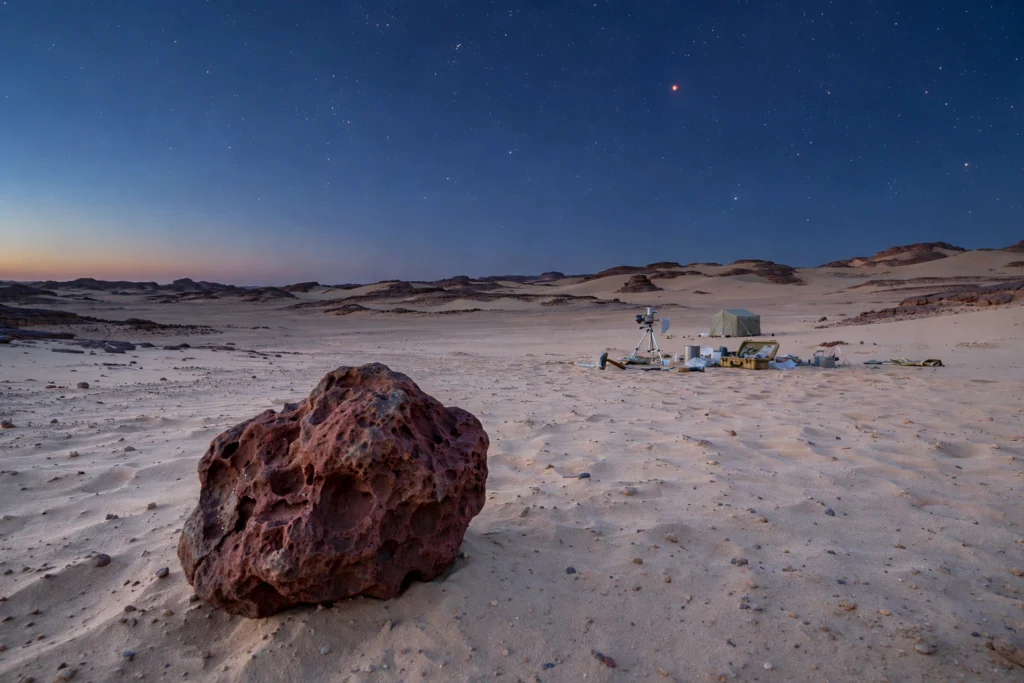
The latest nasa news reaches back to a time before almost anything we recognise on Earth had taken shape. Scientists have reported that a reddish rock found in the Sahara desert in Mali formed in the crust of Mars at least 4.1 billion years ago, a date that would make it perhaps the oldest of the 435 meteorites from Mars known on Earth. The rock, called Teghaza 001, was found in 2022, and the research describing it has now been published in the journal Science. It is not a spectacular object to look at. It is a piece of igneous rock, broken into eight pieces, the largest about the size of a fist. Its importance lies not in its appearance but in its age, and in what its chemistry says about the world it came from.
Teghaza 001 matters because it is a survivor from the earliest chapter of Mars. The planets of our solar system, Earth and Mars included, formed roughly 4.5 billion years ago. A rock dated to at least 4.1 billion years ago therefore comes from within the first few hundred million years of the planet’s existence, a period for which evidence is exceptionally scarce. Mars today is cold, dry and desolate, a place of thin air, frozen ground and dust storms. The evidence gathered over decades of exploration points to a very different early Mars, one where water flowed on the surface in rivers and lakes, and where an ocean may once have covered part of the northern hemisphere. Teghaza 001 adds a new, laboratory-tested piece to that picture, because unlike a photograph taken from orbit or a chemical reading taken by a rover, it is a physical sample that scientists can examine in detail on Earth.
Planetary scientist Yang Liu, of NASA’s Jet Propulsion Laboratory in California, which is managed by Caltech, led the study. Liu described the meteorite as a witness to a time when Mars was likely warmer and wetter than it has been for most of its history. That single image, of a rock as a witness, captures why the find has drawn attention. A witness does not tell the whole story, and it does not answer every question, but it was present when the events in question took place, and what it carries in its minerals can be read, tested and checked by other researchers. In this case, what it carries is evidence of water, of heat from deep inside a young planet, and of a crust forming from molten rock rising from below.
NASA News: How Scientists Dated a 4.1-Billion-Year-Old Rock
Dating a rock that old is not a matter of looking at it and guessing. The researchers dated Teghaza 001 using a technique based on the decay of uranium into lead over time. Uranium decays at a known rate, so by measuring the proportions of uranium and its decay products in suitable minerals, scientists can work out how long ago those minerals formed. In Teghaza 001, the minerals that made that measurement possible were crystals of zircon, a mineral that bears uranium and that is prized by geologists precisely because it is tough, chemically stable and able to preserve a record of its formation over billions of years.
The rock itself is a type of coarse-grained igneous rock called gabbro. Its main minerals are feldspar and pyroxene, the common building blocks of much of the crust of rocky planets. Gabbro forms when molten rock cools slowly underground, giving its crystals time to grow large enough to see. That slow cooling is itself part of the story, because the chemistry of Teghaza 001 shows that, while it was slowly cooling and crystallising in the Martian subsurface, it experienced interactions with water. It was part of the Martian crust, the planet’s outermost layer, but it formed from magma that originated at greater depths, in the planet’s mantle. In other words, the rock connects two parts of early Mars at once: the deep interior that supplied the molten material, and the crust near the surface where water was present.
That connection is what makes the sample more than a curiosity. On Earth, the movement of water through rock, the melting of material in the mantle, and the building of crust are all parts of a single, restless system, and geologists have spent generations learning to read those processes from rocks. On Mars, the record is far thinner, because scientists have only a few hundred meteorites to work with, and only a handful of places on the surface that have been visited by landers and rovers. A new sample from the earliest period, with its chemistry intact, gives researchers a fresh point of comparison, a way to test whether their models of how Mars formed and cooled match what a real piece of the young planet actually contains.
The discovery itself was unglamorous, as most field discoveries are. Teghaza 001 was found in eight pieces in the desert roughly 21 miles, or 34 kilometres, from the Malian village of Bir Chali. Deserts are good places to find meteorites, because a dark rock standing out against pale sand is easier to spot than the same rock in a forest or a field, and because dry conditions help preserve it. The Sahara has yielded many meteorites over the years, but very few of them come from Mars, and fewer still come from the planet’s earliest history. Finding one, recognising what it was, and then carrying out the painstaking laboratory work to date it and analyse its chemistry took years, from the recovery in 2022 to the publication of the study in Science.
Science News Today: Water Was Percolating Into Early Mars
The most important claim in the new study concerns water. The researchers reported that the composition of Teghaza 001 provides fresh evidence of liquid water on the surface of early Mars, evidence that strengthens the idea that primordial Mars may have been conducive to microbial life. That sentence needs to be read with care, because it contains both a finding and a limit. The finding is about water and conditions. The limit is that the finding does not, by itself, show that life existed there.
The evidence for water comes from isotopes, which are forms of an element that differ in their atomic weight. The isotopes of oxygen and hydrogen present in the meteorite show that water was percolating down into the planet’s deeper crust, in the way that water moves through rock on Earth, and mixing with molten rock rising from the mantle. Liu explained that multiple lines of evidence in Teghaza 001 suggest that the surface of Mars had water more than 4.1 billion years ago, a conclusion reflected in hydrogen isotopes in phosphate minerals and in oxygen isotopes in minerals and in bulk samples of the rock. When several independent chemical signals point in the same direction, researchers treat the result as stronger than any one signal on its own, and that is the case the team is making here.
Water matters so much because it is considered a key ingredient for life as we understand it. Every form of life known on Earth depends on liquid water, and the search for habitable environments elsewhere in the solar system is, in large part, a search for places where liquid water existed for long enough, and in the right conditions, for life to have had a chance. Early Mars is one of the most promising places in that search, precisely because the geological evidence for ancient rivers, lakes and a possible northern ocean is so extensive. Teghaza 001 pushes that evidence further back in time, to a period more than 4.1 billion years ago, and it does so from a sample that can be studied in a laboratory rather than from a distance.
Planetary scientist Lee Saper, of NASA’s Ames Research Center and the BAER Institute in California, who co-authored the study, set out both the promise and the limit of the result. Saper said the findings lend support to the idea that early Mars had the necessary ingredients and conditions to harbour life, but do not directly answer the question of whether there was life on Mars. That distinction is central to how science news today should be reported, and it is easy to lose in a headline. A habitable environment is not the same as an inhabited one. A planet can have water, warmth and the right chemistry and still never develop life, or develop it and leave no trace that survives billions of years. What Teghaza 001 shows, on the researchers’ reading, is that the conditions were present. Whether anything lived in them is a separate question, and one that this rock alone cannot settle.
Saper also described the rock as a snapshot in time, one that shows how a wetter early Mars with a thick atmosphere could have supported habitable conditions, while also showing that those conditions were waning rapidly over the first billion years or so of the planet’s existence, trending towards the dry and inhospitable environment we see today. That picture of a window opening and then closing is important, because it gives the search for ancient Martian life a timescale. If life ever arose on Mars, the argument goes, it would most plausibly have done so during that early, wetter period, before the planet lost much of its atmosphere and its surface water. A rock from that period is therefore not just old for the sake of being old. It is old in exactly the interval that matters most for the question of habitability.
A Rare Survivor From the First Chapter of Mars
Part of what makes Teghaza 001 stand out is how few comparable rocks exist. Only three Martian meteorites, including Teghaza 001, date to the planet’s early history. The other two provide the context against which the new claim of being perhaps the oldest must be understood. One of them was discovered in Antarctica in 1984, and was initially assessed as being about 4.5 billion years old. More recent work has determined that it has a similar age to Teghaza 001, and according to the new study, Teghaza 001 is likely the older of the two. The word likely matters here. Dating rocks billions of years old involves measurements with uncertainties, and when two rocks have similar ages, saying which is older requires careful comparison of those measurements. The researchers are not claiming a runaway record. They are saying that, on the evidence available, Teghaza 001 appears to be the oldest of the known Martian meteorites, while acknowledging that it is close in age to its Antarctic counterpart.
The chemistry of Teghaza 001 also sets it apart. The researchers reported that its chemistry shows it is distinct from the other known Martian meteorites, which suggests that it sampled a different part of the planet, or a different process in its early history, from the rocks studied before. Liu said it may have originated in the southern highlands of Mars, possibly from near Hellas Basin, one of the largest impact craters on the planet. That is presented as a possibility, not a certainty, and the caution is appropriate. Tracing a meteorite back to a specific crater on another planet, from a rock found in a desert on Earth, is an exercise in matching chemistry and geology across an enormous gap, and it can only ever be a best estimate. But if the suggestion is right, it would tie the sample to one of the most dramatic features of the Martian surface, a basin carved by an ancient impact so large that it reshaped a whole region of the planet.
The journey that brought the rock to Earth is dramatic in its own right. Liu described how the meteorite was blasted by an impact from the surface of Mars, flew through space until its path crossed that of Earth, entered the atmosphere as a meteor, and survived the fall to land in the Sahara as a meteorite. That sequence, from a violent impact on Mars to a quiet resting place in a desert, is the story of every Martian meteorite, but it is worth pausing over, because it involves two separate pieces of luck. First, an impact had to be powerful enough to throw rock off Mars entirely, escaping the planet’s gravity, without heating it so much that its chemical record was destroyed. Second, that rock had to survive a second fiery passage, through Earth’s atmosphere, and a landing, without being broken beyond recognition. The researchers do not know when the sample landed on Earth, and that unknown is a reminder of how much of this story remains hidden. The rock could have arrived recently, in geological terms, or it could have lain in the Sahara for a very long time before it was found.
Why a Handful of Rocks Carries So Much Weight
Martian meteorites occupy a strange position in planetary science. They are, as Liu put it, our only samples from Mars, forming the basis for understanding the formation and differentiation of early Mars, and allowing researchers to evaluate in laboratories whether ancient Mars could have supported habitable conditions. No spacecraft has yet returned a sample from Mars to Earth, so every direct laboratory measurement of Martian material comes from meteorites like Teghaza 001. That is why a single new sample can shift the picture in a way that would be impossible if researchers already had crates of Martian rock to study. When the total collection numbers only 435 rocks, each one counts, and a rock from a period represented by only three samples counts a great deal.
Liu also made the point that the detailed information extracted from meteorite samples complements and validates the exploration of Mars using satellites, landers and rovers. The two approaches work in different ways. Orbiters can map the whole planet and spot features that suggest water, such as dried river channels and lake beds. Landers and rovers can examine rocks where they lie, measure their chemistry in place, and photograph their surroundings. But they cannot bring a rock home, and they cannot run the full range of laboratory instruments that exist on Earth. Meteorites fill that gap, at the cost of losing context: scientists know a great deal about what is in the rock, but they do not know exactly where on Mars it came from, because the impact that launched it erased that information. The two kinds of evidence, orbital and rover data on one side and meteorite laboratories on the other, therefore check each other, and a finding that fits both is stronger than a finding that fits only one.
The new study also speaks to a larger question, which is how the evolution of Mars diverged from that of Earth when both planets were in their infancy and life was beginning to take hold on our planet. Earth and Mars started from similar materials, at similar distances from the Sun, and both appear to have had liquid water early on. Earth kept its water, its thick atmosphere and its habitable conditions, and life took hold. Mars did not. Understanding why those two paths diverged is one of the central questions of planetary science, because it bears on how common habitable planets might be, and on how fragile habitability can be. A rock that records conditions on Mars more than 4.1 billion years ago, when the divergence was still under way, is a valuable clue in that investigation, even if it cannot by itself explain the whole story.
What Happens Next for Teghaza 001
The publication of the study in Science is a beginning rather than an end. Other researchers will now be able to examine the published measurements, test the dating, and compare the chemistry of Teghaza 001 with other Martian meteorites and with data from rovers on the surface. That process of checking and comparison is how a claim of being the oldest known Mars meteorite will either be strengthened or revised, and it is a normal part of science, not a sign of weakness in the original work. If further measurements confirm the age and the water evidence, the rock will become a reference point for models of early Mars. If they complicate the picture, the result will still have been useful, because it will have forced those models to become more precise.
There are also open questions that the current reporting leaves unanswered, and they are worth stating plainly rather than filling in with guesswork. The researchers have not said when the rock landed on Earth. They have suggested, but not proven, a possible origin near Hellas Basin. They have shown evidence of water interacting with the rock as it cooled, but they have not shown that life existed on Mars, and they do not claim to have done so. Those limits do not diminish the find. They define it. A rock that is perhaps the oldest of its kind, that carries evidence of water from more than 4.1 billion years ago, and that can be studied in laboratories on Earth, is significant enough without being asked to answer the biggest question of all.
For readers following nasa news, the significance of Teghaza 001 can be put simply. It is a small, reddish rock from a desert in Mali that began its life in the crust of another planet, when that planet was young, wet and warm. It was thrown into space by an impact, crossed the gap between two worlds, survived a fall through Earth’s atmosphere, and lay in the Sahara until it was found in 2022. In a laboratory, its minerals have now told a story about water percolating through the crust of early Mars, about a planet that once had the ingredients for life, and about conditions that faded over the first billion years of its existence. It does not prove that Mars was ever inhabited. It does make the case that early Mars was a place where life could, in principle, have had a chance, and it gives scientists a new, ancient sample with which to test that case further.
Source: The Washington Post