Midterm Elections 2026: Trump Cancels Iowa, Kansas Rallies
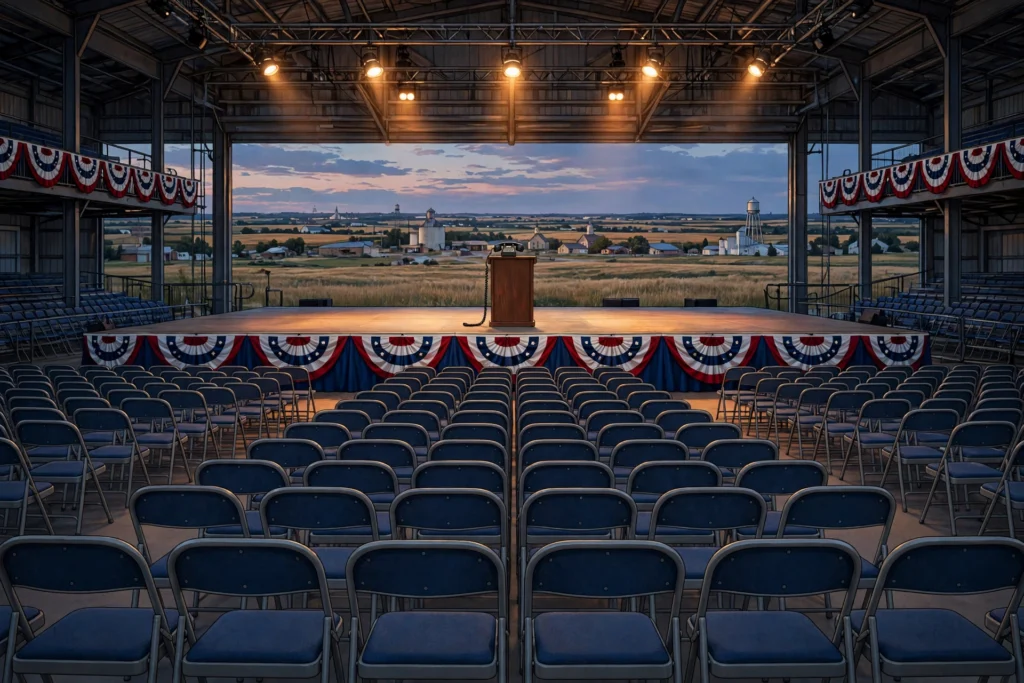
President Donald Trump has called off his planned weekend campaign stops in Kansas and Iowa, reshaping the final days of the midterm elections 2026 campaign. The decision, announced on Thursday, October 29, means two of the last in-person rallies on his crowded October schedule will not take place as planned. Instead, he will address supporters by telephone in a series of remote events running up to Election Day on Tuesday, November 3. The change comes as control of Congress hangs in the balance, as polling in Kansas has tightened unexpectedly, and as several House races in Iowa are being watched closely. It also effectively closes the in-person phase of a rally tour that has carried the president to 19 states since the start of October, with one exception: a rally in Florida on Friday, now set to be his final in-person rally before voters go to the polls.
The announcement came in two parts. First, the president told reporters on Thursday that he did not feel he needed to travel to Kansas, pointing to the standing of the Republican senator he had planned to campaign for there. Later the same day, the Republican National Committee confirmed that the Iowa stop would also be dropped from the in-person schedule, saying the party was in a strong position in both states and that the planned rallies would no longer take place as scheduled. For supporters who had planned to attend in person in Kansas and Iowa, the practical effect is the same: no presidential visit this weekend, but a telephone appearance instead.
What Was Cancelled, and What Replaces It
The two cancelled rallies were set for the final weekend before the election. The Kansas event was scheduled for Salina on Saturday, October 31. The Iowa event was scheduled for Dubuque on Sunday, November 1, just two days before Election Day. Both had been designed as closing arguments to drive Republican turnout, at a point when early voting is already under way in many states and the remaining undecided voters are few but potentially decisive. Their cancellation does not mean the president has stopped campaigning in those states: the Salina appearance is expected to take place virtually, and Iowa is included among the states covered by the tele-rally programme. But a presidential visit to a town like Salina or Dubuque is normally a major organising moment for a local campaign, a chance to gather volunteers and generate local news coverage that a phone call cannot easily replicate.
The scale of the replacement programme is large. A campaign funding group aligned with the president, MAGA Inc, said on Thursday that it would host tele-rallies with the president in at least 19 states, including Kansas and Iowa, before Election Day. Other reporting put the total at more than 20 tele-rallies. No full public schedule of those virtual events had been released at the time of the announcement, so supporters in individual states were left waiting for details of when their own call would take place. That gap matters, because a tele-rally is a different kind of event from an arena rally: there is no crowd to be seen and no venue to fill. Its value lies in reach, in the ability to speak to supporters in many states in a short period without the travel time a physical tour demands. The one in-person event that survives is the Florida rally on Friday, October 30, now described as the president’s last in-person rally before the election.
Election Polls and the Battle for the Senate in Kansas
The Kansas race at the centre of this story is the Senate contest between Republican Roger Marshall, who is seeking re-election, and Democratic challenger Adam Hamilton. On paper, Kansas is a state Republicans expect to win, and the party’s statement about being in a strong position there reflects that long-term expectation. In practice, the race has become unexpectedly competitive, and that competitiveness is the essential background to the cancellation. Election polls in recent weeks have told different stories, but none has shown a comfortable Republican lead, and several have shown the Democrat ahead.
The most widely cited survey is a CNN and SSRS poll conducted between October 20 and October 26 among 838 likely voters in Kansas. It put Hamilton four points ahead of Marshall, at 49 percent to 45 percent, with a margin of error of plus or minus 4.5 points. That margin means the lead does not, on its own, establish a clear leader: the true position could be a narrow Hamilton lead, a tie, or a narrow Marshall lead. Other surveys have pointed in different directions, which is itself a sign of a close race. A YouGov survey showed Hamilton ahead by three points, a survey by GBAO for Hamilton’s campaign showed him ahead by five, and an InsiderAdvantage survey gave Marshall a one-point edge. Taken together, the surveys do not settle who is leading in the polls right now in any definitive sense. What they do establish is that the race is close, closer than Republicans in Kansas are used to, and that turnout in the final days could decide it.
That closeness gives the battle for the Senate a particular sharpness in Kansas. The midterms will determine whether Republicans retain their narrow control of the Senate and the House of Representatives, and every competitive Senate seat therefore carries weight beyond its own state. A seat once considered safe becoming competitive forces a party to spend time, money, and attention defending it. It also changes the meaning of a presidential visit: in a safe state, a rally is largely about enthusiasm and turnout, while in a close state it is also about signalling that the national party is taking the race seriously. The decision to replace the Salina rally with a telephone event can therefore be read in two ways: as a sign of confidence that the race is already in hand, or as a reallocation of the president’s time to places where an in-person appearance might matter more.
Senator Marshall himself has offered the confident reading. Speaking to reporters on Thursday, he said he believed the rally had been scrapped because those organising the president’s schedule thought he was doing so well in the polls that the president probably had better places to spend his time. That is the interpretation a candidate in a close race would be expected to offer in public, since to suggest anything else would be to concede weakness days before an election. Whether voters accept that reading may depend less on the explanation than on the tele-rally itself, and on whether the telephone format can generate the same momentum in the final weekend that a visit to Salina would have provided.
Voter Turnout and the Competitive Races in Iowa
Iowa presents a related but distinct picture. The party’s statement covered Iowa in the same terms as Kansas, and the Dubuque rally scheduled for Sunday, November 1, has been cancelled on the same basis. Iowa is home to several competitive congressional races, and the Dubuque stop had been planned for the state’s 2nd Congressional District, in the north-east of the state, a district that includes Dubuque on the Mississippi River and Cedar Rapids and has been one of the most closely watched House races in the country. The president had already visited Iowa once during this campaign, in Sioux City in the north-west, and the Dubuque stop was intended to extend the same turnout effort to the eastern side of Iowa.
The broader point about Iowa is about voter turnout. Midterm elections are often decided not by persuading large numbers of voters to switch sides, but by determining which side’s supporters actually cast a ballot. That is why presidential visits to states a party already expects to win are not wasted effort: they are designed to ensure supporters who might otherwise stay at home turn out in a low-turnout election. Iowa is not a swing state in the traditional sense, but its congressional districts include genuinely competitive contests, and its statewide races for the Senate and the governorship are also on the ballot on November 3. A rally in Dubuque two days before the election would have been aimed squarely at that turnout task. Replacing it with a tele-rally preserves the president’s voice in the state, but it removes the local event around which volunteers and local media coverage would otherwise have gathered.
The same logic applies to the tele-rally programme as a whole. By phoning in to events in at least 19 states, the president can speak to supporters across the country without spending days travelling between venues. In a closing stretch in which time is the scarcest resource, that efficiency has obvious attractions. It also carries a risk: a telephone call is easier to ignore than a presidential visit, and it generates less local news coverage. The campaign’s calculation, evidently, is that the reach of many calls outweighs the impact of a smaller number of visits, at least for the final weekend. That calculation will be tested directly by the results on Tuesday night.
A Month on the Road Since October 1
To understand the switch to tele-rallies, it helps to recall the scale of the tour that preceded it. Since October 1, the president has held 25 rallies in 19 states, a pace of almost one a day, often in rural areas of Republican-leaning states, with speeches often lasting more than an hour. The tour has been the most visible element of the Republican closing campaign, and it has also been physically demanding. Speaking in Mississippi on Monday, October 26, sounding hoarse, the president remarked that human vocal cords were not made for a rally every day. The remark was made lightly, but it captured a real constraint: a schedule of near-daily, hour-long speeches cannot be sustained indefinitely.
The final week of that tour illustrates both its intensity and its political purpose. On Thursday, October 29, the president campaigned in South Carolina for Senator Darline Graham, before returning to Washington. It was after that trip that he spoke to reporters about Kansas and his travel schedule, rejecting the suggestion that he was tired of travelling and saying he felt perfect, in an exchange that drew attention for its sharpness. The exchange itself is less important than what it reveals about the closing days of a campaign: the candidate’s energy becomes a story in itself, and every scheduling decision is read as a signal about how the campaign believes the race is going. A decision to cancel two rallies will inevitably be read in that light, whatever the official explanation.
The tour has also been shaped by the national political environment. Presidential approval ratings and election polls have been a constant backdrop to the October campaign, with national surveys showing Democrats with an edge in the generic ballot for Congress. Against that backdrop, the rally tour has had a dual purpose: to energise the Republican base in states the party already holds, and to reassure supporters that the party can hold its narrow majorities despite a difficult national mood. The tele-rallies that now conclude the campaign serve the same purpose by a different means, allowing the president to deliver a consistent closing message across the country rather than one tailored to a single venue.
Reactions and What Happens Next
Reaction to the cancellations has so far been limited, in part because the announcement is so recent and in part because the parties involved have presented a united front. The committee’s statement is the formal record: the in-person rallies in Kansas and Iowa will no longer take place as scheduled, because the party believes it is in a strong position in both states. That is a confident message, designed to prevent the cancellations from being read as a retreat. It leaves open the question of what the tele-rallies will offer supporters in those states beyond the president’s voice on a call, and the answer will become clear only when the calls take place.
The president’s own remarks have been consistent with both the party’s line and the senator’s reading. He has said he does not feel he has to go to Kansas, that Marshall is doing very well, and that he expects a strong result on Tuesday night. Those remarks amount to a prediction, and predictions of that kind set a standard against which the results will be judged. If Republicans hold Kansas comfortably and retain control of Congress, the switch to tele-rallies will be remembered as a sensible conservation of effort. If the Kansas race is closer than expected, or if control of Congress changes hands, the cancellations will be revisited as a possible missed opportunity.
The immediate next step is the Florida rally on Friday, October 30, now the president’s final in-person rally before the election. After Florida, the campaign’s presidential events move to the telephone, with tele-rallies planned in at least 19 states, including Kansas and Iowa, before Tuesday’s vote. Supporters in those states will be listening for details of their own calls, which had not been fully published at the time of the announcement. Beyond the rallies, the final days will be dominated by the mechanics of voting: early ballots already cast, polling places preparing for Tuesday, and both parties making their final turnout appeals. The results in Kansas, Iowa, and the other states covered by the tele-rally programme will form part of the larger picture on November 3. Voters in Salina and Dubuque will not see the president on stage this weekend. They will hear him instead, by phone, as part of a national programme of calls carrying the Republican closing message into Election Day. How effective that message proves to be is a question only Tuesday night can answer.
Source: Reuters