Macy’s Thanksgiving Day Parade Postponed to Saturday
The Macy's Thanksgiving Day Parade will not march on Thanksgiving Day. For the first time in the parade's 100-year history, organisers have postponed the event, moving the 100th march of the Macy's Thanksgiving Day Parade to Saturday, November 28, because a powerful nor'easter is bearing down on New York City with heavy rain and wind gusts that could reach 60 miles per hour. The decision, announced late on Wednesday, ended days of mounting worry about whether the parade's giant balloons could fly safely in the storm, and it leaves millions of Americans who watch the parade every Thanksgiving morning to wait two extra days for the centenary celebration.
Macy's confirmed the postponement in a statement shared through New York City Hall. "The safety of our participants and spectators is our top priority, and after close consultation with our City and agency partners, we have made the decision to move this year's celebration," the statement said. "Due to the expected severe weather, the 100th March of Macy's Thanksgiving Day Parade will move to Saturday, November 28." The parade is now expected to kick off at 8.30 in the morning on Saturday, the same start time it would have had on Thursday.
NBC, which broadcasts the parade every year, confirmed the new plan in its own statement. "Due to the extreme weather conditions, the city of New York, Macy's and NBC have decided, in the interest of safety for both the participants and spectators, to move the Macy's Thanksgiving Day Parade to Saturday, Nov. 28," the network said. NBC had been scheduled to televise the parade starting at 8:30 a.m. ET on Thursday, November 26. The network will now carry the 2026 parade at 8:30 a.m. in the Eastern, Central and Mountain time zones and at 7:30 a.m. in the Pacific time zone on Saturday, and the parade will also air at those times on Peacock and Telemundo.
Macy's Thanksgiving Day Parade Faces Its First Postponement
The postponement is historic in the most literal sense. The Macy's Thanksgiving Day Parade has been held every year since 1924, surviving the Great Depression, the Second World War years when the balloons were deflated and their rubber donated to the war effort, and decades of weather of every kind. It has been shortened, rerouted and held in driving rain, but it has never before been moved to another day. The 100th parade was supposed to be a milestone celebration, the biggest in the event's history, and instead it will now be remembered as the year the weather finally won.
The scale of the celebration makes the decision easier to understand. The parade's route runs about 2.5 miles, or four kilometres, from Midtown Manhattan to the Macy's flagship store at Herald Square on 34th Street, and it draws enormous crowds along every block. Thousands of marchers, dancers, cheerleaders, marching bands and balloon handlers take part, along with the giant character balloons that are the parade's signature. Keeping that many people safe on streets exposed to 60 mph gusts was not a risk the city or Macy's was willing to take, and the decision was made the evening before the parade rather than in the early hours of Thanksgiving morning, when hundreds of thousands of spectators would already have been claiming their spots.
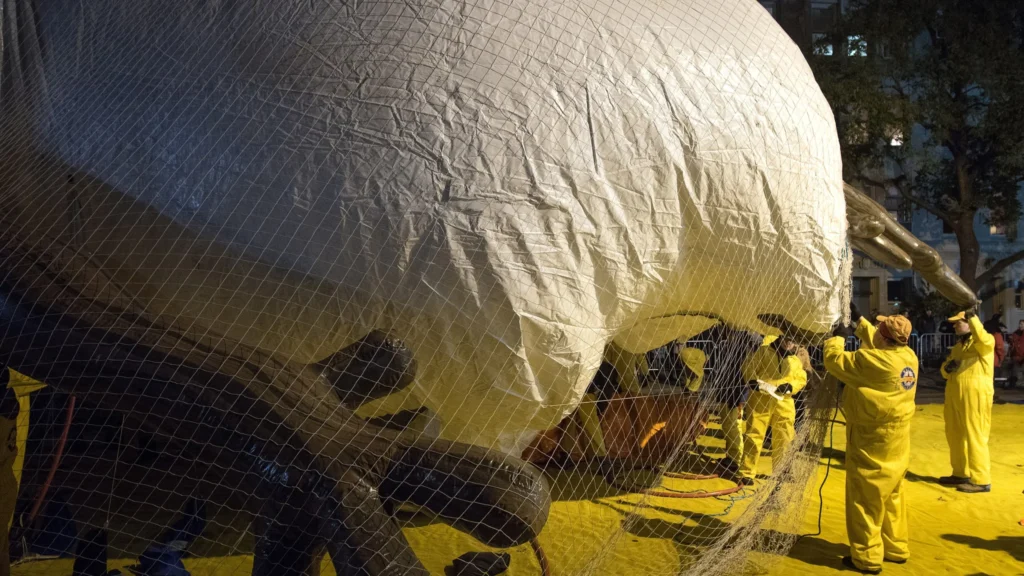
The timing of the announcement also mattered for the people who work on the parade. Balloon inflation traditionally takes place on the streets around the American Museum of Natural History on the afternoon and evening before Thanksgiving, and the crews who handle the balloons spend the night preparing them. By announcing the move on Wednesday evening, organisers gave those crews, the marching bands travelling from around the country, and the broadcast teams time to adjust their plans rather than discovering at dawn that the parade was off.
The Nor'easter Behind the Macy's Parade Postponement
The storm behind the decision is a nor'easter, the powerful coastal storm system that forms along the East Coast of the United States and can bring heavy rain, high winds and coastal flooding to the most densely populated part of the country. Forecasters had been watching it for days, and by Wednesday the picture had become clear enough that the parade's fate was effectively sealed. AccuWeather forecast sustained winds of 15 to 25 mph with gusts of 30 to 40 mph for Thursday morning, along with heavy rain, and the National Weather Service issued a high wind warning and a coastal flood warning for New York City.
New York Governor Kathy Hochul warned on Wednesday that New York City, Long Island and the lower Hudson Valley could be battered by heavy rain, coastal flooding and wind gusts of up to 60 mph. Writing on X, she said: "The worst of it is expected late tomorrow afternoon." Her warning covered the same hours in which the parade would have been marching through Manhattan, and it set the tone for the evening's decisions.
New York City Mayor Zohran Mamdani gave the same message at a safety briefing on Wednesday. "This will be a heavy storm. We are expecting sustained winds between 30 and 40 miles per hour, with gusts as high as 60 to 65 miles per hour possible," Mamdani said. "The National Weather Service has issued a high wind warning as well as a coastal flood warning." He also warned that the powerful winds could bring down trees and power lines, leaving residents facing potential Thanksgiving power outages, a danger that extends well beyond the parade route to every neighbourhood in the city.
The danger was not confined to New York. New Jersey Governor Mikie Sherrill declared a statewide state of emergency ahead of the storm, warning of damaging winds, heavy rainfall, coastal flooding and potentially prolonged power outages on Thursday. The emergency declaration came into effect at 6:00 p.m. ET on Wednesday. Forecasters said the East Coast could experience its highest water levels since Superstorm Sandy, while parts of Delaware and New Jersey faced a significant risk of power outages from the strong winds.
Why the Balloons Could Not Fly in the Thanksgiving Storm
The balloons were the heart of the problem, and they have always been the parade's greatest weather vulnerability. The giant character balloons are essentially enormous sails, and in strong wind they become extremely difficult to control. The parade's own rules reflect that danger: the balloons are grounded if sustained winds exceed 23 miles per hour or gusts exceed 34 miles per hour, and the New York Police Department makes the final call on the morning of the parade. Wednesday's forecast blew past both of those limits, with gusts expected to reach 60 mph or more, roughly double the threshold at which the balloons must stay on the ground.
The history of the parade explains why those limits exist and why they are taken so seriously. In 1997, a year remembered as one of the worst in the parade's history, high winds turned the balloons into hazards. The careening 18-foot figure of the Cat in the Hat, from the popular children's book, toppled a lamppost, knocking one bystander unconscious. Another balloon, the purple dinosaur known to children as Barney, went out of control, prompting police armed with scissors to puncture and deflate it. Yet another casualty was the Pink Panther balloon, which blew up over 42nd Street, sending shreds of pink rubber confetti raining on bystanders. Nobody was killed, but the day became a lesson in what the balloons can do when the wind takes them, and the rules that followed were written with that morning in mind.
For days before the postponement, the question hanging over the parade was whether the balloons would fly at all. The forecast gusts of 55 to 60 mph meant the answer was almost certainly no, and a parade without its balloons would have been a shadow of the centenary celebration Macy's had planned. Postponing the whole event to Saturday, when the weather is expected to have cleared, preserves the parade as it was meant to be seen, with the balloons in the air and the crowds lining the route, rather than a rain-soaked march with the stars of the show grounded.
Philadelphia's parade faced the same weather and made a different choice. Organisers of that city's Thanksgiving parade decided not to fly the balloons because of the weather, keeping the march itself on schedule but without its most famous feature. The contrast shows the two options every parade faced this week, and Macy's chose the one that kept its centenary intact, even at the cost of moving the date.
Thanksgiving Travel Chaos as the Storm Hits 80 Million Travellers
The storm is not only disrupting the parade. It is threatening to spark holiday travel chaos for as many as 80 million people hitting the road and flying around the Thursday holiday, one of the country's busiest travel seasons. The nor'easter is arriving at the worst possible moment, on the day when more Americans travel than on almost any other day of the year, and the same winds and rain that grounded the parade are now testing the airports, highways and railways that carry them home.
The weather has already raised concerns over air travel, with Southwest Airlines and United Airlines warning Thanksgiving Day passengers about possible disruptions in the Northeast. The warnings came as the storm gathered strength over the region, and they added to a travel week that was already under strain. Thanksgiving week is the busiest travel period in the United States, and the combination of record numbers of travellers and a major storm is exactly the scenario airlines and airports dread.
The West Coast is facing its own weather emergency at the same time. Severe storms are affecting both coasts, and on the Pacific side coastal flooding continues to pose a serious concern. Powerful waves have already caused part of a pier in Pacifica, south of San Francisco, to collapse, while high tides have broken water-level records around San Diego. King tides combined with powerful waves have destroyed part of the Pacifica pier, and officials have warned of further coastal flooding as the tides peak.
The picture across the country is of a Thanksgiving defined by weather. In the East, a nor'easter brings rain, wind and coastal flooding to the most crowded corridor in America. In the West, king tides and storm surf batter the coast. In between, millions of travellers are trying to reach their families through it all. The parade's postponement is the most visible casualty of the storm, but it is far from the only one, and the travel disruption it signals may affect far more people than the parade itself.
What Happens on Saturday: The 100th Parade Moves to November 28
On Saturday, the parade will go ahead as planned, two days late. The 100th March of Macy's Thanksgiving Day Parade will kick off at 8.30 in the morning, following the same 2.5-mile route from Midtown Manhattan to Herald Square, with the same balloons, floats, marching bands and performers that had been prepared for Thursday. Macy's said its team was working through the operational logistics for the change and would share details as they were finalised, and the expectation is that the full parade will be staged on Saturday rather than a reduced version.
For the broadcasters, the move means rebuilding a Thanksgiving morning around a Saturday show. Today show favourites Savannah Guthrie, Hoda Kotb and Al Roker were set to return as hosts of NBC's parade coverage on Thursday, and the network will now carry the parade on Saturday morning instead, at 8:30 a.m. in the Eastern, Central and Mountain time zones and 7:30 a.m. in the Pacific time zone, with the same coverage also available on Peacock and Telemundo. The change is a logistical challenge for a broadcast built around a holiday morning, but it is a smaller one than staging the parade in a storm.
For the spectators, the postponement means a different kind of Thanksgiving. Many families watch the parade from home as part of their holiday morning, and they will now have to choose between watching it live on Saturday or catching up later. The crowds who had planned to line the route on Thursday will have to decide whether they can return on Saturday, and the hotels, restaurants and shops around Herald Square that depend on parade-day crowds will feel the difference. But the alternative, a parade in dangerous weather, would have been worse for everyone involved, and the decision to move it was made with the spectators as much as the participants in mind.
A Century of Thanksgivings and What Comes Next
The parade began in 1924, when Macy's employees marched from Harlem to Herald Square dressed as clowns, cowboys and knights, accompanied by animals borrowed from the Central Park Zoo. The giant balloons arrived three years later, in 1927, when the Felix the Cat balloon first floated above the crowds, and they have been the heart of the parade ever since. Over a century, the parade has grown from a modest store promotion into one of the most watched events in American television, a fixture of Thanksgiving morning for generations of families.
The parade has survived interruptions before, but never a postponement. During the Second World War, from 1942 to 1944, the parade was cancelled outright and the balloons were deflated so their rubber could be donated to the war effort. It returned in 1945 bigger than ever, and it has marched every year since, through snow, rain and cold, and through the changing fortunes of the city around it. The decision to move the 100th parade to Saturday is the first time the parade has ever been postponed, and it will be remembered as the year the weather finally forced the parade to wait.
What comes next is a Saturday parade that will carry the weight of the centenary and the strangeness of its timing. The balloons will fly, the bands will march, and the crowds will line the route, just two days later than planned. The storm will have passed, the winds will have dropped, and the parade will be the celebration it was meant to be, even if the calendar says it is no longer Thanksgiving. For the families who watch from home, the parade will still be there, just on a different morning, and for the city, the postponement will be remembered as the moment the parade's first century ended with a reminder that some things, even a hundred-year tradition, still answer to the weather.
Source: USA Today