Iran War News: Trump, Xi and Putin to Meet in Shenzhen
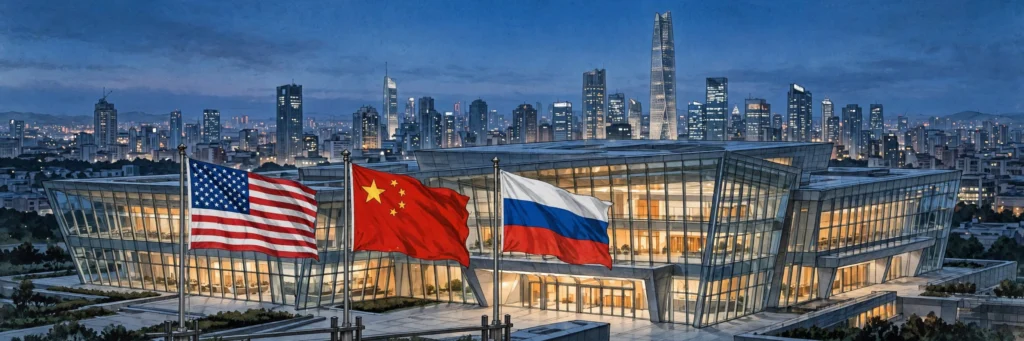
The leaders of the United States, China and Russia will sit down together next week for the first time, in a meeting that brings the three most powerful men in the world to the same table at a moment when there is no arms control treaty left between any of them. President Donald Trump, Chinese President Xi Jinping and Russian President Vladimir Putin are expected to meet on November 19 in Shenzhen, on the sidelines of the Asia-Pacific Economic Cooperation summit, in an unprecedented three-way encounter between the heads of the world's three great nuclear powers.
The meeting has been confirmed by Washington and Moscow. White House assistant press secretary Olivia Wales confirmed on November 13 that Trump would hold the trilateral meeting, and Kremlin spokesman Dmitry Peskov confirmed the following day that the three countries had agreed to hold the summit. Beijing, for its part, has confirmed that Xi will chair the APEC Economic Leaders' Meeting in Shenzhen on November 18 and 19 — although its public announcement of the summit made no mention of a separate three-way session, and a spokesperson for the Chinese embassy in Washington said only that China was in communication with the relevant parties about a meeting of the three heads of state.
Iran War News: Nuclear Arms and the Iran War Top the Agenda
The leaders are expected to discuss the two subjects that dominate the Trump administration's foreign policy: nuclear arms and the war in Iran. According to Al Jazeera, the White House has said the three leaders will discuss nuclear arms negotiations and stockpile reductions, along with the war in Iran. A senior United States official has said Ukraine is not expected to be discussed, and that Trump plans to raise the Iran war while steering away from the war in Ukraine — a choice that will disappoint Kyiv and reassure no one in Europe.
The Iran war itself has become the most urgent item on the agenda. The United States-Israeli war with Iran, launched on February 28, 2026, has run for more than 100 days in deadlock, and the Strait of Hormuz remains closed. Trump told reporters this week that the United States was seeing momentum toward an end to the conflict, and the Shenzhen meeting gives him a new forum in which to pursue it — with the leaders of the two countries best placed, for very different reasons, to influence how it ends. China is Iran's most important economic partner and largest buyer of oil, while Russia has deepened its military and strategic ties with Tehran during the war. Any path to an end to the fighting runs, in some form, through Beijing and Moscow.
A Nuclear Vacuum: New START Expired in February
The nuclear question gives the Shenzhen meeting its deepest significance, and its most difficult arithmetic. The last treaty limiting American and Russian strategic nuclear arsenals, New START, was signed in 2010 and expired in February 2026. Its expiry removed the final bilateral cap on the two largest nuclear arsenals on earth, and nothing has replaced it. Russia proposed a one-year extension; Trump rejected it and called instead for a new, improved and modernised agreement that includes China. The Shenzhen meeting is the first attempt to give that idea a room, a date and three people in it.
China has declined the premise. Its Foreign Ministry has said it is neither fair, reasonable nor realistic to ask China to join nuclear negotiations — a position rooted in the sheer imbalance of the arsenals involved. Russia and the United States each possess more than 5,000 nuclear warheads, while China has around 500, according to Reuters, although Beijing is rapidly expanding its arsenal. The Stockholm International Peace Research Institute put the Chinese figure higher, at approximately 620 warheads in January 2026, but on any estimate the gap is roughly ten to one. From Beijing's perspective, a three-way negotiation that treats the three arsenals as equals would lock in American and Russian superiority while capping China's growth — a bargain it has no reason to accept.
Edgard Kagan, a former senior Biden White House official for East Asia now with the Center for Strategic and International Studies, put the resistance bluntly: "This is something the Chinese hate. I think it's fair to say the Chinese do not want arms control discussions with the United States. And they certainly don't want to do it with the United States and Russia, because it suggests that they accept the framing that they are now a major nuclear power that should be subject to similar restrictions." The remark captures why the meeting's most likely outcome is a photograph rather than a treaty — and why the White House has been careful to lower expectations in advance.
Why Beijing Is the Reluctant Host
For Xi, the meeting is an unpredictable gathering full of risks, and his reluctance is visible in every aspect of Beijing's handling of it. The Chinese president runs his high-profile appearances on a tight script; Trump's improvisational style is the opposite of that discipline, and a three-way session with no agreed agenda is the kind of event Chinese protocol officials work hardest to avoid. The optics are awkward for another reason: China was not invited to the 1945 Yalta Conference, and it has spent decades presenting itself as an advocate for smaller countries against great-power deals made over their heads. Hosting a meeting that looks like a new Yalta sits uneasily with that story.
Beijing and Moscow have grown closer in recent years, trading oil, gas and military know-how, but they have taken different approaches to the proposed meeting. While Moscow sought a conversation on the war in Ukraine, Beijing has resisted putting that topic on the agenda, according to a person briefed on the meeting and a European diplomat. A United States official said on Friday that Trump was not likely to raise the war in Ukraine and that three-way talks were not the proper forum to do so. The split reflects a real difference of interest: Russia wants the war in Ukraine settled by the great powers, on its terms; China wants its trade relationships and its economic agenda protected from a war it did not start and cannot control.
China benefits from Russia's economic dependence — it buys Russian oil and gas at a discount and sells Russia the goods its sanctioned economy needs — without assuming responsibility for the Kremlin's territorial demands. A trilateral meeting in which Xi appeared to bless a settlement of the Ukraine war, or to accept a three-way arms control framework, would cost Beijing the careful distance it has kept since the war began.
The Yalta Comparison — and Why Kyiv Is Worried
The proposed meeting has drawn comparisons, particularly in Russia, with the 1945 Yalta Conference between the United States, Britain and the Soviet Union, which formalised spheres of influence, set the stage for the post-war order and became shorthand for great-power deals imposed on smaller countries. For Russian nationalists, the prospect of an updated Yalta has generated real excitement, potentially opening the door to an agreement ending the four-year-old Ukraine conflict in a manner favouring Moscow. Just holding the meeting elevates Russia to superpower status alongside China and the United States, they argue — a return to the table from which Western sanctions were meant to exclude it.
Russian nationalist ideologue Alexander Dugin told Radio Sputnik this week that the meeting showed who mattered in the world: "We are, China and the West. It's deeply symbolic — it's a confirmation of a multi-polar world that the West denies." The enthusiasm is not confined to the nationalist fringe. For Putin, the meeting is a chance to secure an agreement to end the war in Ukraine on his terms, and to demonstrate that Western efforts to isolate Moscow have failed. Even without an agreement, photographs of Putin sitting alongside the American and Chinese presidents would carry considerable political value for the Kremlin, and Moscow's ambitions extend beyond territorial concessions in Ukraine to a challenge to the post-Cold War European security architecture itself, including NATO's enlargement and the freedom of neighbouring countries to determine their own strategic alliances.
For smaller governments not at the table, including Ukraine and Taiwan, the idea of the big powers possibly cutting a private deal without them is a cause of deep unease. Ukrainian President Volodymyr Zelenskiy said last month: "We really don't want this to turn into 'Yalta 2, 3, 4,' with a redistribution of influence." The anxiety has spread from Kyiv to Tokyo, according to people briefed on those governments' reactions, and it is not hard to see why. The original Yalta was a conference of victors dividing a continent; a new one, held without Ukraine, would signal that the fate of a country at war could be negotiated by three men in a room in Shenzhen.
What Happens Next
The immediate question is whether an agenda can be agreed before the leaders arrive. Peskov told reporters that proposals for a possible agenda were being exchanged, adding: "In any case, the meeting will certainly be interesting. And, of course, it will capture the attention of people all over the world." That is also Trump's hope. Facing a Democratic-controlled Congress next year after his Republican Party's recent electoral losses, the president may be seeking wins abroad, and an agreement on arms or help ending the war with Iran could burnish his legacy. Kurt Tong, a former senior State Department official for East Asia now at the Asia Group consultancy, said the president would undoubtedly use the trip to reassert leadership and authority, demonstrate his statesmanship, and show off on the international stage.
What to watch is narrow and specific: whether Beijing publicly acknowledges the trilateral session or confirms only the APEC meeting it is hosting; whether an agenda emerges, and in particular whether Ukraine stays off it; what the leaders say when they emerge — a joint statement, however thin, would signal the meeting was more than a photograph; and the reaction in Kyiv, Taipei, Tokyo and Seoul, where governments will read every word for signs of what was agreed in their absence.
The meeting in Shenzhen is, in the end, a test of whether the world's three most powerful leaders can do more together than pose for the same photograph. The arms control framework that governed their arsenals for a generation is gone, the war in Iran is in deadlock, and the war in Ukraine is in its fourth year. Trump has held high-profile summits before, including with Putin and Kim Jong Un, and none produced a breakthrough — and the rest of the world will find out, on November 19, whether Shenzhen is different, or simply enough to fill a room.
Source: Reuters